

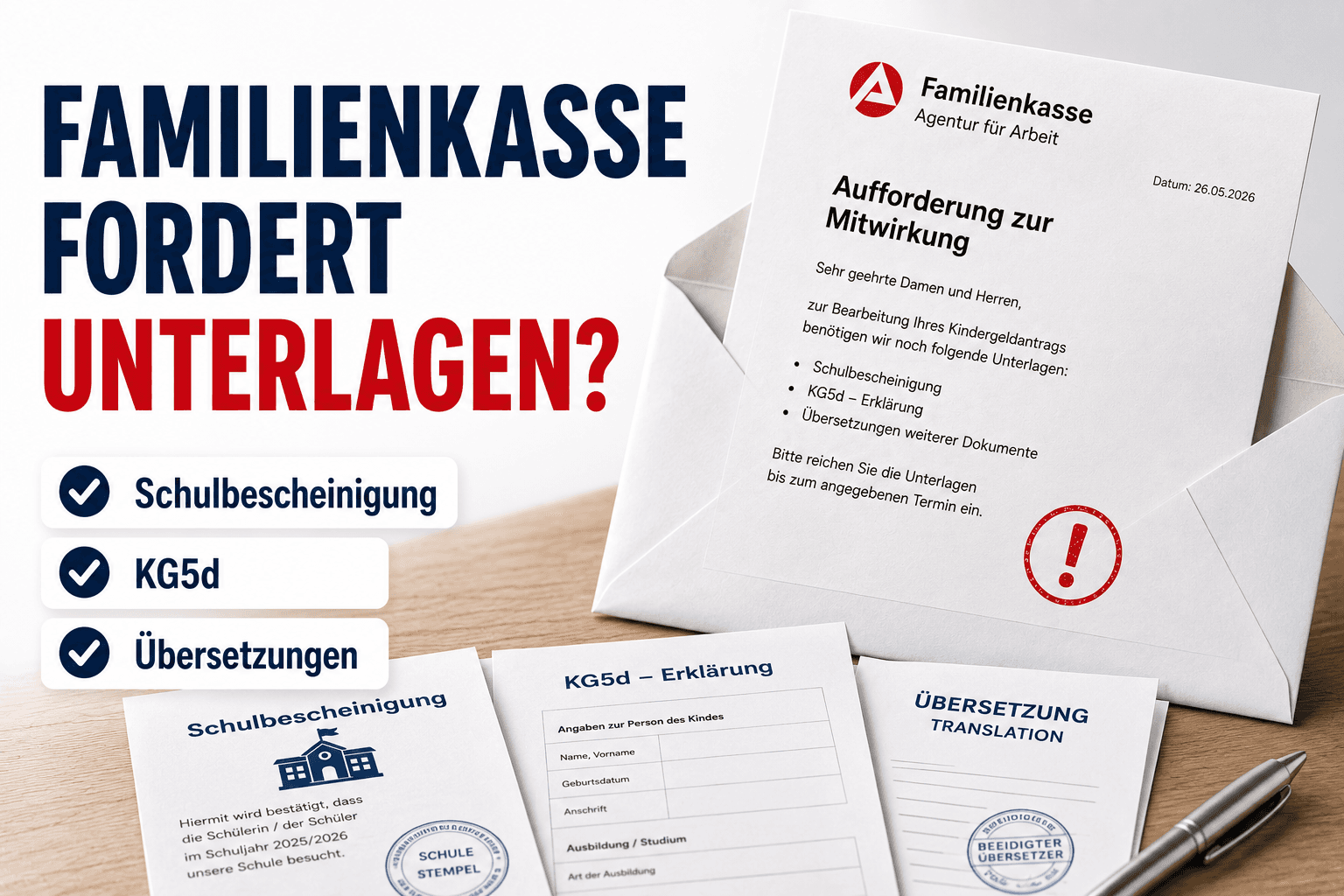
Has Familienkasse Requested Additional Documents? (2026) – School Certificate (Schulbescheinigung), KG5d, Translations and Practical DMS Experience
Many parents believe that after submitting their Kindergeld application, all they need to do is wait for a decision from the Familienkasse. In reality, however, many families receive a letter just a few weeks or months later requesting additional documents.
The most commonly requested documents include a School Certificate (Schulbescheinigung), the KG5d form, proof of university studies or vocational training, as well as translations of foreign documents.
The process can become particularly challenging for families whose children live or attend school in another European Union country.
If this is your first time dealing with the Familienkasse, receiving such a letter can be stressful. The documents are often written in formal legal German, several forms may need to be completed, and it is not always obvious why certain documents are required or how urgently they must be submitted.
In this guide, we not only explain which documents the Familienkasse most frequently requests, but also share DMS's practical experience, gained through several years of communication with the Familienkasse.
Why Does the Familienkasse Request Additional Documents?
Receiving a request for additional documents does not automatically mean that your Kindergeld application will be rejected.
In most cases, the Familienkasse is simply verifying that you still meet the legal requirements for receiving German Child Benefit (Kindergeld).
The more complex your family situation is, the more supporting documents may be required.
Additional documents are commonly requested when:
- the child lives in another European Union country;
- the child has reached the age of 18;
- the child is still attending school;
- the child has started vocational training (Ausbildung) or university studies;
- the family has ties to more than one country;
- the submitted documents are not in German.
Many parents become concerned after receiving their first letter from the Familienkasse, but requests for additional documentation are a normal part of the administrative review process.
Which Documents Does the Familienkasse Request Most Frequently?
Depending on your individual circumstances, the Familienkasse may ask you to provide different documents.
The most commonly requested documents include:
- School Certificate (Schulbescheinigung);
- KG5d form;
- University Enrollment Certificate (Studienbescheinigung);
- Vocational Training Certificate (Ausbildungsnachweis);
- the child's birth certificate;
- documents confirming family benefits received in another country;
- translations of official documents;
- written explanations or additional statements.
Not every family will need to submit all of these documents. The required documentation always depends on the specific circumstances of each individual case.
School Certificate (Schulbescheinigung) – The Most Common Challenge
Once a child turns 18 years old, the Familienkasse regularly verifies whether the child is still eligible for Kindergeld.
To do this, it usually requests an up-to-date School Certificate (Schulbescheinigung).
If the child attends school in Germany, obtaining this document is usually straightforward.
However, the situation is often very different for families whose children attend school in Latvia or another EU country.
This is where many families encounter a problem they were not expecting.
DMS Practical Experience – The School Certificate Is Often Available Only in September
Our family faced exactly this situation for several consecutive years.
In Latvia, the school year ends in June.
During the summer, however, the Familienkasse often requests a new School Certificate (Schulbescheinigung) for the upcoming school year.
The difficulty is that Latvian schools generally issue an official certificate for the new school year only after the school year begins in September.
As a result, parents are simply unable to provide the document requested by the Familienkasse during the summer months.
During the first two years, after the school year ended, we submitted:
- the student's annual report card;
- a written explanation stating that the new School Certificate (Schulbescheinigung) would not be available until September.
Despite this, the Familienkasse temporarily suspended our Kindergeld payments and repeatedly sent standard letters requesting an up-to-date School Certificate.
DMS Practical Experience – A Personal Visit to the Familienkasse May Help
In the third year, we decided to take a different approach.
After receiving the student's annual report card, we visited our local Familienkasse office in person and submitted the documents directly to a caseworker.
The employee carefully listened to our explanation and understood that Latvian schools simply cannot issue a certificate for the new school year before September.
He also explained that, from a procedural standpoint, the Familienkasse cannot complete its review until it receives a current School Certificate (Schulbescheinigung).
However, in our case, the Kindergeld payments were not suspended, even though we submitted the official school certificate at a later date.
Of course, we cannot say that the personal visit alone was the deciding factor, as every application is assessed individually.
Nevertheless, our experience suggests that speaking directly with a caseworker can sometimes explain a complex situation far more effectively than written correspondence alone.
It is also worth noting that in recent years many Familienkasse offices have introduced limited opening hours or appointment-only services. Before visiting, always check the opening hours or appointment procedures for your local office.
DMS Practical Tip – How to Send Documents to the Familienkasse
Our experience has shown that it is not enough simply to send the requested documents. You should also be able to prove that they were actually sent.
For this reason, we always mailed our documents to the Familienkasse by registered mail (Einschreiben).
We also kept:
- the postal receipt;
- copies of every document we submitted;
- all letters received from the Familienkasse;
- records of the dates when the documents were sent.
If questions arise later about whether the documents were submitted before the deadline, the registered mail receipt can serve as valuable evidence.
Naturally, this does not guarantee faster processing of your case. However, it can help avoid disputes about whether the documents were submitted on time.
What Is the KG5d Form?
The KG5d form is one of the documents most commonly requested by the Familienkasse after a child turns 18 years old.
The purpose of the form is to determine whether the child still qualifies for Kindergeld.
The form asks for information such as:
- the child's current place of residence;
- the educational institution they attend;
- the type of education or training;
- details of any employment, if applicable;
- the expected completion date of the education or training.
An incomplete or incorrectly completed KG5d form may significantly delay the processing of your Kindergeld case.
When Are Document Translations Required?
If the documents requested by the Familienkasse are not written in German, you may also be asked to provide a German translation.
This commonly applies to:
- School Certificates (Schulbescheinigung);
- birth certificates;
- marriage certificates;
- documents issued by government authorities;
- other official documents.
In some situations, the Familienkasse may accept foreign documents without a translation.
In other cases, however, an official German translation may be required.
If you are unsure, it is always advisable to contact your Familienkasse office in advance and ask what requirements apply to your specific documents.
DMS Practical Experience – The Biggest Challenge Was Not the Documents
Many people assume that collecting all the required documents is the most difficult part of the process.
Our experience was quite different.
The biggest challenge was understanding the letters sent by the Familienkasse.
When we received our first letter requesting additional documents and several forms to complete, our German language skills were approximately at the B1 level.
We understood only a small portion of what was written.
At first, we asked one of our German colleagues for help.
Although German was her native language, she had never dealt with Familienkasse documents before.
She had to read the letters and forms several times before she fully understood their meaning.
Her conclusion was particularly interesting.
Even for a native German speaker, Familienkasse documents were not always easy to understand because they are written in formal legal and administrative language.
In our opinion, this is exactly where many families make their first mistakes.
Our Recommendation
If you are dealing with the Familienkasse for the first time and are unsure whether you fully understand the letters or how to complete the required forms correctly, we recommend seeking advice from someone with practical experience in dealing with the Familienkasse as early as possible.
At first, we tried to handle everything on our own.
As a result, we received several follow-up letters requesting additional information or asking us to clarify details that we believed we had already provided.
In some cases, the Familienkasse even requested information that we were convinced had already been submitted.
This does not necessarily mean that your documents have been lost.
In more complex cases, applications are often reviewed in several stages, and different caseworkers may ask you to confirm information that has already been submitted or provide additional explanations.
Our experience has shown that consulting someone with practical Familienkasse experience early in the process can significantly reduce misunderstandings and help your case move forward more smoothly.
What Should You Do If You Cannot Submit the Documents on Time?
Sometimes it is simply impossible to obtain certain documents before the deadline.
If this happens, do not wait until the deadline has passed.
Instead, contact the Familienkasse in writing as soon as possible and clearly explain your situation.
Your explanation should include:
- why the document cannot currently be obtained;
- when you expect it to become available;
- which documents you have already submitted.
Based on our experience, clear and timely communication often helps prevent unnecessary misunderstandings and delays.
Can the Familienkasse Suspend Your Kindergeld Payments?
Yes.
If the Familienkasse has not yet received all the required documents, it may temporarily suspend your Kindergeld payments.
However, this does not automatically mean that you have lost your entitlement to German Child Benefit.
If you later prove that all legal requirements were met throughout the entire period and your child continuously attended school, vocational training, or university, the Familienkasse will often pay the suspended Kindergeld amounts retroactively.
Frequently Asked Questions (FAQ)
1. Why does the Familienkasse request additional documents?
The Familienkasse requests additional documents to verify that you still meet the legal requirements for receiving Kindergeld.
2. Which documents are requested most often?
The most common documents include:
- School Certificate (Schulbescheinigung);
- KG5d form;
- university enrollment certificate;
- vocational training certificate;
- translations of foreign documents;
- other supporting documents, depending on your individual circumstances.
3. What is a School Certificate (Schulbescheinigung)?
A School Certificate (Schulbescheinigung) is an official document issued by a school confirming that the child is currently enrolled and attending classes.
4. Why does the Familienkasse request a School Certificate after a child turns 18?
Once a child reaches the age of 18, Kindergeld is only paid if certain legal conditions continue to be met.
A School Certificate confirms that the child is still attending school and may therefore remain eligible for Kindergeld.
5. What should I do if the school issues the certificate only in September?
Inform the Familienkasse as early as possible.
If available, submit the student's annual report card together with a written explanation stating that the official School Certificate will only be available after the new school year begins.
6. Is the annual report card enough?
Not always.
In many cases, the Familienkasse will later require an up-to-date School Certificate (Schulbescheinigung) as well.
7. What is the KG5d form?
The KG5d form is used by the Familienkasse to collect information about an adult child's education, training, and personal circumstances in order to determine whether Kindergeld payments should continue.
8. When must the KG5d form be completed?
It is usually requested after a child turns 18 years old, provided that Kindergeld payments are expected to continue.
9. Do foreign documents need to be translated?
In some cases, yes.
Whether a translation is required depends on the type of document and the specific requirements of the Familienkasse.
10. Is Google Translate sufficient?
Usually not.
For important documents, the Familienkasse may require an official or certified German translation.
11. Is it better to send documents by post or online?
If you send documents by post, it is highly recommended to use registered mail (Einschreiben).
This provides proof that the documents were sent and records the date of mailing.
12. Why should I use registered mail?
Registered mail provides evidence that the documents were sent.
If any questions arise later, the postal receipt can help prove that you submitted your documents before the deadline.
13. Should I keep copies of all submitted documents?
Yes.
We recommend keeping:
- copies of every document you submit;
- all letters received from the Familienkasse;
- postal receipts;
- records of when the documents were sent.
Maintaining complete records can make the entire process much easier if questions arise later.
14. What should I do if I cannot submit the documents before the deadline?
Notify the Familienkasse in writing as soon as possible.
Clearly explain:
- why the document cannot currently be provided;
- when you expect to receive it;
- which documents you have already submitted.
15. Can the Familienkasse suspend Kindergeld payments?
Yes.
If the required documents have not yet been received, the Familienkasse may temporarily suspend your Kindergeld payments while your case is being reviewed.
16. Will suspended Kindergeld payments be paid later?
In many cases, yes.
If it is later confirmed that you remained eligible for Kindergeld throughout the entire period, the Familienkasse will often pay the suspended amounts retroactively.
17. Can visiting the Familienkasse in person help?
Sometimes, yes.
A face-to-face conversation can help explain a complex situation much more effectively than written correspondence alone.
However, every application is assessed individually, so outcomes may differ from case to case.
18. Why does the Familienkasse sometimes request information that has already been submitted?
In more complex cases, applications are often reviewed in several stages.
Different caseworkers may ask you to confirm previously submitted information or provide additional explanations.
This does not necessarily mean that your documents have been lost.
19. Are Familienkasse letters really difficult to understand?
Yes.
Many applicants experience the same difficulty.
Familienkasse letters are often written in formal legal and administrative German, which can be challenging even for native German speakers.
20. How can I reduce the risk of delays?
You can help the process run more smoothly by:
- submitting documents as early as possible;
- using registered mail (Einschreiben) when sending documents by post;
- keeping copies of everything you submit;
- providing written explanations for unusual situations;
- seeking advice from someone with practical Familienkasse experience whenever necessary.
Conclusion
A request for additional documents from the Familienkasse is a normal part of the administrative process and does not automatically mean that your Kindergeld application will be rejected.
However, our experience shows that in more complex situations—especially when a child lives or studies in another European Union country—it is not only important to submit the required documents on time.
Clear communication with the Familienkasse and keeping proof of every submitted document can be just as important.
We hope that the practical experience shared by DMS in this guide will help other families avoid common mistakes, better understand the Familienkasse requirements, and navigate the Kindergeld process with greater confidence.
Related Articles
➡️ Kindergeld in Germany (2026) – A complete guide to German Child Benefit, eligibility requirements, and how to apply.
Related practice
Continue with the learning pages and games connected to this article.