

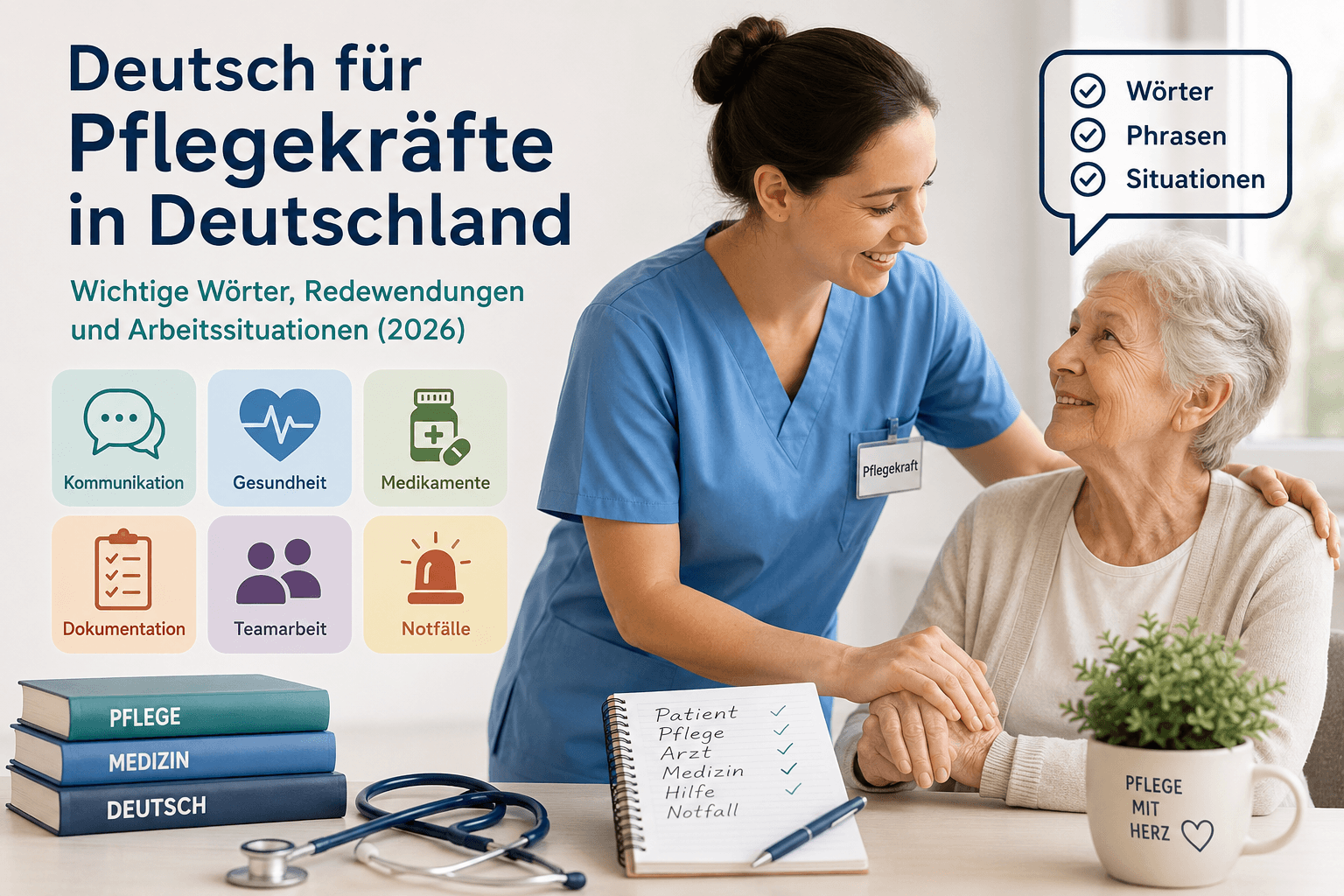
German for Care Work in Germany (2026) — Professional German, Important Vocabulary and Typical Work Situations
A practical guide for people planning to work in healthcare or caregiving in Germany.
Working in the care sector in Germany is one of the most popular opportunities for many people looking for stable employment and long-term career development. Hospitals, nursing homes, and home care providers regularly look for new employees, but German language skills are required in almost all cases.
However, general German knowledge alone is often not enough in everyday work. Care work involves specific vocabulary, professional phrases, and workplace situations that are not always taught in traditional German language courses.
For many people, the biggest challenge is not grammar but professional terminology, communication with patients, and real workplace situations.
Everyday German and German used when working with patients are often two very different things.
In this article, you will find:
- the most important German words for care work
- commonly used phrases
- required language levels
- practical tips for working in Germany
- more effective learning methods
Why is professional German so important in caregiving?
Communication is especially important in healthcare and caregiving.
Employees should be able to:
- understand patients
- explain procedures
- react correctly in emergency situations
- cooperate with colleagues
- complete documentation
- follow safety requirements
Even if employers initially accept candidates with an A2 level, in practice at least B1 or B2 is often required.
The following become especially important:
- listening skills
- professional terminology
- the ability to speak calmly and clearly
That is why many people frequently search for:
- Deutsch für Pflegekräfte
- German for Pflege
- German for care work in Germany
- Professional German for caregiving
Related topics in caregiving
The care sector is often connected with other important topics:
- First Aid in Healthcare
- Health and Medicine
- Work and Professions
- Everyday Situations
Essential German vocabulary for care work
These are common words frequently used in workplaces in Germany.
| German | English |
|---|---|
| der Patient | patient |
| die Pflegekraft | caregiver / care worker |
| das Krankenhaus | hospital |
| das Pflegeheim | nursing home / care facility |
| die Medizin | medicine |
| das Medikament | medication |
| der Arzt | doctor |
| die Krankenschwester | nurse |
| der Blutdruck | blood pressure |
| der Puls | pulse |
| die Temperatur | temperature |
| die Schmerzen | pain |
| die Atmung | breathing |
| die Wunde | wound |
| der Verband | bandage |
| der Rollstuhl | wheelchair |
| der Notfall | emergency |
| die Untersuchung | examination |
| die Hilfe | help |
| die Spritze | injection |
| die Tablette | tablet |
| die Pflege | care |
Important phrases when working with patients
Similar situations often repeat in everyday work.
Greetings and communication
- Guten Morgen! — Good morning!
- Wie geht es Ihnen? — How are you feeling?
- Brauchen Sie Hilfe? — Do you need help?
- Bitte warten Sie kurz. — Please wait a moment.
Health-related questions
- Haben Sie Schmerzen? — Are you in pain?
- Wo tut es weh? — Where does it hurt?
- Haben Sie Fieber? — Do you have a fever?
- Ich hole den Arzt. — I will get the doctor.
Daily caregiving situations
- Bitte nehmen Sie die Medikamente ein. — Please take your medication.
- Wir messen jetzt Ihren Blutdruck. — We will measure your blood pressure now.
- Können Sie aufstehen? — Can you stand up?
- Ich helfe Ihnen. — I will help you.
What German language level is required for working in Germany?
A2 Level
Suitable for:
- entry-level jobs
- assistant positions
- some care assistant roles
B1 Level
Most commonly required for:
- communication with patients
- teamwork
- documentation
B2 Level
Often required for:
- medical staff
- nurses and qualified care workers
- professional certification
- long-term work in hospitals
Some professions may also require language certificates or official recognition of qualifications in Germany.
How can you learn German for caregiving more effectively?
The best results usually come from:
- topic-based vocabulary learning
- short dialogue situations
- listening exercises
- regular repetition
- profession-specific tests
Many people make the mistake of studying only general German.
However, professional terminology often differs significantly from everyday conversations.
Learn German through topics and workplace situations
If German is not your native language, memorizing individual words alone is often not enough.
On the Deutsch mit Spaß platform users can learn German through specific topics and workplace situations:
- health and medicine
- care work
- workplace environment
- everyday situations
- professional vocabulary
Additional resources include:
- Word Search
- professional vocabulary catalogs
- topic-based learning
Learning through topics creates context, making words much easier to understand and remember.
Frequently Asked Questions (FAQ)
Is an A2 level enough for care work in Germany?
For some entry-level positions, it may be enough, but in practice B1 is often required.
What German language level is required for care work in Germany?
B1 is the most common requirement, while B2 is often required for medical professionals.
Which German words are most frequently used in care work?
Patient, Pflege, Medikament, Blutdruck, Untersuchung, and Notfall.
Is it possible to work in caregiving in Germany without speaking German?
In some situations it may be possible, but German language skills significantly improve work and communication.
Conclusion
Working in the care sector in Germany can become an excellent opportunity for people looking for stable employment and professional growth.
The earlier you begin learning professional terminology and everyday workplace situations, the easier it becomes to:
- find a job
- understand patients
- feel confident in the workplace
- integrate successfully into Germany
Learning German becomes much more effective when it is connected to real workplace situations and a specific profession.
Related practice
Continue with the learning pages and games connected to this article.