

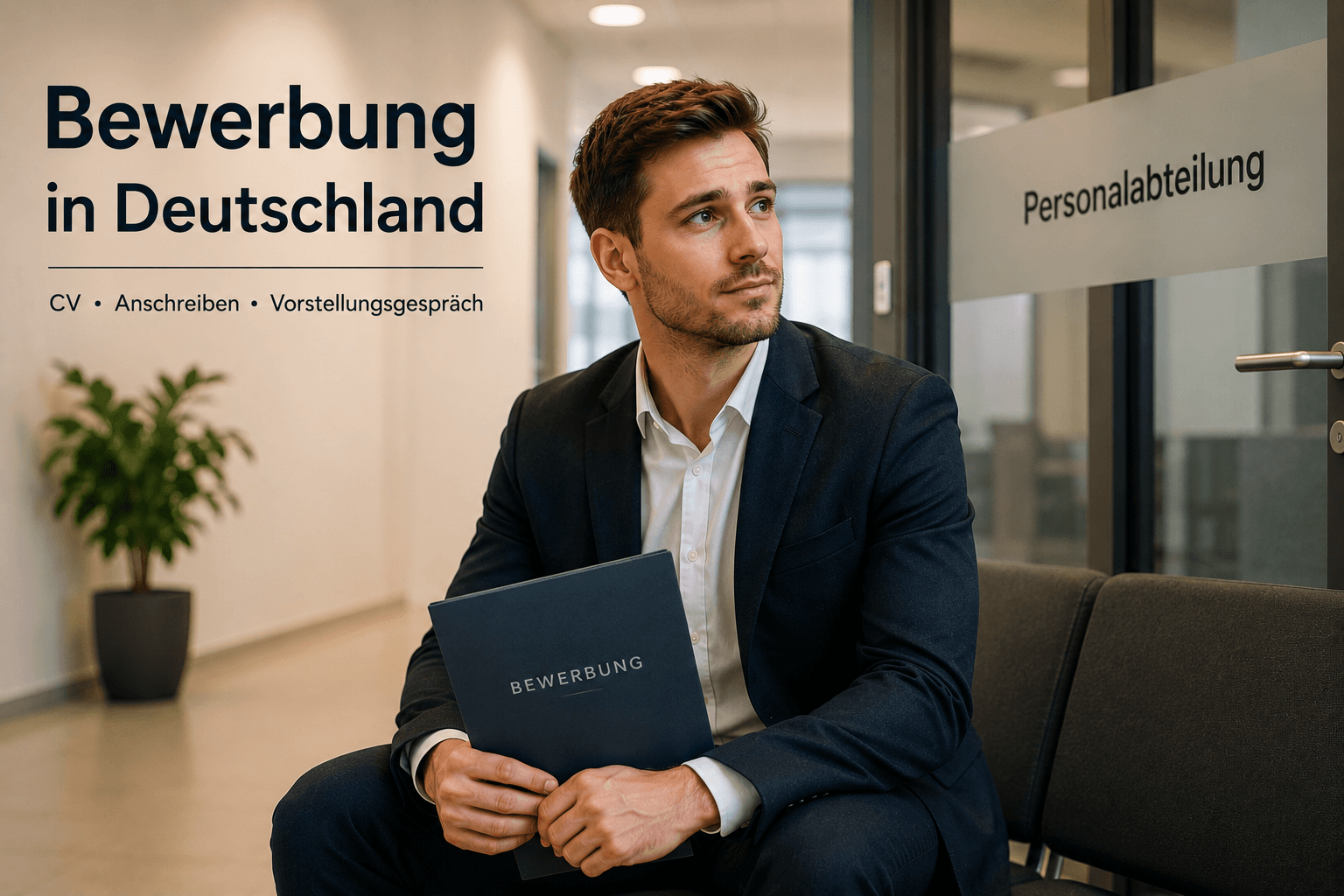
How to Successfully Apply for a Job in Germany? (2026) – CV, Cover Letter and Job Interview
Applying for a Job in Germany Is More Than Just Sending a CV
Finding the right job is only the first step toward building a successful career in Germany. What happens afterwards is just as important: how well you prepare your application and the first impression you make on your future employer.
Every day, German companies receive dozens or even hundreds of applications for a single vacancy. HR managers often spend only a few minutes reviewing each candidate. That's why a well-prepared job application (Bewerbung) can make the difference between being invited to an interview and receiving a rejection.
Many job seekers believe that finding the right vacancy is the hardest part. In reality, employers first review your CV (Lebenslauf), cover letter (Anschreiben) and supporting documents before deciding whether to invite you to the next stage of the recruitment process.
On the German job market, having good work experience and professional skills is not enough. You must also know how to present them clearly, professionally and convincingly.
In this comprehensive guide, you'll learn how the job application process in Germany works step by step. We'll explain how to write a professional German CV, when you need a cover letter, how to prepare for a job interview and which common mistakes can prevent you from getting hired.
If you haven't found a suitable vacancy yet, we recommend reading our guide "How to Find a Job in Germany? (2026)", where we explain the job search process, the best job portals and practical tips for finding work in Germany.
In this article, we'll focus on the next crucial step: how to make an employer choose you.
How Does the Job Application Process Work in Germany?
Applying for a job in Germany is not just about sending one document or attending one interview. It is a structured process in which every step depends on the previous one.
In most cases, the process looks like this:
- Find a suitable job vacancy
- Review the job requirements and prepare your documents
- Submit your application (Bewerbung)
- Receive an invitation to a job interview (Vorstellungsgespräch)
- Attend a trial working day (Probetag), if required
- Receive a job offer
- Sign the employment contract
- Start work and begin your probation period (Probezeit)
Every stage is important.
A strong CV may get you invited to an interview, but a poor interview performance can still cost you the job.
How to Write a Professional CV for Germany (Lebenslauf)
Your CV (Lebenslauf) is one of the most important documents in the entire job application process in Germany. In most cases, it is the first document reviewed by a recruiter or HR manager, and very often the decision to invite you for an interview is based on your CV alone.
A great CV is not the longest one or the most creatively designed. The best CV is one that allows an employer to quickly find all the important information within a few minutes.
German employers appreciate clear structure, accuracy and professionalism. Therefore, when writing your CV, pay attention not only to the content but also to how easy it is to read.
What Should a German CV Include?
Although there may be small differences between industries, most employers in Germany expect a traditional CV structure.
A professional Lebenslauf usually includes:
- Personal information
- Work experience
- Education
- Professional skills
- Language skills
- Computer skills
- Certificates and professional training
- Additional information (if relevant)
The key is to keep everything well organised and avoid unnecessary information.
Personal Information
At the beginning of your CV, you should include:
- Full name
- Place of residence
- Telephone number
- Email address
Optionally, you may also include:
- Date of birth
- Nationality
- Driving licence categories
- LinkedIn or Xing profile (if professionally maintained)
Information unrelated to the job, such as your marital status or religion, is generally unnecessary.
Work Experience
For most employers, this is the most important section of your CV.
List your previous jobs in reverse chronological order, starting with your current or most recent position.
For each job, include:
- Company name
- Job title
- Employment period
- Main responsibilities
- Key achievements
Whenever possible, describe your work in a way that demonstrates your value rather than simply listing duties.
Instead of writing:
Worked in a warehouse.
Write something more informative, such as:
Picked customer orders, managed incoming goods, worked with warehouse scanners, performed quality checks and prepared shipments for dispatch.
This provides employers with a much clearer picture of your experience.
Education
Your education should also be listed in reverse chronological order.
If you already have extensive work experience, it is usually enough to include your main qualifications.
If you are at the beginning of your career, you can provide a little more detail about your education, relevant coursework or internships.
Language Skills
Always describe your language skills honestly.
For example:
- Latvian – Native
- German – B1
- English – B2
- Russian – C1
If you hold an official language certificate, make sure to mention it.
Computer Skills
This section is particularly important for office and administrative positions.
Typical examples include:
- Microsoft Office
- Excel
- Outlook
- SAP
- WMS systems
- AutoCAD
- Other industry-specific software
Only include software that you can confidently use in a professional environment.
Certificates and Professional Training
If your profession requires specific qualifications, they should be clearly visible in your CV.
For example:
- Staplerschein
- First Aid Certificate (Erste Hilfe)
- Hygiene Certificate according to Section 43 (Hygienebelehrung nach §43 IfSG)
- ADR Certificate
- Welding certificates
- Electrical qualifications
- Other industry-specific certifications
For many employers, these qualifications immediately demonstrate that you meet the requirements of the position.
Should You Include a Photo?
Today, a photo is no longer mandatory on a German CV.
However, in many industries a professional portrait still creates a positive first impression.
If you decide to include a photo, it should be:
- high quality;
- professionally taken;
- on a neutral background;
- with appropriate business attire.
Selfies, holiday photos and heavily edited images are not suitable for a professional job application.
CV Layout
A professional CV should be easy to read at first glance.
Use:
- clear headings;
- one consistent font;
- sufficient spacing between sections;
- a consistent date format throughout the document.
Complicated layouts, bright colours and excessive graphic elements are rarely necessary.
In Germany, a clean and professional design usually creates a much stronger impression than an overly creative one.
Final Checklist Before Sending Your CV
Before attaching your Lebenslauf to your Bewerbung, take a few minutes for one final review.
Make sure that:
- Your telephone number is correct.
- Your email address is up to date.
- There are no spelling or grammar mistakes.
- Your employment history is in logical chronological order.
- Your CV is saved as a PDF file.
- The file name looks professional (for example, John_Smith_CV.pdf or John_Smith_Lebenslauf.pdf).
- Your CV has been tailored specifically for the vacancy.
This simple checklist can help you avoid mistakes that might otherwise create an unprofessional impression.
The 10 Most Common CV Mistakes
Even experienced professionals make mistakes that reduce their chances of being invited to an interview.
The most common ones include:
- Sending the same CV to every employer.
- Spelling or grammar mistakes.
- Describing work experience too vaguely.
- Using outdated contact information.
- Sending the CV as a Word document instead of a PDF.
- Using an overly complicated design.
- Listing skills you do not actually possess.
- Forgetting to include important professional certificates.
- Writing a CV that is too long and filled with irrelevant information.
- Failing to tailor the CV to the specific position.
Avoiding these mistakes already puts you ahead of many other applicants.
Cover Letter (Anschreiben)
Although many employers in Germany no longer require a cover letter (Anschreiben), it remains an important part of the job application (Bewerbung) in many industries.
A cover letter gives you the opportunity to explain why you want to work for a particular company and why you are the right person for the position.
While your CV (Lebenslauf) focuses mainly on facts, your cover letter allows you to demonstrate your motivation, personality and genuine interest in the role.
What Makes a Good Cover Letter?
A good cover letter does not need to be long.
In most cases, one page is more than enough.
It should clearly answer three important questions:
- Why do you want to work for this company?
- Why are you the right candidate for this position?
- What value can you bring to the employer?
Avoid using generic text that could be sent to any company.
The more personalised your cover letter is, the more likely it is to attract the employer's attention.
What Should a Cover Letter Include?
A professional Anschreiben usually consists of four parts:
- a brief introduction;
- your motivation for applying;
- your experience and strengths;
- a polite closing statement expressing your interest in an interview.
There is no need to repeat everything already written in your CV.
Instead, your cover letter should complement your Lebenslauf by showing the person behind the qualifications.
The Most Common Mistake
Many applicants send exactly the same cover letter to every employer.
Recruiters recognise generic applications almost immediately.
Spending just a few minutes adapting your cover letter to the specific company can significantly improve your chances of being invited to an interview.
Bewerbungsmappe – Your Complete Application Package
Many German employers still prefer receiving all application documents together in one well-organised PDF file or in a clearly structured order.
A complete Bewerbungsmappe usually includes:
- Cover Letter (Anschreiben)
- CV (Lebenslauf)
- Educational certificates
- Professional certificates and qualifications
- Employment references or recommendation letters (if available)
If the job advertisement specifies a different order or requests additional documents, always follow the employer's instructions.
A well-organised application package creates a professional impression and makes it easier for recruiters to evaluate your application.
Job Interview (Vorstellungsgespräch)
If you have been invited to a job interview, you have already achieved an important milestone. It means that your CV and application documents have successfully attracted the employer's attention.
Your next goal is to demonstrate that you are not only professionally qualified but also the right person to join the team.
Many applicants see a job interview as an examination. In reality, it is a conversation where both sides get to know each other.
The employer wants to determine whether you are suitable for the position and whether you would fit into the company.
At the same time, you have the opportunity to evaluate whether the company matches your expectations and career goals.
How Should You Prepare for a Job Interview?
Good preparation reduces stress and helps you feel more confident.
Before the interview, it is recommended that you:
- carefully read the job advertisement again;
- research the company's website;
- review your CV;
- prepare examples from your previous work experience;
- plan your journey in advance;
- arrive 10–15 minutes early.
If your interview takes place online, make sure to test your internet connection, camera and microphone beforehand.
Common Job Interview Questions
Although every interview is different, many employers ask similar questions.
For example:
- Tell us about yourself.
- Why do you want to work for our company?
- Why did you choose this profession?
- What are your greatest strengths?
- What are your weaknesses?
- How do you deal with conflict?
- Why did you leave your previous job?
- Where do you see yourself in five years?
Try not to memorise prepared answers.
Employers are usually much more impressed by honest, well-structured and thoughtful responses.
Questions You Can Ask the Employer
At the end of many interviews, employers ask:
"Do you have any questions for us?"
Simply answering "No" does not always create the best impression.
Instead, prepare a few thoughtful questions in advance.
For example:
- What does a typical working day look like?
- How are new employees trained?
- How large is the team?
- What career development opportunities are available?
- When will the final hiring decision be made?
Questions like these show genuine interest in both the company and the position.
What Should You Avoid During an Interview?
Even highly qualified candidates can leave a poor impression through unprofessional behaviour.
Try to avoid:
- arriving late;
- interrupting the interviewer;
- speaking negatively about previous employers;
- exaggerating or lying about your experience;
- using your mobile phone during the interview;
- giving one-word answers without explanation;
- showing no interest in the company.
Professional behaviour, politeness and respect are often just as important as your qualifications and work experience.
What Happens After the Interview?
For most employers, the recruitment process does not end with the interview.
Many companies interview several candidates before making a final decision.
If the interviewer tells you approximately when you should expect an answer, wait until that period has passed.
If you still haven't received a response afterwards, you may send a short, polite email asking about the status of your application.
This is not considered inappropriate—in fact, it often demonstrates genuine interest in the position.
If You Receive a Rejection
A rejection does not mean you are a poor candidate.
Sometimes another applicant simply has experience that matches the vacancy slightly better.
If possible, politely ask the employer whether they can provide brief feedback.
Even one useful suggestion can help you prepare more successfully for your next interview.
Remember that many people find a job in Germany only after submitting several applications.
Persistence is one of the most valuable qualities during the job search process.
Frequently Asked Questions (FAQ)
Can I send the same CV to multiple employers?
Technically, yes.
However, tailoring your CV to each specific vacancy usually leads to much better results.
Can I apply for several positions within the same company?
Yes, provided that your qualifications match the different roles.
Just make sure that each application is adapted to the specific position.
Can I submit my application during the weekend?
Yes.
However, many recruiters recommend sending applications on working days, when they are more likely to be reviewed quickly.
Can I call the employer after the interview?
If the company has provided a timeframe for making a decision, wait until that period has passed.
If you still haven't received an answer, sending a polite follow-up email is usually a better option than calling.
Can the employer ask about my salary expectations?
Yes.
This is a very common question in Germany, particularly for skilled and qualified positions.
Before your interview, it is worth researching the average salary for your profession and region.
Can I apply again after being rejected?
Absolutely.
If the company advertises another suitable position in the future and you have gained additional experience or qualifications, submitting a new application is completely acceptable.
Conclusion
A successful job application is not a matter of luck.
It is the result of careful preparation, professional application documents and the ability to present your skills, experience and motivation convincingly.
Every well-written CV, every personalised cover letter and every well-prepared interview brings you one step closer to your next job.
If your first attempt is unsuccessful, don't give up.
Review your previous applications, improve your documents and continue applying.
Every application teaches you something new and increases your chances of success.
Remember:
German employers are not only looking for candidates with strong technical skills.
They are also looking for people who are reliable, motivated, willing to learn and committed to continuous improvement.
These qualities often become the foundation of a successful career in Germany.
Related practice
Continue with the learning pages and games connected to this article.