

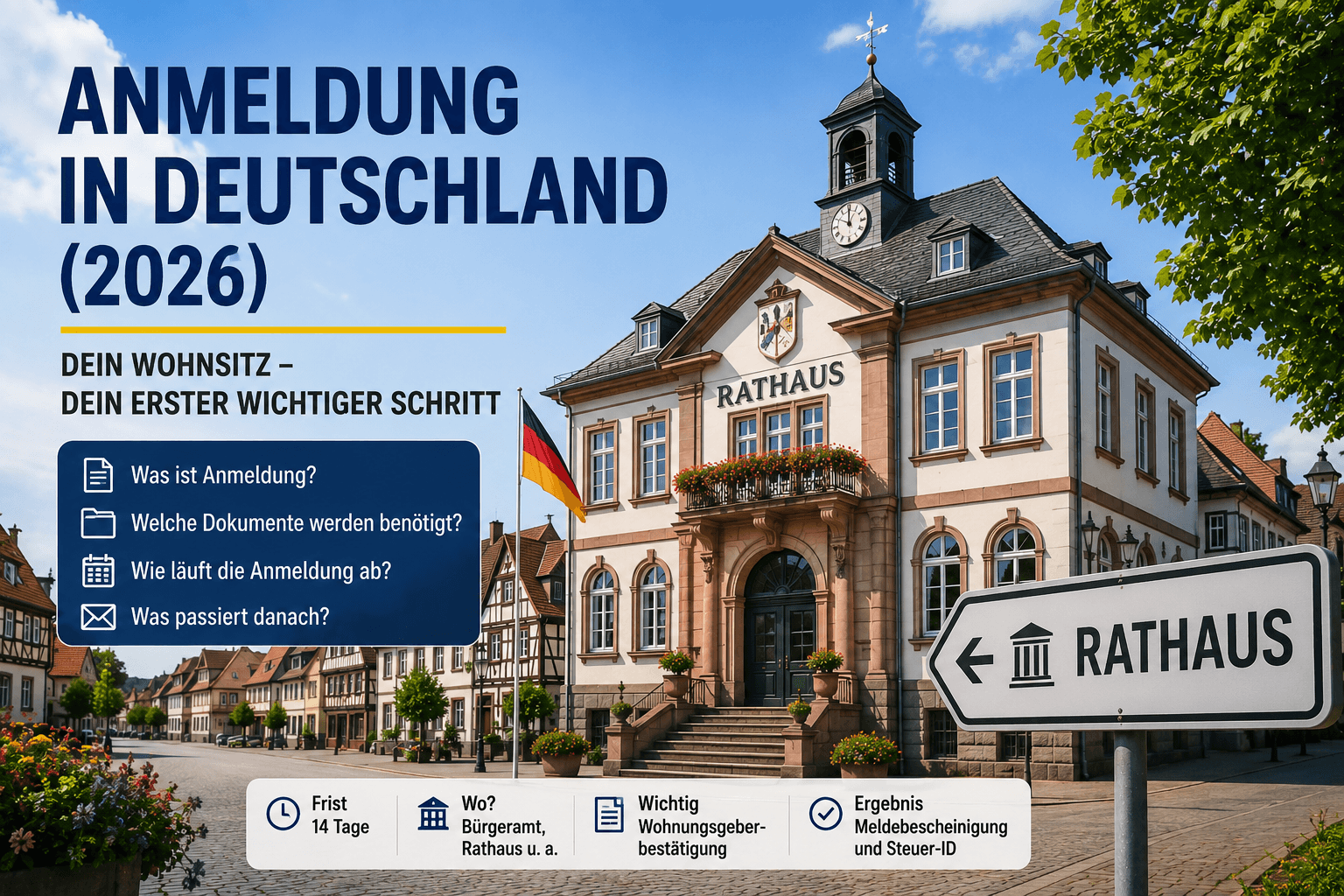
Anmeldung in Germany (2026) – How to Register Your Address Step by Step
If you're moving to Germany, one of the first and most important administrative tasks is completing your Anmeldung — the official registration of your place of residence.
Without registering your address, it is often impossible to fully settle into life in Germany. Many important administrative processes depend on it, including receiving your German Tax Identification Number (Steuer-ID), communicating with government authorities, and accessing a wide range of public services.
For many newcomers, the Anmeldung process can seem confusing at first. In reality, it is usually straightforward once you know which documents you need and what to expect during the appointment.
In this guide, you'll learn:
- what Anmeldung is;
- who is required to register their address;
- when you must complete the registration;
- which documents you need;
- what happens during your appointment at the Bürgeramt or Rathaus;
- what documents you receive after registering;
- common mistakes to avoid and practical tips for a smooth process.
Anmeldung at a Glance
Anmeldung is the official registration of your residential address in Germany. In most cases, you are required to register within 14 days of moving into your new home.
| Question | Answer |
|---|---|
| What is it? | Official registration of your residential address in Germany |
| Where? | Bürgeramt, Bürgerbüro, Einwohnermeldeamt, or Rathaus |
| When? | Usually within 14 days after moving in |
| What do you need? | Passport or ID card, completed Anmeldung form, and a Wohnungsgeberbestätigung |
| What do you receive? | A Meldebescheinigung, or registration certificate, and later your personal Steuer-ID |
What Is Anmeldung?
Anmeldung is the official registration of your place of residence with the local registration authority in Germany. Anyone moving to a new address is generally required to register their residence with the municipality responsible for that location.
Depending on where you live, the registration is usually completed at one of the following offices:
- Bürgeramt — Citizens' Office;
- Bürgerbüro — Citizens' Service Office;
- Einwohnermeldeamt — Residents' Registration Office;
- in many smaller towns and villages, the Rathaus — Town Hall.
It is important to understand that Anmeldung is not:
- a residence permit;
- a work permit;
- a visa.
It is simply the official registration of your residential address.
Why Is Anmeldung So Important?
Registering your address is one of the most important administrative steps after moving to Germany. Once your residence has been officially registered, many other government procedures can begin automatically.
Without an Anmeldung, you may encounter difficulties when trying to:
- receive your Steuer-ID — Tax Identification Number;
- receive official mail from German authorities;
- complete various administrative procedures;
- access many public and municipal services.
For this reason, it is highly recommended to complete your Anmeldung as soon as possible after moving in.
Who Must Register Their Address?
In most cases, anyone moving to Germany is legally required to register their place of residence.
This includes:
- citizens of European Union member states;
- non-EU nationals;
- international students;
- employees;
- families;
- people moving from one German city or municipality to another.
If you move to a new address within Germany, you will usually need to complete an Ummeldung — change of address registration.
If you leave Germany permanently, you may be required to complete an Abmeldung — deregistration — depending on your circumstances.
When Must You Complete Your Anmeldung?
According to German registration regulations, you generally have 14 days after moving into your new home to register your address.
In larger cities, appointment slots can fill up quickly, so it is advisable to book your Termin, or appointment, as early as possible.
However, the registration process can vary considerably from one municipality to another.
Do You Always Need an Appointment?
No.
In many large cities, Anmeldung is only available with a pre-booked appointment.
However, in many smaller towns and villages, you can still visit the Bürgeramt or Rathaus without an appointment. If other visitors are waiting, the queue is often only a few minutes long.
Some municipalities offer both options — scheduled appointments and walk-in service.
DMS Practical Experience
Based on our own experience in Glatten, Baden-Württemberg, we completed the Anmeldung process three separate times without booking an appointment in advance. We simply visited the Rathaus during office hours. If other visitors were already there, the waiting time was only a few minutes.
This demonstrates that in smaller municipalities, the registration process is often much simpler and faster than in large cities.
Nevertheless, before visiting your local office, we always recommend checking your municipality's official website for the latest information about appointments, opening hours, and required documents.
What Documents Do You Need?
In most cases, you will need the following documents:
| Document | Required? |
|---|---|
| Passport or national ID card | ✔ |
| Completed Anmeldung form | ✔ |
| Wohnungsgeberbestätigung | ✔ |
| Residence permit | In certain cases |
| Marriage certificate | If applicable |
| Children's birth certificates | If applicable |
Important: If your documents were issued outside Germany, the Bürgeramt may, in some cases, require certified German translations or additional supporting documents. Requirements can vary depending on the municipality.
Checklist Before Your Appointment
- ✅ Passport or national ID card;
- ✅ completed Anmeldung form;
- ✅ Wohnungsgeberbestätigung;
- ✅ any additional documents relevant to your personal situation.
What Is a Wohnungsgeberbestätigung?
A Wohnungsgeberbestätigung is an official confirmation from your landlord or property owner stating that you have actually moved into the address you are registering.
The document usually includes:
- the landlord's details;
- the tenant's name;
- the residential address;
- the move-in date;
- the landlord's signature.
Important: A tenancy agreement, or Mietvertrag, alone is usually not sufficient.
Without a Wohnungsgeberbestätigung, you will often not be able to complete your Anmeldung.
How Does the Anmeldung Process Work?
The name of the responsible office may vary depending on where you live. In larger cities, registrations are usually handled by the Bürgeramt or Bürgerbüro, while other municipalities may use the Einwohnermeldeamt. In many smaller towns and villages, the Rathaus, or Town Hall, performs the same function.
Regardless of the office's name, the registration process is very similar throughout Germany.
In most cases, the process looks like this:
- Visit the Bürgeramt or Rathaus.
- Submit all required documents.
- A staff member reviews your information.
- Your residential address is officially registered.
- You receive your Meldebescheinigung — registration certificate.
The appointment itself often takes only a few minutes.
What Is a Meldebescheinigung?
A Meldebescheinigung is the official certificate confirming that your residential address has been successfully registered in Germany.
You may be asked to present this document by:
- banks;
- employers;
- health insurance providers;
- government authorities;
- schools or kindergartens;
- other public or private organisations.
For this reason, it is a good idea to keep your Meldebescheinigung in a safe place even after completing your Anmeldung.
What Happens After Anmeldung?
Registering your address is only the first step. During the following weeks, several additional administrative processes usually begin automatically.
While some procedures happen without any action on your part, others require you to submit applications or provide additional information.
That's why it's important to check your mailbox regularly, as most official communication in Germany is still sent by post.
After completing your Anmeldung, you will commonly receive or need to deal with:
- your Steuer-ID — Tax Identification Number — by mail;
- a letter regarding the Rundfunkbeitrag — broadcasting contribution;
- additional administrative formalities;
- starting or officially registering your employment;
- applications for family benefits, if applicable.
Steuer-ID — German Tax Identification Number
After your Anmeldung, your registration details are automatically forwarded to the Federal Central Tax Office — Bundeszentralamt für Steuern, or BZSt.
Your personal Steuer-ID is then usually sent by post to your registered address.
You will need your Steuer-ID for:
- starting a new job;
- payroll and salary payments;
- tax-related matters;
- communication with the Finanzamt — tax office.
Rundfunkbeitrag
After registering your address, many people receive a letter regarding the Rundfunkbeitrag.
This is Germany's mandatory public broadcasting contribution, which helps fund public television and radio services.
In most cases, only one broadcasting contribution is paid per household, regardless of how many people live there.
If someone in your household is already paying the contribution, it is usually possible to avoid paying it twice.
Working in Germany
If you are moving to Germany for employment, your registered address and, shortly afterwards, your Steuer-ID will usually be required by your employer.
These details are necessary for payroll processing, tax reporting, and completing your employment records correctly.
Family Benefits
If you move to Germany with your children, completing your Anmeldung will also allow you to take care of other important administrative matters, including:
- applying for Kindergeld — Child Benefit;
- registering your child at a school or kindergarten;
- applying for other family-related benefits and support.
Common Mistakes When Completing Your Anmeldung
Many people make the same mistakes when registering their address in Germany. Fortunately, most of them can be avoided with a little preparation.
The most common mistakes include:
- booking an appointment, or Termin, too late;
- forgetting to bring the Wohnungsgeberbestätigung;
- arriving without all the required documents;
- missing the legal registration deadline;
- forgetting to register all family members.
Preparing everything in advance will usually allow you to complete your Anmeldung successfully during your first visit.
Practical Tips for a Smooth Anmeldung
These simple tips can help make your registration process faster and less stressful:
- Check your municipality's official website before your appointment.
- Find out whether you need to book an appointment in advance.
- Prepare all required documents ahead of time.
- Arrive a few minutes early.
- Keep your Meldebescheinigung in a safe place after registration.
Especially in larger cities, appointment slots can fill up quickly, so it's worth booking as early as possible.
Frequently Asked Questions About Anmeldung
Is Anmeldung mandatory?
Yes. In most cases, registering your address in Germany is a legal requirement.
Does Anmeldung cost anything?
In many municipalities, Anmeldung is free of charge. However, some local authorities may charge a small administrative fee for certain certificates or additional documents.
Can I complete my Anmeldung online?
Some German cities and municipalities now offer online registration services. However, many local authorities still require you to visit the office in person.
Can I register without a rental agreement?
In most cases, you will need a Wohnungsgeberbestätigung. A rental agreement, or Mietvertrag, alone is usually not enough.
Can Anmeldung be completed in a single day?
Yes. If an appointment is available or your municipality accepts walk-in visitors, the entire registration process can often be completed during one visit.
Do all family members need to be registered?
Yes. If your whole family is moving to Germany, all family members — including children — must generally be registered.
When will I receive my Steuer-ID?
Your Steuer-ID is usually sent by post within a few weeks after completing your Anmeldung.
What happens if I move to another city in Germany?
If you move to another city or municipality within Germany, you will generally need to complete an Ummeldung, which is the official registration of your new address.
What's Next After Anmeldung?
Once your address has been successfully registered, several other important administrative steps usually follow.
These commonly include:
- Steuer-ID — when you will receive it and where you'll need it;
- opening a bank account in Germany — how to choose the right bank;
- health insurance — Krankenversicherung — understanding Germany's healthcare system;
- Rundfunkbeitrag — what it is, who has to pay it, and when;
- Kindergeld — how to apply for child benefit in Germany.
For each of these topics, Deutsch mit Spaß (DMS) provides detailed guides, practical advice, and up-to-date information to help you navigate life in Germany.
Conclusion
Anmeldung is one of the very first and most important administrative steps after moving to Germany. Although the process may seem complicated at first, it is usually straightforward once you have prepared the required documents and understand how the registration works.
Whether you are moving to Berlin, Munich, Hamburg, Cologne, or a small town in Baden-Württemberg, it is always advisable to familiarise yourself with your local municipality's requirements and register your address as soon as possible.
Successfully completing your Anmeldung lays the foundation for many other important administrative procedures in Germany — from receiving your Steuer-ID and arranging health insurance to opening a German bank account and applying for Kindergeld.
The better you understand the registration process, the easier your transition to life in Germany will be.
Taking the time to complete your Anmeldung correctly is one of the best first steps you can make towards a smooth and successful start to your new life in Germany.
Related practice
Continue with the learning pages and games connected to this article.