

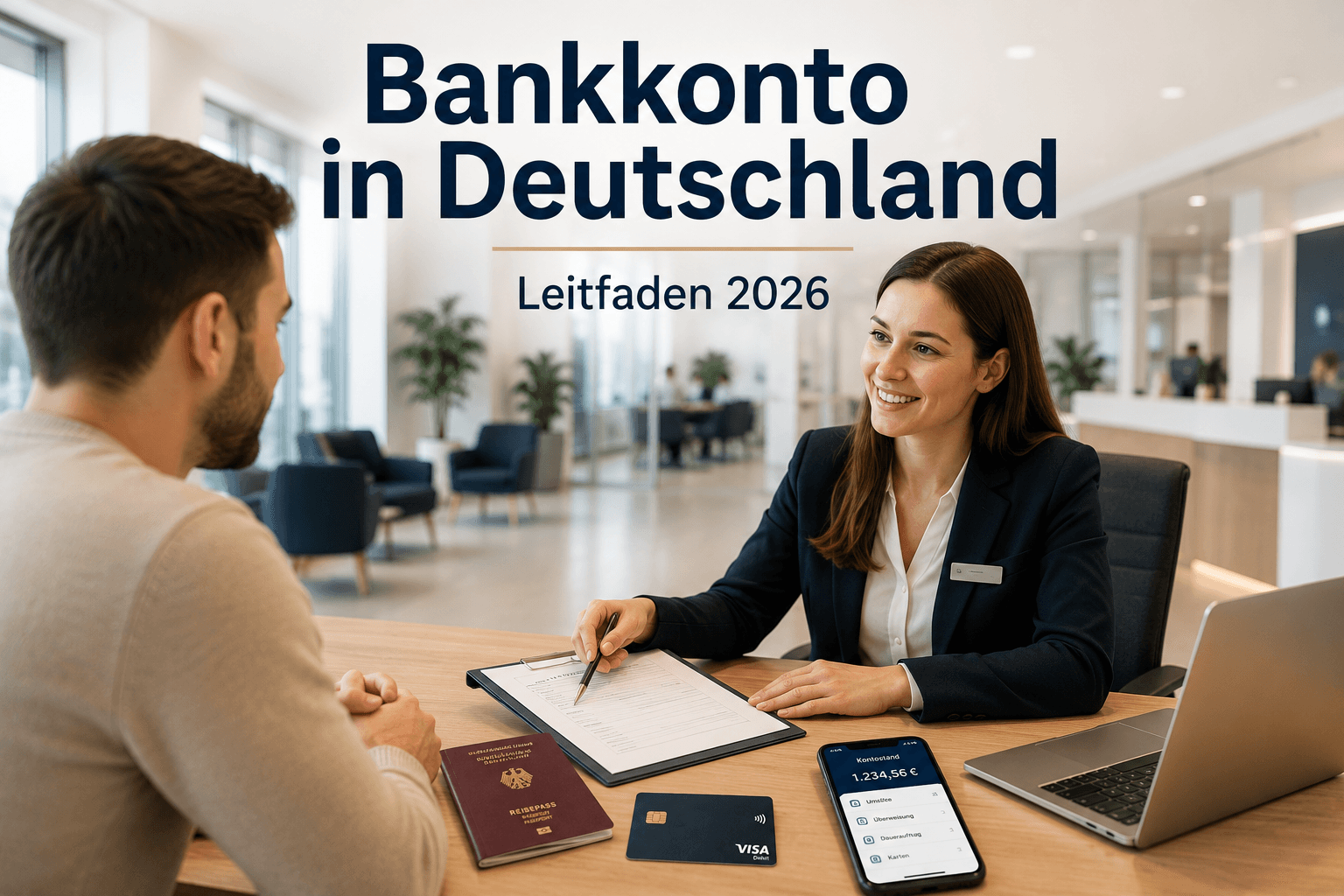
Bank Account in Germany (2026) – Complete Guide for Foreigners
Opening a bank account is one of the first and most important steps when moving to Germany. Whether you are coming to work, study, start a business, or build a new life, a German bank account will quickly become an essential part of your daily routine.
Without a bank account, receiving your salary, paying rent, setting up direct debits, or accessing many public services can be difficult. Although the process is generally straightforward, it often raises many questions, especially for people who have recently arrived in Germany.
This guide explains everything you need to know about opening a bank account in Germany in 2026.
You will learn:
- who can open a bank account
- which documents you need
- how the application process works
- what Girokonto and Basiskonto are
- how to choose the right bank
- what to consider before signing a banking agreement.
Whether you are planning your move or are already living in Germany, this guide will help you understand the German banking system and make the right choice.
In Brief
- Most people in Germany use a Girokonto (current account).
- Foreigners can also open a bank account in Germany.
- Many banks require proof of address registration (Anmeldung).
- You will usually need an identity document and proof of address.
- Most banks also offer online banking and a mobile banking app.
- Before opening an account, compare fees, ATM availability, and banking services.
What Will You Learn in This Guide?
This guide covers the most important information about bank accounts in Germany.
You will learn:
- why a bank account is necessary
- who can open one
- which documents are required
- how to choose the right bank
- what Girokonto and Basiskonto are
- how debit and credit cards differ
- how to use online banking safely
- the most common mistakes to avoid.
Why Do You Need a Bank Account in Germany?
A bank account is one of the foundations of everyday life in Germany.
Although cash is still widely used, most payments are made through a bank account.
You will usually need one to:
- receive your salary
- pay rent
- pay electricity, internet and insurance bills
- receive benefits from German authorities
- make online purchases
- use direct debits (Lastschrift)
- transfer money to other people.
Many employers transfer salaries only to a German or European bank account.
Without a bank account, everyday life in Germany becomes much more complicated.
DMS Tip
If you plan to stay in Germany for more than just a short period, opening a bank account should be one of your first priorities after registering your address.
Can a Foreigner Open a Bank Account in Germany?
Yes.
In most cases, foreigners can open a bank account in Germany.
The exact requirements depend on the bank, your residence status, and the type of account you want to open.
People who commonly open bank accounts in Germany include:
- EU citizens
- non-EU citizens
- employees
- students
- self-employed people
- business owners
- newly arrived residents.
Some banks have stricter requirements, while others are specifically designed for newcomers and international customers.
Is Address Registration (Anmeldung) Required?
In many cases, yes.
Most traditional banks require proof of address registration (Anmeldung).
Some digital banks may allow you to open an account before completing your registration, but their requirements vary.
Always check the conditions of your chosen bank before applying.
DMS Tip
If you have already completed your Anmeldung, keep the registration certificate readily available, as banks often ask for it during the application process.
What Is a Basiskonto?
A Basiskonto (basic payment account) is a special type of bank account intended for people who are unable to open a standard current account.
Under German law, many people have the right to a Basiskonto.
With this account you can:
- receive money
- make bank transfers
- pay bills
- use direct debits
- withdraw cash.
However, a Basiskonto may have fewer features than a standard Girokonto and can sometimes involve higher fees.
Which Documents Do You Need?
The required documents vary from bank to bank.
Most commonly, you will need:
- a valid passport or identity card
- proof of address registration (Anmeldung)
- your German tax identification number (Steuer-ID), if available
- proof of income or an employment contract (for some banks)
- a residence permit, if applicable.
Some banks may ask for additional documents depending on your individual situation.
Identity Document
A valid passport or national identity card is required in almost every case.
The document must be valid and officially recognised.
Proof of Address Registration
Many banks require the registration certificate you receive after completing your Anmeldung.
This document confirms your official residential address in Germany.
Tax Identification Number (Steuer-ID)
Some banks ask for your German tax identification number.
If you have recently moved to Germany, you may receive your Steuer-ID shortly after registering your address.
Employment Contract
Not every bank requires proof of employment.
However, some banks may ask for:
- an employment contract
- salary information
- proof of regular income.
Additional Documents
Depending on your circumstances, a bank may also request:
- a residence permit
- a student certificate
- business registration documents
- other supporting documents.
How to Open a Bank Account in Germany
Although procedures vary slightly between banks, the process is usually very similar.
1. Choose a Bank
Compare:
- account fees
- ATM network
- online banking features
- customer service
- additional services.
2. Prepare Your Documents
Make sure all required documents are ready before you start your application.
3. Submit Your Application
Depending on the bank, you can apply:
- online
- through a mobile banking app
- in person at a branch.
4. Verify Your Identity
Most banks require identity verification.
This may be completed:
- at a branch
- through video identification
- via another approved verification method.
5. Wait for Approval
Many banks approve applications within a few days.
Some digital banks may open your account even faster.
6. Receive Your Bank Card
Once your account has been approved, your bank card and online banking access details will usually be sent by post.
Checklist Before Opening a Bank Account
Before applying, make sure that you:
- have a valid identity document
- have completed your address registration, if required
- have all necessary documents ready
- have compared several banks
- understand the account fees
- know where the nearest ATMs are
- have reviewed the bank's online banking features.
How Long Does It Take to Open a Bank Account?
The time required to open a bank account depends on the bank and the application method.
Some digital banks can open an account within just a few minutes, while traditional banks may take several business days.
In most cases, the process takes between one and seven business days.
| Bank Type | Typical Processing Time |
|---|---|
| Digital banks | A few minutes to 1 business day |
| Traditional banks | 2–7 business days |
| Basic payment account (Basiskonto) | May take longer |
If additional documents are required, the process may take more time.
DMS Tip
If you need a bank account urgently to receive your salary, choose a bank that offers online account opening and digital identity verification.
What Is a Girokonto?
A Girokonto is the standard current account used in Germany for everyday banking.
It is the most common type of bank account and is used by almost everyone.
With a Girokonto, you can:
- receive your salary
- make bank transfers
- pay bills
- set up direct debits (Lastschrift)
- withdraw cash
- pay with a bank card
- use online banking.
For most people moving to Germany, a Girokonto is the right choice.
What Can You Do with a Girokonto?
A Girokonto is designed for everyday financial transactions.
You can use it to:
- receive salary payments
- receive pensions or benefits
- pay rent
- pay utility bills
- transfer money to family or friends
- shop online
- pay in shops
- withdraw cash
- manage your finances through online banking.
For most people living in Germany, nearly all day-to-day financial activities are carried out through a Girokonto.
Is a Girokonto Free?
It depends on the bank.
Some banks offer a completely free current account.
Others only provide free account maintenance if certain conditions are met, for example:
- a minimum monthly income is paid into the account
- you are a student
- you are under a certain age.
Some banks also charge separately for:
- the bank card
- paper account statements
- cash withdrawals from non-partner ATMs
- additional banking services.
Always read the fee schedule before opening an account.
Can You Change Banks Later?
Yes.
Changing banks in Germany is usually straightforward.
Many banks even offer a bank switching service that helps you transfer:
- direct debits
- standing orders
- regular incoming payments.
This makes switching to another bank much easier than many people expect.
What Are IBAN and BIC?
Soon after opening your account, you will receive two important banking details:
- IBAN
- BIC
These identifiers are used when sending and receiving bank transfers.
What Is an IBAN?
IBAN stands for International Bank Account Number.
It uniquely identifies your bank account.
In Germany, an IBAN usually begins with:
DE
followed by numbers that identify your bank and your account.
Whenever someone wants to transfer money to your account, they will usually need your IBAN.
Where Can You Find Your IBAN?
You can usually find your IBAN:
- in your online banking account
- in your mobile banking app
- on your bank statements
- on letters sent by your bank.
What Is a BIC?
BIC stands for Bank Identifier Code.
It identifies the bank itself rather than your personal account.
Today, for most domestic and SEPA transfers, only the IBAN is required.
The BIC is mainly used for certain international bank transfers outside the SEPA area.
Important to Know
Never confuse your IBAN with your bank card number.
The IBAN identifies your bank account, while the card number identifies your payment card.
You can safely share your IBAN when someone needs to send money to you.
However, you should never share your PIN, online banking password, or authentication codes with anyone.
Girocard, Debit Card and Credit Card – What's the Difference?
Many people think that all bank cards work the same way. In reality, they do not.
In Germany, you will come across several types of bank cards, each with its own advantages.
Girocard
A Girocard is the traditional German bank card linked to your Girokonto (current account).
It allows you to:
- pay for purchases in shops
- withdraw cash
- use ATMs
- make everyday payments.
Although more and more banks now issue Visa Debit or Mastercard Debit cards, the Girocard is still widely used throughout Germany.
Debit Card
When you pay with a debit card, the money is taken directly from your bank account.
You are spending your own money rather than borrowing money from the bank.
Today, debit cards are the most common type of payment card offered by German banks.
Credit Card
A credit card works differently.
When you pay with a credit card, you use a credit limit provided by the bank.
Depending on your agreement:
- the full amount may be charged at the end of the month
- or you may repay the balance in instalments.
Keep in mind that paying in instalments usually involves interest charges.
What Is an EC Card?
If you hear someone in Germany talking about an EC card, don't be surprised.
These cards are no longer issued, but many Germans still use the term in everyday conversation.
In most cases, when someone says EC card, they are actually referring to a Girocard.
Girocard, Debit Card and Credit Card Comparison
| Feature | Girocard | Debit Card | Credit Card |
|---|---|---|---|
| Pay in shops | ✓ | ✓ | ✓ |
| Uses your own money from your account | ✓ | ✓ | ✗ |
| Uses a bank credit limit | ✗ | ✗ | ✓ |
| Suitable for everyday purchases | ✓ | ✓ | ✓ |
| Car rental | Sometimes | Sometimes | ✓ |
| Hotel bookings | Sometimes | Sometimes | ✓ |
| Monthly credit repayment | ✗ | ✗ | ✓ |
DMS Tip
For everyday life in Germany, a Girokonto with a debit card is sufficient for most people.
A credit card becomes particularly useful if you travel frequently, book hotels, rent cars, or shop in international online stores.
How to Choose the Right Bank
You'll find hundreds of articles online with titles such as "The Best Bank in Germany" or "The Best German Banks for Foreigners."
In reality, there is no single bank that is the best for everyone.
A bank that is perfect for a student in Berlin may not be the right choice for a family living in a small town in Baden-Württemberg. Likewise, a bank that is excellent for everyday banking may not be the best option if you plan to take out a mortgage or start a business in the future.
That's why it's worth comparing several important factors before opening an account.
Account Maintenance Fees
Many people focus first on whether the account is free.
While this is important, it shouldn't be the only factor.
Check:
- whether the account is genuinely free
- whether there are conditions for free account maintenance
- whether the debit card costs extra
- whether additional banking services carry extra fees.
Sometimes an account advertised as "free" remains free only if a certain amount of money is paid into it every month.
ATM Network
This is one of the most important factors that many people overlook.
Before choosing a bank, find out:
- whether there is an ATM in your town or city
- whether partner bank ATMs are available nearby
- where you can withdraw cash free of charge.
If the nearest ATM is 30–40 kilometres away, it can become a significant inconvenience over time.
This is especially important for people living in smaller towns or rural areas.
Online Banking and Mobile App
Today, most banking services can be managed from your smartphone.
Consider:
- how user-friendly the mobile app is
- whether you receive transaction notifications
- how convenient the online banking system is
- whether two-factor authentication is supported
- whether the service is available in English.
If you plan to manage most of your banking online, a high-quality mobile app is just as important as the bank itself.
Bank Branches and Customer Support
Some people prefer to manage all their banking online.
Others want the option to visit a branch and speak with a bank adviser in person whenever necessary.
Before making your decision, consider:
- whether personal advice is important to you
- whether there is a branch near your home
- the branch opening hours
- whether customer support is available by phone or live chat.
Your Future Plans
Choosing a bank is not just about today.
Think about your future as well.
Do you plan to:
- buy a car
- apply for a mortgage
- start your own business
- use a credit card
- build a long-term relationship with one bank?
If the answer is yes, it may be worth choosing a bank that offers a broader range of financial services.
DMS Tip
Don't choose a bank simply because a friend or colleague recommends it. Their needs may be very different from yours.
Instead, choose a bank based on where you live, your everyday banking habits, and your future plans.
Traditional Banks vs Digital Banks
In recent years, more and more people have chosen digital banks, but traditional banks still offer several advantages.
The right choice depends on your lifestyle and personal preferences.
Traditional Banks
Traditional banks have a network of physical branches where you can receive face-to-face assistance.
They are often the preferred choice for people who:
- want personal support from a bank adviser
- plan to use a wide range of banking services
- prefer having the option to visit a branch when needed.
Some of the best-known traditional banks in Germany include:
- Deutsche Bank
- Commerzbank
- Sparkasse
- Volksbank
- Raiffeisenbank.
Each bank offers different conditions, so always compare their specific services and fees.
Digital Banks
Digital banks operate primarily through online banking and mobile apps.
Their advantages often include:
- fast account opening
- a simple application process
- modern mobile banking apps
- lower operating costs
- the ability to manage almost all banking services remotely.
Many newcomers choose digital banks because of their convenience and speed.
However, before making your decision, check how cash withdrawals work and what customer support options are available.
Traditional Bank vs Digital Bank – Comparison
| Feature | Traditional Bank | Digital Bank |
|---|---|---|
| Physical branches | ✓ | ✗ |
| Face-to-face advice | ✓ | Limited |
| Account opening speed | Moderate | Very fast |
| Mobile banking app | ✓ | ✓ |
| Everyday banking | ✓ | ✓ |
| Online account opening | Partly | ✓ |
| Cash services | Extensive | Depends on the bank |
Withdrawing Cash from ATMs
Although cashless payments are becoming increasingly popular in Germany, cash is still used much more frequently than in many other European countries.
For this reason, the availability of ATMs is more important than many people initially realise.
Check the ATM Network
Before opening an account, find out:
- whether the bank has an ATM in your town or city
- how far away the nearest ATM is
- whether you can use partner bank ATMs
- whether cash withdrawals are free of charge.
These details may seem minor, but they can make a significant difference in everyday life.
Watch Out for Fees
Not every bank allows free withdrawals from every ATM.
If you withdraw cash from another bank's ATM, you may have to pay a fee.
Depending on the bank, this may be:
- a fixed fee per withdrawal
- a percentage of the amount withdrawn.
Before confirming the transaction, the ATM will usually inform you if a fee applies.
If the fee is too high, you can cancel the transaction and use another ATM or one belonging to a partner bank.
Important to Know
Many newcomers choose a bank because of an attractive advertisement or a free account offer, only to discover later that the nearest free ATM is in another town.
Spending a few minutes checking the bank's ATM network before opening an account can save both time and money in the future.
Do You Need to Speak German to Open a Bank Account?
No.
Today, it is possible to open a bank account in Germany even if you do not speak German.
Many digital banks offer the application process in English, and in larger cities you can often find staff at traditional banks who can assist you in English.
However, the situation varies depending on where you live.
In smaller towns and rural areas, English-speaking customer service may not always be available.
If you are unsure, simply contact the bank before your appointment and ask whether assistance in English is available at your local branch.
If necessary, you can also:
- use a translation app
- bring someone who speaks German with you
- visit a branch in a larger city.
DMS Tip
Even if the bank staff speak English, it is worth learning the most common German banking terms. This will make it much easier to understand contracts, online banking, and everyday communication with your bank.
Bank Account Security in Germany
German banks use high security standards, but customers also play an important role in protecting their accounts.
Most cases of fraud happen not because of weaknesses in the banking system, but because criminals trick customers into revealing their login details.
Following a few simple security rules can significantly reduce the risk of becoming a victim of fraud.
Never Share Your PIN or Login Details
A bank will never:
- call you and ask for your PIN
- ask for your online banking password
- ask you to provide a TAN code over the phone
- ask you to send authentication codes by email or text message.
If anyone requests this information, it is almost certainly a scam.
Check the Website Address
Before logging into your online banking account, always make sure that:
- the website address is correct
- the connection is secure and uses HTTPS
- your browser displays the secure connection icon.
Fraudsters often create websites that look almost identical to genuine banking websites.
Enable Two-Factor Authentication
Two-factor authentication (2FA) means that, in addition to your password, you must confirm your identity using a second method, such as:
- approval through the bank's mobile app
- a TAN code
- biometric authentication.
This is one of the most effective ways to protect your bank account.
Check Your Transactions Regularly
It is a good idea to review your account every few days and check:
- recent payments
- incoming transfers
- direct debits.
The sooner you notice a suspicious transaction, the greater the chance of preventing financial loss.
DMS Tip
Enable transaction notifications in your bank's mobile app. If an unexpected payment is made from your account, you will be notified almost immediately
What Should You Do If You Lose Your Bank Card?
If you lose your bank card or suspect that it has been stolen, act immediately.
1. Block Your Card
The first step is to block your card as quickly as possible.
In most cases, you can do this:
- through your bank's mobile app
- via online banking
- by calling your bank's customer support
- through Germany's central card blocking service, if your bank supports it.
The sooner your card is blocked, the lower the risk that someone else will be able to use it.
2. Check Your Recent Transactions
After blocking your card, carefully review your account transactions.
If you notice any payments that you did not authorise, contact your bank immediately.
3. Order a Replacement Card
Most banks allow you to request a replacement card:
- through online banking
- in the bank's mobile app
- at a bank branch
- by contacting customer support.
In most cases, your new card will arrive by post within a few business days.
4. Update Your Payment Details
If your old card was linked to:
- streaming services
- online stores
- mobile payment services
- subscription services,
remember to update your payment details after receiving your new card.
The Most Common Mistakes
Many banking problems can be avoided before you even open an account.
These are the mistakes newcomers make most often.
Choosing the First Bank Without Comparing Options
An attractive advertisement does not always mean the best choice.
Compare several banks and choose the one that best matches your needs.
Ignoring Fees
A free bank account may still include charges for:
- the bank card
- cash withdrawals
- international transfers
- additional banking services.
Always read the bank's fee schedule carefully.
Not Checking the ATM Network
This is one of the most common mistakes.
Before opening an account, find out where you can withdraw cash free of charge.
Not Enabling Security Features
Many people postpone enabling two-factor authentication.
It is much better to activate it immediately after opening your account.
Forgetting to Update Your Personal Information
If any of the following changes:
- your address
- your surname
- your contact details,
inform your bank as soon as possible.
Otherwise, important correspondence may never reach you.
The Most Useful Banking Terms
| Term | Meaning |
|---|---|
| Girokonto | Current account for everyday banking |
| Basiskonto | Basic payment account |
| Girocard | Traditional German debit card |
| Debit Card | Debit payment card |
| Credit Card | Credit payment card |
| IBAN | International Bank Account Number |
| BIC | Bank Identifier Code |
| SEPA | Single Euro Payments Area |
| Lastschrift | Direct debit |
| Dauerauftrag | Standing order |
| Dispokredit | Overdraft facility |
| TAN | One-time authentication code |
| Online Banking | Internet banking |
Frequently Asked Questions (FAQ)
Can I Open a Bank Account in Germany Without an Employment Contract?
Yes.
In most cases, you do not need an employment contract to open a standard Girokonto.
Can I Use My Latvian Bank Account in Germany?
Yes.
In many situations, this is possible because Latvia is part of the SEPA area.
However, in everyday life, using a German bank account is usually much more practical.
Is Address Registration (Anmeldung) Mandatory?
Many banks require it, but the rules vary.
Always check the requirements of your chosen bank before applying.
Can I Have More Than One Bank Account?
Yes.
In Germany, you are free to have bank accounts with several different banks.
Can I Change Banks Later?
Yes.
Many banks offer a dedicated bank switching service that helps transfer your regular payments automatically.
Can I Access My Account on My Phone?
Yes.
Almost every modern bank offers a mobile banking app for both Android and iPhone.
Can I Get a Credit Card Immediately?
Not always.
Some banks first assess your creditworthiness before deciding whether to issue a credit card or provide a credit limit.
What Should I Do If I Forget My Online Banking Password?
Contact your bank or use the password recovery option available through online banking or the bank's mobile app.
Can I Close My Bank Account at Any Time?
In most cases, yes.
Before closing your account, make sure that all payments, subscriptions, and other financial obligations linked to it have been completed.
Can I Open a Bank Account for a Child?
Yes.
Many banks offer special accounts for children and teenagers.
In most cases, the consent of a parent or legal guardian is required.
Conclusion
Opening a bank account is one of the first and most important steps when starting a new life in Germany. Although the process may seem complicated at first, most people can complete it within just a few days if they prepare the necessary documents in advance and choose the right bank.
When selecting a bank account, don't base your decision solely on advertising or promises of free account maintenance. Compare banks based on the factors that will genuinely affect your daily life, such as fees, ATM availability, the quality of online banking, customer support, and future financial services.
Security is just as important. Protect your login credentials, enable two-factor authentication, and review your account activity regularly. These simple habits will help keep your money safe and make everyday banking more secure.
We hope this guide has helped you understand how the German banking system works and how to prepare for opening a bank account. Choosing the right bank today can make your everyday life in Germany much easier and more convenient in the years ahead.
Related practice
Continue with the learning pages and games connected to this article.