

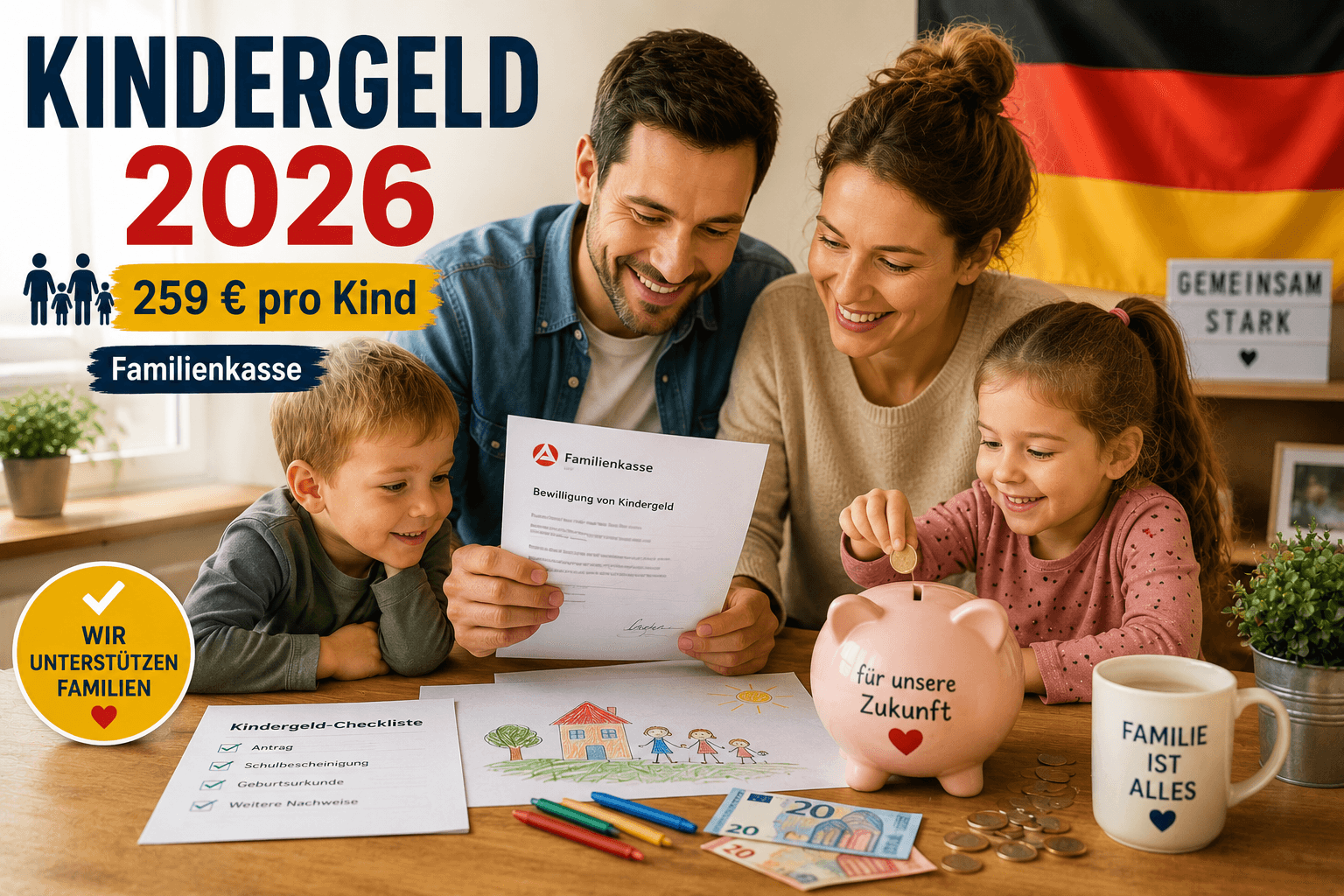
Child Benefit in Germany (2026) — Eligibility, Amount, Application Process, Family Benefits Office, Children Living Abroad, and Common Mistakes
Child Benefit (Kindergeld) is one of the most important forms of family support in Germany. Every month, millions of families receive this benefit to help cover the costs of raising children, education, and everyday living expenses.
Many people ask questions such as:
- What is Kindergeld?
- How much is Kindergeld in 2026?
- Can EU citizens receive Kindergeld?
- Can you receive Kindergeld if your children live in another EU country?
- What is the Familienkasse (Family Benefits Office)?
- How do you apply for Kindergeld?
- How long does the application process take?
- Can Kindergeld be paid after the age of 18?
- What is the KG 5d form?
- Can the Familienkasse demand repayment of benefits?
In this article, you will find both official information and practical examples, as well as the most common situations families face in Germany.
What Is Kindergeld?
Kindergeld is a German government family benefit designed to provide financial support to families with children.
The benefit is administered by the Familienkasse (Family Benefits Office), which operates within the Federal Employment Agency (Bundesagentur für Arbeit).
Kindergeld is paid monthly and is generally not dependent on the parents' income, provided the legal requirements are met.
For many families, it is one of the most important regular government support payments.
How Much Is Kindergeld in 2026?
In 2026, Kindergeld is €259 per month for each child.
The total amount a family receives depends on the number of children.
| Number of Children | Total Monthly Kindergeld |
|---|---|
| 1 child | €259 |
| 2 children | €518 |
| 3 children | €777 |
| 4 children | €1,036 |
For this reason, Kindergeld remains one of the most significant family benefits in Germany.
Why Are So Many EU Citizens Interested in Kindergeld?
Many people initially move to Germany alone while their family remains in their home country.
In such situations, a common question is whether German Kindergeld can be claimed.
For example, family benefits in Latvia for one child are significantly lower than German Kindergeld.
| Country | Family Benefit for 1 Child |
|---|---|
| Latvia | Approximately €25 |
| Germany | €259 |
Important
In many EU countries, family benefits increase when there are multiple children.
Therefore, the exact amounts may vary depending on the country and family situation.
This comparison is intended only as an illustrative example but clearly shows why so many EU citizens are interested in Kindergeld and the Familienkasse.
Who Is Eligible for Kindergeld?
Generally, the following groups may be entitled to Kindergeld:
- German citizens;
- EU citizens;
- Employees working in Germany;
- Self-employed individuals in Germany;
- Holders of certain residence permits.
Each case is assessed individually by the Familienkasse.
Can EU Citizens Receive Kindergeld?
Yes.
EU citizens who live or work in Germany can often receive Kindergeld under the same conditions as German citizens.
However, if the family lives in another EU country, the Familienkasse will usually request additional documents and carry out further checks.
Can You Receive Kindergeld If Your Children Live in Another EU Country, Such as Latvia?
Yes, in many cases this is possible.
A typical situation:
- the father lives and works in Germany;
- pays taxes in Germany;
- the mother and children live in another EU country.
In such cases, the Familienkasse examines:
- where the children live;
- where the parents work;
- what benefits are already being received;
- which country is responsible for paying family benefits.
In many cases, the family may receive either full Kindergeld or a supplementary payment known as Differenzkindergeld.
Practical Example
Mark lives and works in Germany.
Margarita lives with their two children in another EU country.
The family already receives local family benefits in their country of residence.
In this situation, the Familienkasse reviews:
- the children's place of residence;
- the parents' employment status;
- benefits already received;
- whether the family is entitled to full Kindergeld or only a differential payment.
After the review, the family may receive German Kindergeld or Differenzkindergeld.
How Does Differenzkindergeld Work?
If a family is entitled to family benefits in more than one EU country, EU coordination rules apply.
In practice, this often means:
- one country pays its regular family benefit;
- another country pays the difference.
For example:
- the family receives a child benefit in their home country;
- Germany calculates the difference up to the German Kindergeld level.
In many cases, this allows the family to receive significantly higher overall support.
Practical Example
Mark works in Germany.
Margarita and the children live in another EU country.
The family receives family benefits in their country of residence.
After reviewing the case, the Familienkasse determines that the family is entitled to a differential payment.
As a result, the family continues receiving local benefits and additionally receives the difference from Germany.
How Do You Apply for Kindergeld?
The application process usually begins after a person:
- moves to Germany;
- registers their residence (Anmeldung);
- starts employment or another activity that creates eligibility for family benefits.
In many cases, the application is submitted by the parent who:
- lives in Germany;
- works in Germany;
- pays taxes in Germany;
- is covered by the German social security system.
The application is reviewed by the Familienkasse.
How Does the Application Process Work?
1. Register Your Residence in Germany
Before applying for Kindergeld, you usually need to:
- register your address;
- obtain a tax identification number (Steuer-ID);
- start employment or another qualifying activity.
2. Submit the Application to the Familienkasse
Applications can generally be submitted:
- online;
- by post;
- in some cases, in person.
3. Submit Supporting Documents
The Familienkasse usually requests various documents.
The more complex the situation, the more documentation may be required.
4. Review and Verification
This is the stage where most questions arise.
The Familienkasse reviews:
- family circumstances;
- children's place of residence;
- employment status;
- benefits received from other countries;
- eligibility for Kindergeld.
If the children live in another EU country, the review process is usually longer.
Required Documents
The required documents may vary depending on the family's situation.
The Familienkasse most commonly requests the following:
| Document | When It Is Required |
|---|---|
| Identification documents | Almost always |
| Child's birth certificate | Almost always |
| Tax ID (Steuer-ID) | Almost always |
| Proof of residence | Almost always |
| School certificate | For children over 18 |
| KG 5d form | For children over 18 |
| Documents regarding family benefits in another country | International cases |
| Certificates from foreign authorities | International cases |
Important
The Familienkasse may request additional documents even if they were not mentioned in the original list.
What Is the Familienkasse?
The Familienkasse (Family Benefits Office) is the German authority responsible for administering Kindergeld and several other family benefits.
The Familienkasse:
- accepts applications;
- requests documents;
- conducts reviews and investigations;
- makes decisions;
- organizes payments.
If you have questions about Kindergeld, communication will usually take place directly with the Familienkasse.
How Long Does a Kindergeld Application Take?
This is one of the most frequently asked questions.
Unfortunately, there is no single answer.
In straightforward cases, a decision may be made relatively quickly.
However, many families experience significantly longer waiting periods.
DMS Practical Experience
In practice, the process often looks like this:
- The application is submitted.
- Several weeks or even months pass without a response.
- The Familienkasse requests additional documents.
- The documents are submitted.
- Further information is requested.
- A decision is made only after all checks have been completed.
In many international cases, the entire process can take:
- 3 months;
- 4 months;
- 6 months;
- sometimes even longer.
This is especially common when children live in another EU country.
Kindergeld After the Age of 18
Many parents mistakenly believe that Kindergeld automatically ends when a child turns 18.
In reality, Kindergeld can often continue until the age of 25 if the child remains in education.
This applies to:
- school students;
- university students;
- vocational training participants (Ausbildung);
- certain other forms of education.
However, after the age of 18, the Familienkasse usually examines documents and educational status much more carefully.
Until What Age Is Kindergeld Paid?
The general rule is:
| Situation | Age Limit |
|---|---|
| Child | Up to age 18 |
| School student | Up to age 25 |
| University student | Up to age 25 |
| Vocational training (Ausbildung) | Up to age 25 |
Important
After the age of 18, it is no longer enough simply that the child exists.
You must prove that the child is genuinely continuing their education.
How Do You Prove Continued Education?
The Familienkasse regularly requests supporting documents.
Most commonly:
- school certificates;
- university enrollment confirmations;
- vocational training documents;
- the KG 5d form;
- other educational evidence.
If the child studies outside Germany, translated documents may also be required.
What Is the KG 5d Form?
KG 5d is a Familienkasse form called:
"Declaration Regarding the Circumstances of an Adult Child"
It is often requested when a child is already over 18 years old.
The form includes information such as:
- where the child lives;
- whether the child is studying;
- the type of education being pursued;
- the expected completion date;
- whether the child is working;
- other important circumstances.
For many families, KG 5d becomes one of the most important documents after a child reaches adulthood.
Practical Example
Mark's daughter is 19 years old.
She continues studying at a secondary school in another EU country.
The Familienkasse requests:
- the KG 5d form;
- a school certificate;
- additional educational documents.
After the documents are submitted, Kindergeld payments continue.
Problems Between School Years
This is one of the most common issues faced by families whose children study outside Germany.
It is especially common when the child studies in another EU country.
Why Does This Problem Occur?
German authorities often assume that schools can issue confirmation of the next school year during the summer.
However, in many countries this is not possible.
For example:
- the school year ends in June;
- the new school year begins in September;
- official confirmation for the new school year can only be issued after the school year starts.
Why Is a School Report Card Sometimes Not Enough?
From a parent's perspective, a statement in a report card such as:
"Promoted to the next grade"
clearly proves that the child will continue studying.
However, the Familienkasse may also want to see:
- a current school certificate;
- confirmation that the child has actually started the new school year.
This is why a report card alone is not always sufficient.
Why Does the Familienkasse Sometimes Suspend Payments During Summer?
In practice, the following situation often occurs:
- the school year ends in June;
- in July, the Familienkasse requests a new school certificate;
- the school cannot yet issue the document;
- Kindergeld payments are temporarily suspended.
This does not automatically mean that entitlement has been lost.
In many cases, the Familienkasse is simply waiting for the next document.
DMS Practical Experience
In some countries, a school certificate for the new academic year can only be obtained after classes begin.
As a result, a gap arises between:
- the June report card;
- the September school certificate.
During this period, parents are unable to provide the exact document that the Familienkasse would like to see.
This is precisely when misunderstandings and payment delays occur most frequently.
The Good News
If it is later proven that the child continued their education without interruption, the Familienkasse will usually pay the suspended months retroactively.
In practice, this often happens as follows:
- a school certificate is issued in September;
- the documents are submitted to the Familienkasse;
- the case is reviewed;
- the previously unpaid months are paid after approval.
This means that the suspended payments are usually not lost.
What Should You Do If a School Certificate Is Only Available in September?
DMS practical experience shows that in such situations it is advisable to:
- submit the report card or end-of-year school report;
- provide a translation of the document;
- explain the situation to the Familienkasse in writing;
- clearly state that the new school certificate will only be available after the start of the school year;
- submit the new certificate as soon as it becomes available.
This can help reduce the risk of additional delays in the processing of your case.
Can Kindergeld Be Stopped If a Child Does Not Continue Their Education?
Yes.
If a child stops attending school, university, or vocational training after the age of 18 and no longer meets the legal requirements, entitlement to Kindergeld may end.
For this reason, it is very important to inform the Familienkasse about any changes as soon as possible.
Can the Familienkasse Demand Repayment of Kindergeld?
Yes.
If it is later determined that there was no entitlement to Kindergeld during a specific period, the Familienkasse may require the repayment of benefits already received.
This can happen, for example, if:
- the child stops studying;
- requested documents are not submitted;
- continued education cannot be proven;
- important changes are not reported to the Familienkasse.
The Most Important DMS Advice
- ✅ Keep all report cards and school records.
- ✅ Keep all school certificates.
- ✅ Keep all document translations.
- ✅ Keep all letters from the Familienkasse.
- ✅ Report changes immediately.
- ✅ Submit requested documents without delay.
Missing documentation is one of the most common reasons for problems with Kindergeld after the age of 18.
Document Translations and Foreign Documents
If a child lives outside Germany or studies in another country, the Familienkasse often requests additional documentation.
- birth certificates;
- school certificates;
- report cards;
- university enrollment confirmations;
- documents relating to family benefits in another country;
- proof of the child’s residence;
- other documents confirming the family situation.
Is Google Translate Enough?
Usually not.
This is one of the most common mistakes.
German authorities often require official or certified translations, especially for important documents.
Which Translations Are Usually Accepted by German Authorities?
- a certified translation;
- a translation prepared by a sworn translator;
- an officially approved translation.
How Much Does Document Translation Cost?
DMS practical experience shows that many people underestimate these costs.
- from approximately €30 per page;
- often between €30 and €60 per page;
- significantly more for complex documents.
If a family needs multiple documents translated, total costs can easily reach several hundred euros.
DMS Practical Experience
- The document is submitted in the original language.
- The Familienkasse requests a translation.
- Processing is paused.
- Several weeks or even months are lost.
How Do You Stop Receiving Family Benefits in Another EU Country?
Many families initially receive family benefits in their home country.
For example:
- Mark starts working in Germany;
- Margarita and the children live in another EU country;
- the family already receives family benefits there.
What Documents Can the Familienkasse Request?
- information about existing family benefits;
- records of benefit payments;
- documents confirming benefit termination;
- certificates from foreign authorities;
- proof of the child’s residence;
- other evidence relating to the family situation.
Why Is the Familienkasse Interested in Benefits Paid by Other Countries?
- whether the family already receives benefits elsewhere;
- which country has primary responsibility;
- whether full Kindergeld is payable;
- whether only Differenzkindergeld is payable.
DMS Practical Experience
Even when all requested documents are submitted, the Familienkasse often:
- requests additional information;
- asks again for documents that have already been submitted;
- carries out further checks;
- compares information with authorities in other countries.
Why Do International Kindergeld Cases Take Longer?
- reviews submitted documents;
- requests additional information;
- contacts authorities in the other country;
- compares information about benefits already paid;
- determines which country is responsible for family benefit payments.
Is Money Lost During This Time?
In many cases, no.
If the Familienkasse later confirms entitlement to Kindergeld or Differenzkindergeld, payments are usually made retroactively.
What Should You Do If the Familienkasse Rejects Your Application?
- carefully read the decision;
- determine the reason for the rejection;
- prepare the missing documents;
- submit an appeal (Einspruch) if necessary;
- comply with all deadlines.
What Happens If the Familienkasse Requests Repayment?
- carefully read the decision;
- check the calculations;
- ensure that all documents were considered;
- provide additional explanations or documents if necessary.
30 Common Mistakes When Receiving Kindergeld
- Applying too late.
- Assuming the application will be approved automatically.
- Failing to submit all requested documents.
- Ignoring letters from the Familienkasse.
- Not reporting a change of address.
- Not reporting changes in family circumstances.
- Assuming that a child living outside Germany automatically disqualifies the family.
- Failing to check eligibility for Differenzkindergeld.
- Not keeping copies of important documents.
- Relying on verbal explanations.
- Using only Google Translate.
- Ordering non-certified translations.
- Delaying document translations.
- Assuming processing always takes only a few weeks.
- Panicking when there is no response for several months.
- Missing document submission deadlines.
- Assuming Kindergeld automatically continues after age 18.
- Failing to submit the KG 5d form.
- Failing to submit a current school certificate.
- Assuming a report card is always sufficient.
- Not reporting a break in education.
- Not reporting a change of school.
- Not reporting the start of university studies.
- Not reporting the start of vocational training.
- Ignoring issues between school years.
- Not expecting temporary payment suspensions during summer.
- Failing to explain why a school certificate will only be available in September.
- Not keeping old report cards and certificates.
- Not reporting the end of education.
- Assuming the Familienkasse will automatically learn about all changes.
Kindergeld FAQ (2026) — 30 Frequently Asked Questions
Šeit seko visi 30 FAQ jautājumi un atbildes no oriģinālā raksta. Tā kā vienas ChatGPT atbildes limits ir sasniegts, FAQ sadaļa jādod atsevišķā 3/2 daļā vai jāveido kā atsevišķs HTML bloks zem šī raksta.
What Sources Were Used for This Article?
- German Family Portal (Familienportal Deutschland);
- Federal Employment Agency (Bundesagentur für Arbeit) and Familienkasse;
- European Union family benefit coordination regulations;
- publicly available German family benefit information materials;
- DMS practical experience working with the Familienkasse.
DMS Conclusion
Kindergeld is one of the most important family benefits in Germany. In 2026, it amounts to €259 per month for each child, and in many cases it can also be received by EU citizens whose children live in another EU country.
Most problems arise not because a family is ineligible, but because of missing documents, translations, deadlines, or additional international checks.
- submit documents on time;
- keep all certificates and records;
- respond to Familienkasse correspondence;
- report important changes promptly;
- keep official translations of foreign documents.
In most cases, receiving Kindergeld is a smooth process, even if your children live outside Germany or are already over 18 years old.
Related practice
Continue with the learning pages and games connected to this article.