

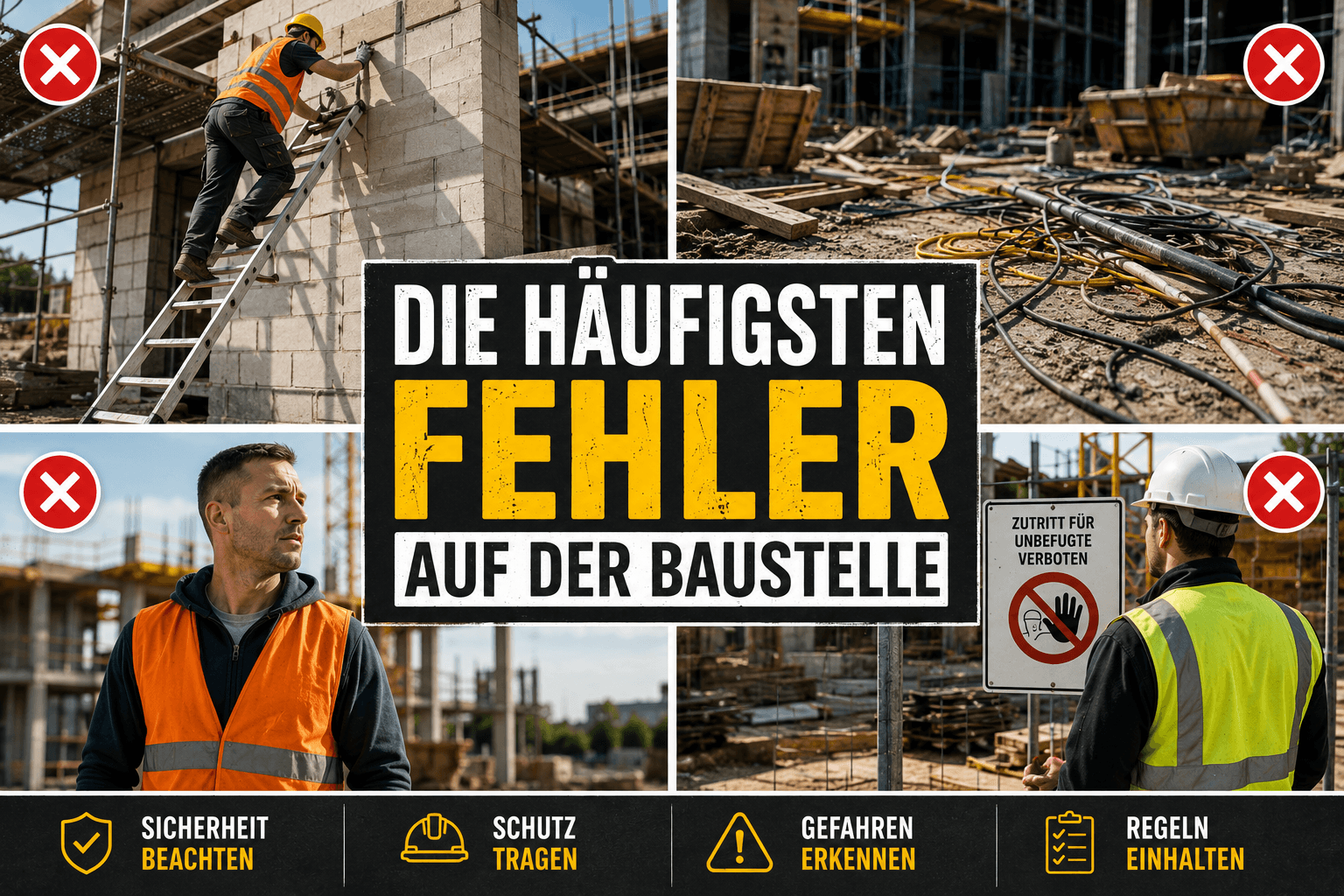
The Most Common Construction Site Mistakes in Germany (2026) — 15 Mistakes That Cause Accidents and How to Avoid Them
Working in construction in Germany is physically demanding, highly responsible, and often well paid. At the same time, the construction industry remains one of the most hazardous working environments, where thousands of workplace accidents occur every year.
The good news is that most accidents can be prevented. In many cases, accidents are not caused by complex technical failures but by everyday mistakes made due to rushing, inattention, or routine habits.
In this article, you'll learn:
- which construction site mistakes occur most frequently;
- why they are dangerous;
- how to prevent workplace accidents;
- which safety regulations in Germany are especially important;
- how to work more safely and professionally.
Why Do Most Workplace Accidents Happen?
Many people believe that accidents only happen to beginners. In reality, experienced workers often become overly confident and start ignoring important safety rules.
The most common causes include:
- rushing;
- fatigue;
- routine;
- ignoring safety regulations;
- lack of attention;
- underestimating risks.
The most dangerous moments are often when you think nothing can go wrong.
Construction Site Safety in Germany by the Numbers
Although workplace safety standards in Germany continue to improve, accidents still occur regularly.
- In 2024, more than 754,000 workplace accidents were recorded in Germany that resulted in more than three days of absence from work or ended in a fatality.
- More than 9,900 accidents were so severe that disability pensions or survivor benefits were granted.
- 345 people lost their lives in workplace accidents.
- Construction remains one of the industries with the highest accident rates in Germany.
These figures demonstrate why following safety regulations on construction sites is not a formality but a necessity.
Mistake #1 — Not Using Personal Protective Equipment (PPE)
One of the most common mistakes is working without proper personal protective equipment.
The most frequently neglected items are:
- safety helmets;
- safety shoes;
- safety glasses;
- work gloves;
- hearing protection.
Many workers think: “I'll just do this quickly.” Unfortunately, accidents often happen in exactly these situations.
Mistake #2 — Working at Heights Without Fall Protection
Falls from height are one of the leading causes of serious injuries in construction.
Particularly dangerous activities include:
- roofing work;
- scaffold assembly;
- facade work;
- ladder work;
- operating aerial work platforms.
Even a fall from a relatively low height can have severe consequences.
Mistake #3 — Improper Ladder Use
Ladders are among the most common sources of workplace accidents.
Typical mistakes include:
- using damaged ladders;
- incorrect ladder angles;
- placing ladders on unstable surfaces;
- standing on the top steps;
- overreaching sideways.
Mistake #4 — Poor Housekeeping on the Construction Site
Many accidents occur not because of machinery, but simply because someone trips or slips.
Common causes include:
- cables lying on the ground;
- tools left in walkways;
- leftover materials;
- construction debris;
- unstable walking surfaces.
A clean and organized construction site is one of the easiest ways to reduce risks.
Mistake #5 — Ignoring Hazard Zones
Construction sites contain areas with increased risk.
Examples include:
- crane operating zones;
- excavation areas;
- construction pits;
- heavy equipment traffic routes;
- lifting and loading areas.
Ignoring barriers and warning signs can result in serious accidents.
Mistake #6 — Incorrect Lifting Techniques
Back injuries are among the most common health issues in the construction industry.
Frequent mistakes include:
- lifting with a bent back;
- twisting while lifting;
- moving heavy objects alone.
The correct approach:
- bend your knees;
- keep your back straight;
- use lifting aids whenever possible.
Mistake #7 — Operating Equipment Without Training
Every tool and machine has specific safety requirements.
Dangerous behaviors include:
- using equipment without proper instruction;
- ignoring manufacturer guidelines;
- performing unauthorized repairs.
This applies to:
- angle grinders;
- drills;
- concrete saws;
- lifting platforms;
- construction machinery.
Mistake #8 — Ignoring Safety Signs
Safety signs are designed to prevent accidents.
They warn about:
- electrical hazards;
- fall hazards;
- moving heavy machinery;
- restricted access areas;
- suspended loads.
Ignoring these warnings often leads to dangerous situations.
Mistake #9 — Working While Fatigued
Fatigue reduces:
- reaction time;
- concentration;
- risk awareness.
This is particularly dangerous when:
- working at heights;
- operating machinery;
- transporting materials.
Mistake #10 — Working Under the Influence of Alcohol or Drugs
In Germany, such violations are taken very seriously.
Possible consequences include:
- dismissal from work;
- removal from the construction site;
- loss of insurance coverage;
- criminal liability in severe accident cases.
Mistake #11 — Underestimating Electrical Hazards
Electrical accidents can be fatal.
Particularly dangerous situations include:
- damaged cables;
- improvised electrical connections;
- wet work areas;
- faulty extension cords.
Equipment should always be inspected before use.
Mistake #12 — Improper Use of Scaffolding
Scaffolding must be used according to safety regulations.
Common mistakes include:
- removed guardrails;
- overloaded platforms;
- incomplete assembly;
- unauthorized modifications.
Mistake #13 — Failing to Report Near Miss Incidents
A Near Miss is an incident where an accident almost happened, but no one was injured.
Examples include:
- a tool falling;
- a near collision;
- a load almost slipping.
These incidents should always be reported. They help prevent future accidents.
Mistake #14 — Poor Communication on Site
Construction sites often involve multiple teams working simultaneously:
- construction workers;
- electricians;
- plumbers;
- equipment operators;
- subcontractors.
Without effective communication, the risk of accidents increases significantly.
Mistake #15 — Ignoring Safety Briefings and Instructions
Many workers view safety briefings as a mere formality. In reality, they often help prevent costly mistakes and serious injuries.
Experienced professionals regularly review safety procedures because construction environments change constantly.
Which Mistakes Cause the Most Serious Injuries?
| Mistake | Risk Level |
|---|---|
| Working at heights without fall protection | Very High |
| Operating equipment without training | Very High |
| Ignoring electrical hazards | Very High |
| Working without a safety helmet | High |
| Incorrect lifting techniques | Medium |
| Poor housekeeping on site | Medium |
The 10 Most Important Construction Site Safety Rules
- Always wear a safety helmet.
- Wear safety shoes.
- Never ignore safety signs.
- Do not use damaged equipment.
- Use fall protection when working at heights.
- Keep your workplace clean and organized.
- Report Near Miss incidents.
- Never perform tasks without proper training.
- Never work under the influence of alcohol or drugs.
- Safety is always more important than speed.
Frequently Asked Questions About Construction Site Safety in Germany
Is a Safety Helmet Mandatory on Construction Sites in Germany?
On most construction sites, wearing a safety helmet is mandatory. This is required by workplace safety regulations and company policies. Helmets protect workers from falling objects, collisions, and head injuries.
What Is a Near Miss?
A Near Miss is a situation where an accident almost happened, but nobody was injured.
For example:
- a tool falls next to a worker;
- a load almost slips from lifting equipment;
- machinery nearly collides with a person.
Such incidents should always be reported to management.
Can You Work Without Safety Shoes?
No. Safety shoes are one of the most important pieces of personal protective equipment in construction. They help prevent serious foot injuries.
Who Is Responsible for Construction Site Safety?
Both employers and employees share responsibility for workplace safety. Employers must provide a safe working environment and adequate training, while employees must follow safety rules and use protective equipment correctly.
What Are the Most Common Construction Accidents?
The most common accidents include:
- falls from height;
- slips, trips, and falls;
- injuries caused by falling objects;
- machinery-related accidents;
- electrical injuries;
- back injuries caused by lifting heavy loads.
Are You Ready to Work Safely on a Construction Site in Germany?
Test your knowledge on the Deutsch mit Spaß platform:
- Construction German vocabulary;
- Workplace safety terminology;
- First Aid (Erste Hilfe) knowledge;
- Forklift Licence (Staplerschein) preparation;
- Professional industry vocabulary;
- Tests, games, and exam simulations.
How Does Deutsch mit Spaß Help You Prepare for Construction Work?
Working in construction in Germany requires more than physical strength. It also requires knowledge of workplace safety, equipment, and professional communication in German.
Construction German Vocabulary
Learn:
- tool names;
- building material terminology;
- safety vocabulary;
- professional phrases;
- commonly used workplace expressions.
Staplerschein Preparation
Many construction sites use:
- forklifts;
- telehandlers;
- material handling equipment.
A Staplerschein certificate is therefore often a significant advantage in the German job market.
On Deutsch mit Spaß, you can:
- practice Staplerschein test questions;
- prepare for the exam;
- review safety regulations;
- test your knowledge in the Exam Center.
First Aid (Erste Hilfe) Knowledge
Construction is one of the industries with the highest accident risks. For this reason, First Aid knowledge is especially important.
On the platform, you can:
- learn First Aid theory;
- practice First Aid questions;
- review emergency procedures;
- prepare for a First Aid course in Germany.
Games and Knowledge Tests
Learning is not limited to reading articles. You can also use:
- Word Search;
- Match-Up;
- Wordle;
- Die Match;
- knowledge quizzes;
- exam simulations.
This helps you memorize German terminology and professional vocabulary faster.
DMS Learning Path for Construction Workers
- Learn construction-related German vocabulary.
- Read the article “Working in Construction in Germany (2026)”.
- Study the Construction Site Safety topic.
- Learn about the most common construction site mistakes.
- Review First Aid basics.
- Prepare for the Staplerschein exam.
- Regularly practice with tests and games.
Conclusion
Most construction site accidents are not random events. They are often caused by rushing, carelessness, or ignoring safety regulations.
The better you understand the risks, the safer you can work. Construction site safety is not an obstacle to productivity—it is an essential part of professional work.
That is why experienced construction professionals always follow safety rules, use protective equipment, and avoid unnecessary risks.
Related practice
Continue with the learning pages and games connected to this article.