

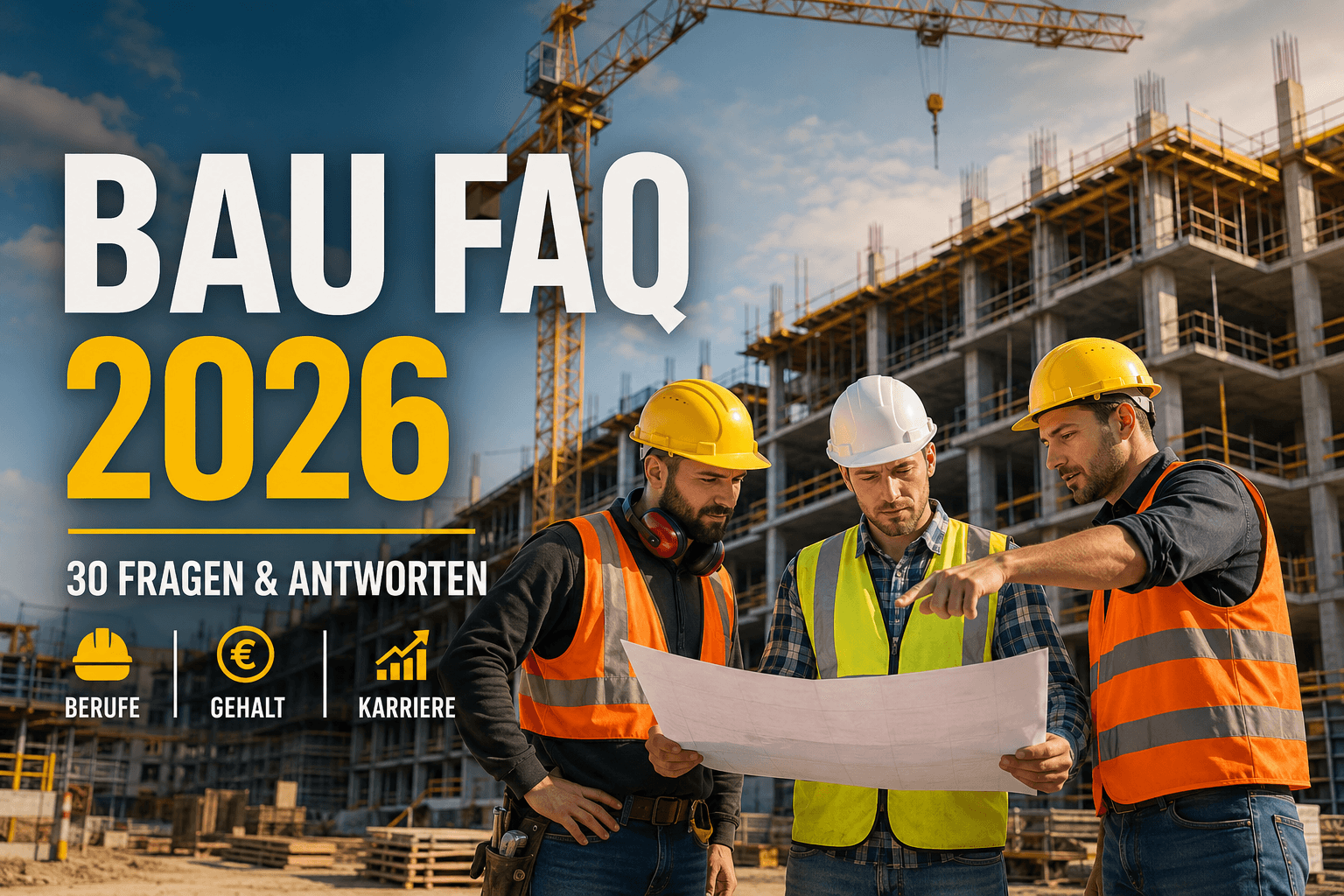
Construction FAQ (2026) — 30 Most Frequently Asked Questions About Working in Construction in Germany
Introduction
The construction industry is one of the largest and most important sectors of the German economy. Every year, thousands of people find employment in residential construction, industrial projects, road construction, infrastructure development, and various specialized construction trades.
The industry offers opportunities for both newcomers with no previous experience and qualified professionals. Many foreign workers begin their careers in Germany in construction because demand for skilled and unskilled labor remains high in many regions.
However, people who are considering a construction career often have many questions. How much can you earn? Do you need German language skills? Which professions are in demand? Is vocational training required? How do you find your first job? What are the working conditions and risks?
This FAQ article answers the 30 most frequently asked questions about working in the German construction industry in 2026.
1. What is the construction industry in Germany?
The German construction industry (Baugewerbe) covers a wide range of activities. It includes not only residential building projects but also industrial construction, road and bridge construction, underground infrastructure, renovation projects, building maintenance, and infrastructure development.
Construction plays a vital role in the German economy. The country regularly invests in new infrastructure projects, energy-efficiency programs, and residential housing development. As a result, demand for workers remains relatively stable in the long term.
For many people, construction offers an opportunity to earn a good income without a university degree, develop practical skills, and build a stable long-term career.
2. Is there a labor shortage in Germany's construction industry?
Yes.
The shortage of qualified workers is one of the biggest challenges facing the German construction sector.
Many experienced professionals are approaching retirement age, while the number of young people entering construction trades is not sufficient to replace them.
The most in-demand professions include:
- Bricklayers (Maurer);
- Concrete workers (Betonbauer);
- Roofers (Dachdecker);
- Carpenters and timber construction specialists (Zimmerer);
- Road construction workers (Straßenbauer);
- Electricians (Elektriker);
- Plumbing, heating and ventilation specialists (Anlagenmechaniker SHK);
- Construction machinery operators (Baumaschinenführer).
Because of this shortage, many employers actively recruit foreign workers.
3. Can you work in construction without experience?
Yes.
Construction is one of the industries where it is possible to start working without previous professional experience.
Many companies hire construction helpers (Bauhelfer). In this role, workers assist experienced specialists, transport materials, prepare work areas, maintain order on construction sites, and perform basic support tasks.
Over time, workers can learn new skills and gradually specialize in a trade. Many people who start as construction helpers eventually become qualified concrete workers, bricklayers, or scaffolders.
The most important qualities are willingness to learn, responsibility, and adherence to safety regulations.
4. Can you work without German language skills?
Partially, yes, but it is not an ideal solution.
Some international construction teams allow employees to work with minimal German skills, especially if coworkers speak the same native language or communicate through another common language.
However, German language skills significantly improve career opportunities. Safety instructions, work assignments, and communication on construction sites are often conducted in German.
Employees with stronger language skills are also more likely to receive promotions, become supervisors, or qualify for higher-skilled positions.
For this reason, learning German is one of the best long-term investments for anyone planning to work in Germany.
5. What level of German is needed on a construction site?
The answer depends on the position and responsibilities.
Construction helpers can often begin working with A1–A2 German language skills. At this level, workers mainly need to understand simple instructions, tools, and basic safety terminology.
Specialists who regularly communicate with customers, colleagues, or management often need at least a B1 level.
Positions such as:
- Foreman (Vorarbeiter);
- Site Supervisor (Polier);
- Construction Manager (Bauleiter).
usually require good German language skills because these roles involve managing teams, organizing work, and solving problems on site.
The better your German, the more career opportunities become available.
6. How much do construction workers earn in Germany?
Construction salaries depend on profession, experience, region, and employer.
Typical monthly gross salary ranges are:
| Experience | Gross Salary per Month |
|---|---|
| No experience | €2,500–€2,900 |
| Experienced worker | €2,900–€3,500 |
| Qualified specialist | €3,500–€4,500+ |
Some professions offer significantly higher earnings. Experienced electricians, construction machinery operators, site supervisors, and construction managers often earn more than €5,000 gross per month.
Actual salaries depend on the employer, workload, overtime, bonuses, and collective agreements.
7. Which construction professions earn the highest salaries?
The highest salaries are usually earned by specialists with advanced qualifications or significant responsibility.
Among the best-paid construction professions are:
- Electrician;
- Plumbing, Heating and Ventilation Specialist (SHK);
- Crane Operator;
- Site Supervisor (Polier);
- Construction Manager (Bauleiter);
- Project Manager.
These positions often require vocational training, several years of experience, or additional qualifications.
As in most industries, the highest salaries are usually reached after gaining substantial experience.
8. What is a Bauhelfer?
A Bauhelfer is a construction helper.
This role is often the first step for people who want to enter the construction industry but do not yet have professional qualifications or experience.
Typical duties include:
- Delivering materials to work areas;
- Assisting with concrete work;
- Preparing work zones;
- Helping with scaffold installation;
- Maintaining site cleanliness;
- Supporting skilled workers.
Although this position is often considered entry-level, it provides an excellent opportunity to learn about the industry and gain practical experience.
9. Does a Bauhelfer need vocational training (Ausbildung)?
Usually not.
Most construction helper positions do not require formal vocational education or professional qualifications.
However, this does not mean vocational training is unimportant.
Workers who later complete vocational training often benefit from:
- Higher salaries;
- Better career prospects;
- More advancement opportunities.
Many employees begin as construction helpers and later choose a specialization or vocational training program.
This career path is very common and often highly successful in Germany.
10. What is vocational training (Ausbildung) in construction?
Ausbildung is Germany's vocational education system, combining classroom learning with practical work experience at a company.
In construction, vocational training usually lasts between two and three years, depending on the profession.
During the training period, participants gain:
- Theoretical knowledge;
- Practical construction experience;
- A training salary.
Many employers prefer candidates who have completed vocational training because it demonstrates professional competence and job readiness.
Vocational training is considered one of the best ways to build a successful long-term career in Germany's construction industry.
11. Which construction apprenticeships (Ausbildung) are available in Germany?
Germany's construction industry offers a wide range of vocational training programs. These apprenticeships allow students to learn a specific trade while earning a nationally recognized qualification.
Some of the most popular construction apprenticeships include:
- Bricklayer (Maurer);
- Concrete Worker (Betonbauer);
- Road Construction Worker (Straßenbauer);
- Roofer (Dachdecker);
- Carpenter / Timber Construction Specialist (Zimmerer);
- Tiler (Fliesenleger);
- Civil Engineering Worker (Tiefbaufacharbeiter);
- Building Construction Worker (Hochbaufacharbeiter).
Each profession offers different responsibilities, work environments, and career opportunities. Many of these occupations have been in high demand for years, making it easier for qualified workers to find employment after graduation.
12. Do apprentices get paid during vocational training?
Yes.
One of the biggest advantages of Germany's vocational training system is that apprentices receive a salary while learning.
This means students work and study at the same time. The training salary usually increases each year. First-year apprentices earn less, while third-year apprentices typically receive significantly higher pay.
This system makes vocational training particularly attractive because apprentices gain:
- Professional qualifications;
- Real work experience;
- A monthly income.
After completing the apprenticeship, employment opportunities and earning potential generally improve significantly.
13. Can foreigners apply for construction apprenticeships?
Yes.
German companies increasingly recruit young workers from abroad, especially in industries facing labor shortages such as construction.
Typical requirements include:
- Completed secondary education;
- Motivation to learn;
- Sufficient German language skills;
- Legal right to live and work in Germany.
Many employers actively support foreign apprentices during integration and training.
For many international workers, vocational training is one of the safest and most reliable paths toward a long-term career in Germany.
14. Do foreign construction qualifications need recognition?
It depends on the profession and the qualification.
People who have already completed vocational training in another country may be able to have their qualifications officially recognized in Germany through a process known as Anerkennung (recognition).
Recognized qualifications can help workers:
- Find better-paying jobs;
- Apply for skilled positions;
- Officially prove their professional competence.
However, many construction employers also place great value on practical experience. As a result, it is often possible to find work even without formal qualification recognition.
15. What does "Baustelle" mean?
Baustelle is the German word for a construction site.
It is any location where construction work is taking place, whether it is a small home renovation project or a large infrastructure development involving hundreds of workers.
A typical construction site may include:
- Bricklayers;
- Concrete workers;
- Electricians;
- Plumbers;
- Scaffolders;
- Machinery operators.
Because many trades work together simultaneously, organization, communication, and safety are extremely important.
16. What are the biggest risks on a construction site?
Construction is one of the most physically demanding and potentially dangerous industries.
Common risks include:
- Falls from height;
- Falling objects;
- Construction vehicles and machinery;
- Electric shocks;
- Dust and hazardous substances;
- Slips and trips;
- Heavy lifting.
Most workplace accidents occur not during complex tasks but because of rushing, distraction, fatigue, or ignoring safety procedures.
This is why construction safety regulations are taken very seriously in Germany.
17. Is workplace safety mandatory?
Yes.
Following safety regulations is not optional. It is a legal requirement for both employers and employees.
Before starting work, employees usually receive safety training and instructions. Construction sites are regularly inspected to ensure that workers use personal protective equipment and follow safety procedures.
Workers who deliberately ignore safety rules may be removed from the construction site or even lose their jobs.
The purpose of safety regulations is to protect workers' health and lives.
18. What personal protective equipment (PPE) is required?
The required protective equipment depends on the specific job.
Commonly used equipment includes:
- Safety helmet;
- Safety footwear;
- Work gloves;
- Safety glasses;
- Hearing protection;
- High-visibility vest;
- Respiratory protection;
- Fall-protection harnesses.
In most cases, employers provide the necessary protective equipment.
Employees are responsible for using it correctly and consistently.
19. What is DGUV?
DGUV (Deutsche Gesetzliche Unfallversicherung) is Germany's statutory accident insurance organization.
Its responsibilities include:
- Developing workplace safety standards;
- Accident prevention;
- Educational materials and training;
- Occupational accident insurance;
- Safety consulting and guidance.
Many of the safety rules and procedures used on German construction sites are based on DGUV regulations and recommendations.
20. Are workplace accidents common in construction?
Compared to office work and many other industries, construction has a higher risk of workplace accidents.
However, this does not mean accidents happen every day.
Modern German construction sites use strict safety standards, regular training programs, and extensive protective equipment. As a result, many potentially dangerous situations are prevented before accidents occur.
Problems most commonly arise when:
- Safety rules are ignored;
- Protective equipment is not used;
- Workers rush to finish tasks;
- Employees are tired or distracted.
Experienced professionals often emphasize that construction safety is not merely a formality—it is one of the most important professional skills in the industry.
21. Do construction workers work during winter in Germany?
Yes.
Contrary to popular belief, Germany's construction industry does not completely shut down during the winter months.
Many projects continue throughout the year, especially:
- Interior construction work;
- Renovation projects;
- Industrial construction;
- Infrastructure projects;
- Installation of technical systems.
However, certain outdoor activities may be affected by frost, snow, or extremely low temperatures. In such cases, employers adjust work schedules or use specialized construction methods.
During winter, workers should pay particular attention to:
- Warm work clothing;
- Waterproof protection;
- Safety footwear;
- Regular breaks.
Many people are surprised to learn that construction workers can often maintain steady employment and income throughout the entire year.
22. Does construction stop when it rains?
It depends on the weather conditions and the type of work being performed.
Light rain is usually not a reason to stop construction work. Many tasks can continue even in unfavorable weather conditions.
However, work may be suspended when:
- There is a risk of falling;
- Heavy machinery cannot be operated safely;
- Work is being performed at height;
- Strong winds or thunderstorms occur.
In these situations, the site manager or supervisor decides whether work should be paused.
On German construction sites, safety always takes priority over deadlines.
23. Can construction workers work overtime?
Yes.
Overtime is common on many construction projects, especially:
- Large-scale projects;
- Final project phases;
- Peak construction seasons;
- Infrastructure developments.
However, overtime is regulated by labor laws, collective agreements, and employment contracts.
For some workers, overtime provides an opportunity to significantly increase earnings. Others prefer a predictable work schedule and better work-life balance.
Before starting a job, it is advisable to clarify:
- Whether overtime is expected;
- How working hours are recorded;
- How overtime is compensated.
24. Is overtime paid additionally?
In most cases, yes.
However, the exact conditions depend on:
- The employment contract;
- Collective bargaining agreements;
- Company policies.
Some employers pay higher hourly rates for overtime. Others provide additional time off instead of extra pay.
Workers should regularly monitor their recorded working hours and ensure that all overtime is properly documented.
If any questions arise, employees have the right to request clarification from their employer or human resources department.
25. How can you find a construction job in Germany?
Finding a construction job is often easier than many people expect.
The most common methods include:
- Online job portals;
- Recruitment agencies;
- Company websites;
- Social media platforms;
- Recommendations from friends and colleagues.
If you have no previous experience, it is often best to search for positions such as:
- Construction Helper (Bauhelfer);
- Construction Site Assistant (Baustellenhelfer);
- Scaffolding Helper (Gerüstbauhelfer);
- Drywall Construction Helper (Trockenbauhelfer).
These entry-level positions provide valuable experience and can open doors to future career growth.
A professional CV is extremely important. Applicants should include all previous work experience, even if it was gained outside Germany or outside the construction industry.
26. What documents are required to work in construction?
In most cases, the following documents are required:
- Passport or ID card;
- Registration certificate (Anmeldung);
- Tax Identification Number (Steuer-ID);
- Social Security Number;
- Bank account;
- Qualification certificates if applicable.
Depending on the position, employers may also request:
- Professional certificates;
- Training records;
- Qualification documents;
- Driver's license.
It is always advisable to confirm the exact requirements with the employer before starting work.
27. Are there career advancement opportunities in construction?
Yes.
Career growth is one of the main reasons many people choose the construction industry.
A typical career path may look like this:
- Construction Helper (Bauhelfer)
- Skilled Worker (Facharbeiter)
- Foreman (Vorarbeiter)
- Site Supervisor (Polier)
- Construction Manager (Bauleiter)
- Project Manager (Projektleiter)
Many successful professionals started without experience and gradually advanced into leadership positions.
Career development is greatly supported by:
- German language skills;
- Vocational qualifications;
- Work experience;
- Additional courses and certifications.
28. Can women work in construction?
Absolutely.
Although construction has traditionally been associated with men, more and more women are choosing careers in the construction industry.
Women work as:
- Architects;
- Civil Engineers;
- Project Managers;
- Electricians;
- Construction Technicians;
- Quality Control Specialists;
- Skilled Construction Workers.
Modern technology and machinery have reduced the importance of physical strength in many areas of construction.
Today, knowledge, skills, and professionalism are far more important than gender.
29. Is construction a good career choice?
For many people, yes.
The construction industry offers:
- Stable demand for workers;
- Strong career opportunities;
- Competitive salaries;
- Practical, hands-on work;
- Opportunities for professional development.
In addition, many construction careers provide excellent earning potential without requiring a university degree.
For people who enjoy seeing the tangible results of their work, construction can become a rewarding long-term career.
30. How can you prepare for a construction career in Germany?
To improve your chances of success, it is recommended to:
- Learn about construction professions;
- Study essential German construction vocabulary;
- Understand workplace safety fundamentals;
- Prepare a professional CV;
- Create a structured job search plan;
- Familiarize yourself with the German labor market.
Many people mistakenly believe that simply finding a vacancy is enough.
In reality, preparation often determines how quickly a person finds employment and how successfully they develop their career in the future.
The better prepared you are, the greater your chances of building a successful career in Germany's construction industry.
20 Most Important Construction Professions in Germany (2026)
Germany's construction industry includes dozens of professions. Some focus on building construction, while others specialize in infrastructure, road construction, engineering systems, or machinery operation.
Below are some of the most popular and in-demand construction professions in Germany.
| Profession | Description | Average Gross Salary |
|---|---|---|
| Construction Helper | Entry-level construction support worker | €2,500–€2,900 |
| Bricklayer | Builds walls and masonry structures | €3,000–€4,000 |
| Concrete Worker | Works with concrete structures | €3,000–€4,200 |
| Reinforced Concrete Specialist | Specialized concrete construction | €3,200–€4,300 |
| Road Construction Worker | Road and pavement construction | €3,000–€4,200 |
| Civil Engineering Worker | Infrastructure construction | €3,000–€4,200 |
| Building Construction Worker | Structural building construction | €3,000–€4,200 |
| Roofer | Roof installation and maintenance | €3,200–€4,500 |
| Carpenter / Timber Specialist | Timber construction and roof structures | €3,200–€4,500 |
| Scaffolder | Installs and dismantles scaffolding | €3,000–€4,300 |
| Tiler | Tile installation specialist | €3,000–€4,500 |
| Painter and Decorator | Interior and exterior finishing | €2,900–€4,000 |
| Drywall Specialist | Interior partition and ceiling systems | €3,000–€4,200 |
| Electrician | Electrical installation and maintenance | €3,500–€5,000 |
| Plumbing, Heating and Ventilation Specialist (SHK) | Building systems specialist | €3,500–€5,000 |
| Crane Operator | Operates construction cranes | €3,500–€5,200 |
| Excavator Operator | Operates excavators | €3,300–€4,800 |
| Construction Machinery Operator | Operates heavy equipment | €3,300–€4,800 |
| Site Supervisor (Polier) | Coordinates construction teams | €4,500–€6,000 |
| Construction Manager (Bauleiter) | Manages construction projects | €5,000–€8,000+ |
Detailed Overview of the Most Popular Construction Professions in Germany
Bricklayer (Maurer)
The bricklayer is one of the oldest and most respected professions in the construction industry. Bricklayers build walls, foundations, partitions, and structural elements for residential, commercial, and industrial buildings.
Typical daily tasks include:
- Laying bricks and blocks;
- Building foundations;
- Installing concrete components;
- Repairing damaged structures;
- Performing renovation work.
The profession requires precision, physical endurance, and teamwork. Because Germany continues to face a shortage of skilled tradespeople, qualified bricklayers are often able to find employment quickly.
Concrete Worker (Betonbauer)
Concrete workers specialize in building concrete and reinforced concrete structures.
Their responsibilities often include:
- Constructing formwork;
- Preparing reinforcement steel;
- Pouring and finishing concrete;
- Inspecting completed structures.
They play a critical role in projects such as residential buildings, commercial buildings, bridges, industrial facilities and infrastructure projects.
The quality of a concrete worker's job directly affects the durability and safety of the structure.
Roofer (Dachdecker)
Roofers build, repair, and maintain roofs.
Their work may include:
- Installing roofing materials;
- Roof insulation;
- Gutter installation;
- Roof repairs;
- Solar panel mounting systems.
Because roofers frequently work at height, safety awareness and physical fitness are essential.
Roofers remain among Germany's most sought-after construction specialists due to ongoing demand for both new construction and renovation projects.
Carpenter / Timber Construction Specialist (Zimmerer)
Timber construction specialists work primarily with wood structures.
Typical projects include:
- Roof frameworks;
- Timber-frame houses;
- Renovation projects;
- Restoration of historic buildings.
As sustainable and environmentally friendly construction becomes increasingly popular in Germany, demand for timber construction specialists continues to grow.
Road Construction Worker (Straßenbauer)
Road construction workers build and maintain roads, sidewalks, and transportation infrastructure.
Their responsibilities often include:
- Ground preparation;
- Paving work;
- Asphalt installation;
- Drainage systems;
- Road repairs.
These professionals are vital for Germany's transportation network and infrastructure development.
Scaffolder (Gerüstbauer)
Scaffolders install and dismantle scaffolding systems used in construction and maintenance projects.
The profession requires:
- Physical fitness;
- Precision;
- Responsibility;
- Strict adherence to safety rules.
Without scaffolding, many construction activities would be impossible or unsafe.
Tiler (Fliesenleger)
Tilers install ceramic, porcelain, and stone tiles in residential and commercial buildings.
Daily tasks include:
- Surface preparation;
- Tile cutting;
- Tile installation;
- Grouting;
- Repair work.
This profession requires attention to detail and a strong sense of accuracy. Skilled tilers often achieve very competitive earnings.
Electrician (Elektriker)
Electricians are among the most in-demand professionals in Germany's labor market.
Their work includes:
- Electrical installations;
- Wiring systems;
- Troubleshooting;
- Repairs;
- Security and automation systems.
The transition toward renewable energy, smart homes, and modern building technology continues to increase demand for electricians.
Plumbing, Heating and Ventilation Specialist (Anlagenmechaniker SHK)
This profession combines expertise in:
- Plumbing systems;
- Heating systems;
- Ventilation systems;
- Air conditioning technology;
- Heat pump installation.
Germany's focus on energy efficiency and sustainable building technology has made SHK specialists some of the most sought-after professionals in the country.
Crane Operator (Kranführer)
Crane operators are responsible for operating cranes on construction sites.
The role requires:
- Specialized training;
- High concentration;
- Precision;
- Strong responsibility.
Crane operators play a key role in moving heavy materials and structural components safely and efficiently.
Excavator Operator (Baggerfahrer)
Excavator operators perform:
- Earthmoving work;
- Trench excavation;
- Site preparation;
- Infrastructure groundwork;
- Land grading.
Modern construction projects depend heavily on skilled excavator operators.
Site Supervisor (Polier)
The site supervisor serves as a bridge between construction workers and project management.
Responsibilities include:
- Organizing daily work;
- Supervising teams;
- Monitoring quality standards;
- Coordinating schedules;
- Enforcing safety regulations.
This role requires substantial construction experience, leadership skills, and strong German language abilities.
Construction Manager (Bauleiter)
The construction manager is one of the most important figures on a construction project.
Responsibilities include:
- Project planning;
- Budget management;
- Schedule control;
- Quality assurance;
- Workplace safety;
- Communication with clients and authorities.
Construction managers typically have several years of industry experience and often possess advanced vocational or academic qualifications.
While the level of responsibility is high, construction managers are also among the highest-paid professionals in the construction industry.
How to Find Your First Construction Job in Germany
Many people believe that finding work in Germany is difficult. In reality, the construction sector often offers more opportunities than many other industries.
If you have no experience, it is usually best to begin with positions such as:
- Construction Helper (Bauhelfer);
- Construction Site Assistant (Baustellenhelfer);
- Scaffolding Helper (Gerüstbauhelfer);
- Drywall Helper (Trockenbauhelfer).
These entry-level roles provide valuable experience and a pathway into the industry.
A strong CV is essential. Include all previous work experience, even if it was gained outside Germany or outside construction. Employers often value experience in logistics, manufacturing, technical trades, and manual labor.
Before interviews, employers typically want to know:
- Whether you are motivated;
- Whether you understand construction work;
- Whether you are physically fit;
- Whether you will follow safety procedures.
Even basic German language skills can significantly improve your chances of finding employment.
10 Essential German Construction Words
| German | English |
|---|---|
| Baustelle | Construction Site |
| Helm | Helmet |
| Sicherheitsschuhe | Safety Shoes |
| Warnweste | High-Visibility Vest |
| Gerüst | Scaffolding |
| Beton | Concrete |
| Mauer | Wall / Masonry |
| Kran | Crane |
| Bagger | Excavator |
| Werkzeug | Tool |
The more construction vocabulary you learn, the easier it becomes to:
- Understand instructions;
- Communicate with coworkers;
- Avoid mistakes;
- Improve qualifications;
- Apply for better-paying jobs.
5 Common Mistakes When Looking for Construction Work in Germany
1. Underestimating the Importance of German
Many workers believe German language skills are unnecessary.
In reality, even basic German helps workers:
- Understand supervisors;
- Follow safety instructions;
- Avoid misunderstandings;
- Integrate more quickly.
Language skills often become a key factor in career advancement.
2. Ignoring Safety Rules
Some new workers treat safety equipment as a formality. This is a serious mistake.
Experienced professionals always take safety equipment seriously:
- Helmets;
- Safety shoes;
- Protective eyewear;
- Safety instructions.
Workplace safety protects health, careers, and lives.
3. Accepting the First Job Offer Immediately
Accepting the first available position without comparing alternatives may lead to:
- Lower pay;
- Poorer working conditions;
- Limited career opportunities.
It is usually worthwhile to compare multiple offers before making a decision.
4. Not Improving Qualifications
The construction industry offers numerous opportunities for growth.
Workers who continuously learn and develop new skills often gain:
- Higher salaries;
- Better positions;
- More responsibility;
- Stronger job security.
5. Failing to Plan a Long-Term Career
Many workers remain in entry-level positions for years.
A more successful path often looks like:
- Construction Helper
- Skilled Worker
- Foreman
- Site Supervisor
- Construction Manager
Long-term planning frequently leads to significantly better career outcomes.
Conclusion
The construction industry remains one of the most important and stable sectors of the German labor market in 2026.
It offers opportunities for:
- Beginners without experience;
- Skilled tradespeople;
- International workers;
- Career changers.
Success in the industry is usually determined by five key factors:
- Willingness to learn;
- Commitment to safety;
- Continuous skill development;
- German language proficiency;
- Long-term career planning.
The more knowledge, experience, and language skills you acquire, the greater your opportunities will be within Germany's construction industry.
Related practice
Continue with the learning pages and games connected to this article.