

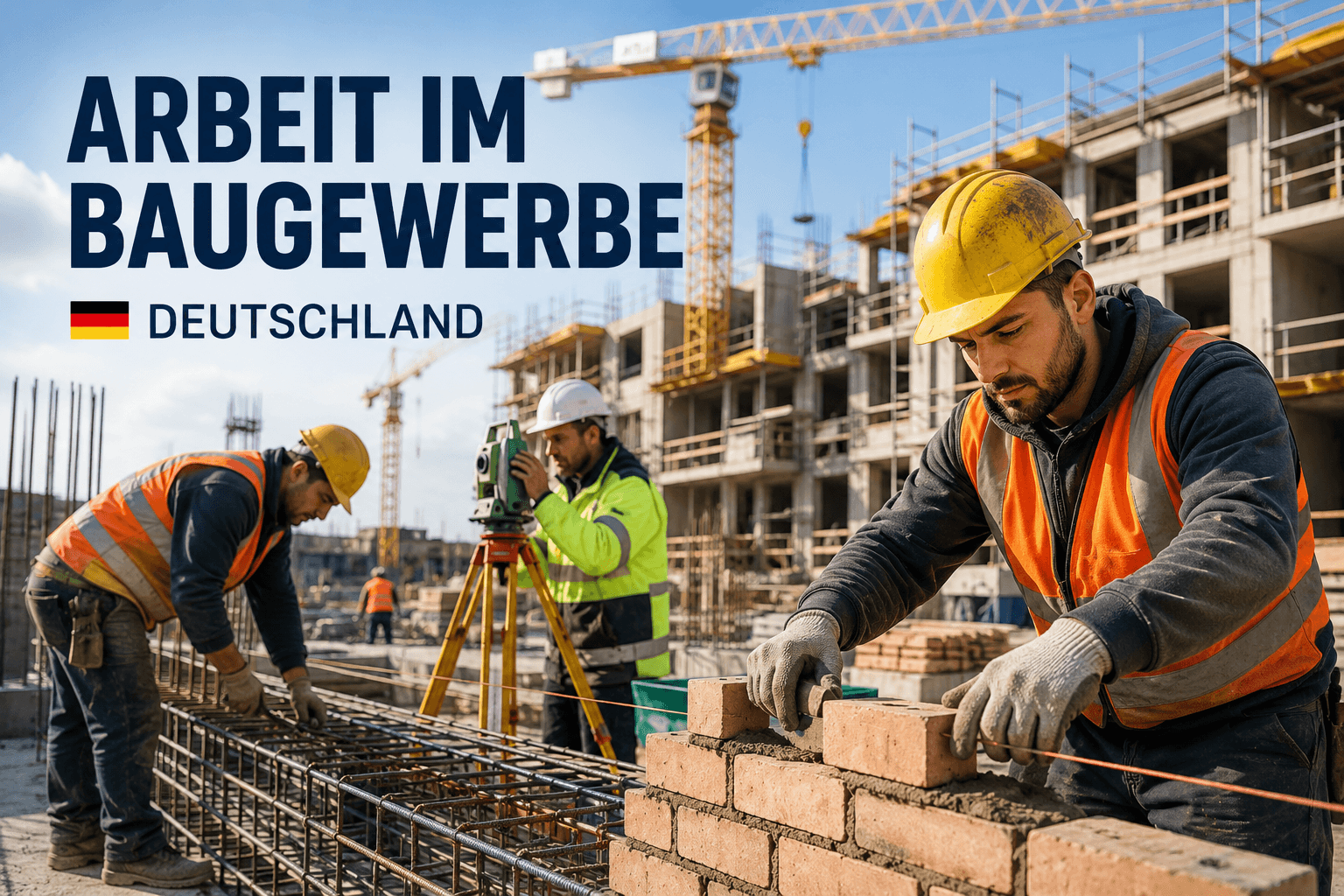
Construction Jobs in Germany (2026) — Professions, Salary, Working Conditions, Requirements and Career Opportunities
Construction is one of the largest and most important industries in Germany. Every year, thousands of people find employment on construction sites, residential building projects, industrial facilities, road construction projects, and infrastructure developments.
The industry offers opportunities for both people without previous experience and qualified professionals. Many foreign workers start their careers in Germany in the construction sector because the demand for workers remains high in many regions.
In this article, you will learn:
- what construction work in Germany involves;
- which professions are commonly found on construction sites;
- how much you can earn;
- which skills are required;
- what the working conditions are like;
- which risks should be considered;
- what career opportunities are available in the construction industry.
What Is Construction Work?
Construction includes a wide range of activities related to the construction, renovation, repair, and maintenance of buildings, roads, bridges, industrial facilities, and infrastructure.
Depending on the project, workers may be involved in:
- residential construction;
- apartment renovations;
- office building construction;
- industrial projects;
- road construction;
- bridge and tunnel projects;
- utility and infrastructure installation.
The construction industry plays a vital role in creating and maintaining the infrastructure needed for everyday life and economic growth.
Why Is the Construction Industry Important in Germany?
Germany has one of the largest economies in Europe, and the demand for housing, industrial facilities, and infrastructure projects remains strong.
Many regions face a shortage of skilled workers, which means employers regularly seek new specialists and construction laborers.
As a result, construction is often one of the industries where people who have recently arrived in Germany can find employment opportunities.
Which Professions Are Found in Construction?
Construction is not a single profession. It is a broad industry with many specialized occupations.
Most Popular Construction Professions
| Profession | Main Responsibilities |
|---|---|
| Construction Helper (Bauhelfer) | General support work on construction sites |
| Bricklayer (Maurer) | Masonry and wall construction |
| Concrete Worker (Betonbauer) | Building concrete structures |
| Drywall Installer (Trockenbauer) | Interior construction and drywall installation |
| Roofer (Dachdecker) | Roof construction and repair |
| Scaffolder (Gerüstbauer) | Assembly of scaffolding systems |
| Road Construction Worker (Straßenbauer) | Road construction and maintenance |
| Civil Engineering Worker (Tiefbauer) | Underground infrastructure and utility work |
| Tile Setter (Fliesenleger) | Tile installation |
| Painter and Decorator (Maler) | Painting and finishing work |
| Electrician (Elektriker) | Electrical installations |
| Plumbing and Heating Installer (Sanitärinstallateur) | Water, heating, and sanitation systems |
What Does a Construction Helper (Bauhelfer) Do?
A Construction Helper (Bauhelfer) is often the first position people take when entering the construction industry.
Typical duties include:
- transporting materials;
- preparing work areas;
- collecting construction waste;
- preparing tools and equipment;
- assisting skilled workers.
Many employers offer opportunities to learn the trade on the job and gradually take on greater responsibilities.
What Does a Typical Day on a Construction Site Look Like?
The workday usually starts early in the morning.
Typical Working Schedule
| Time | Activity |
|---|---|
| 07:00 | Start of work |
| 09:00 | Break |
| 09:15 | Continue working |
| 12:00 | Lunch break |
| 12:30 | Continue working |
| 16:00–17:00 | End of workday |
Working hours may vary depending on the company, season, and project.
How Much Do Construction Workers Earn in Germany?
Salary depends on several factors:
- experience;
- qualifications;
- region;
- employer;
- specialization.
Estimated Gross Monthly Salaries
| Experience | Monthly Salary |
|---|---|
| No Experience | €2,400–€2,700 |
| Experienced Worker | €2,700–€3,200 |
| Qualified Specialist | €3,200–€4,000+ |
Specialized professions can earn significantly higher salaries.
Which Skills Are Required?
Several skills are important for a successful career in construction.
Physical Fitness
The job often involves:
- working outdoors;
- various weather conditions;
- standing for long periods;
- lifting and moving materials.
Technical Understanding
It is beneficial to know how to work with:
- tools;
- measuring equipment;
- construction drawings and blueprints;
- building materials.
Responsibility
Following safety regulations is one of the most important requirements on a construction site.
Is German Language Knowledge Required?
German language skills significantly improve employment opportunities.
| Level | Opportunities |
|---|---|
| No German | Limited opportunities |
| A1 | Basic jobs |
| A2 | More employment options |
| B1 | Stable career opportunities |
| B2 and above | Skilled and supervisory positions |
Even basic German skills help workers understand safety instructions and communicate more effectively with colleagues.
Why Is German Important in Construction?
Many misunderstandings and workplace accidents occur not only because of a lack of experience but also because workers do not fully understand job instructions, safety requirements, or directions from colleagues.
Even basic German language skills help you:
- understand work assignments;
- communicate with coworkers;
- follow safety regulations;
- avoid mistakes;
- improve career opportunities.
The Deutsch mit Spaß platform offers German language topics that help learners acquire professional vocabulary and communication skills needed for work in Germany.
Most Common Risks on Construction Sites
Construction is one of the industries where safety plays a critical role.
Common risks include:
- falls from heights;
- handling heavy objects;
- electrical hazards;
- working with machinery;
- using tools and equipment;
- exposure to dust and noise.
Occupational Safety in Construction
Personal protective equipment (PPE) is mandatory on most construction sites.
This may include:
- safety helmet;
- safety boots;
- protective goggles;
- work gloves;
- hearing protection;
- high-visibility clothing.
Following safety regulations helps reduce the risk of workplace accidents.
Career Opportunities in Construction
The construction industry offers various career development paths.
A typical career progression might look like this:
Construction Helper (Bauhelfer) → Skilled Worker → Foreman (Vorarbeiter) → Site Foreman (Polier) → Construction Manager (Bauleiter)
Experience, qualifications, and German language skills often play a major role in career advancement.
Vocational Training (Ausbildung) in Construction
Germany offers many vocational training programs in the construction sector.
Popular Ausbildung programs include:
- Bricklayer (Maurer)
- Concrete Worker (Betonbauer)
- Road Construction Worker (Straßenbauer)
- Roofer (Dachdecker)
- Tile Setter (Fliesenleger)
- Electronics Technician (Elektroniker)
- HVAC Technician (Anlagenmechaniker SHK)
Vocational qualifications often lead to higher salaries and more stable long-term careers.
Advantages and Disadvantages
Advantages
- high demand for workers;
- stable employment opportunities;
- good career growth potential;
- possibility to learn the profession on the job;
- competitive salaries.
Disadvantages
- physically demanding work;
- exposure to various weather conditions;
- increased safety risks;
- high level of responsibility.
Next Steps for Working in Construction in Germany
If you plan to work in construction or already work in Germany, professional skills alone are not enough. German language skills, safety knowledge, and an understanding of the German work environment can be equally important.
On the Deutsch mit Spaß platform, you can:
- ✅ learn professional construction terminology;
- ✅ practice with interactive tests;
- ✅ use Word Search, Match-Up, Wordle, and Die Match learning games;
- ✅ collect points and track your progress;
- ✅ study at your own pace.
Related Topics
Construction workers often benefit from learning about:
- First Aid (Erste Hilfe);
- Forklift License (Staplerschein);
- Warehouse Work (Lager);
- Hygiene;
- German for Work in Germany.
How Can Deutsch mit Spaß Help?
If you plan to work in construction in Germany, professional experience is important, but German language skills are equally valuable.
On Deutsch mit Spaß, you can:
- learn construction-related terminology;
- improve your professional vocabulary;
- use educational games;
- collect points and monitor your progress;
- explore additional topics related to working and living in Germany.
In addition to construction-related content, the platform also offers other learning worlds:
- Erste Hilfe (First Aid);
- Lager (Warehouse Work);
- Staplerschein (Forklift License);
- Hygiene;
- Einbürgerung (German Citizenship Test).
Conclusion
Construction jobs in Germany offer excellent opportunities for both beginners and experienced professionals. The industry continues to seek new workers, and many occupations provide stable career prospects and competitive salaries.
The right skills, German language knowledge, and adherence to safety regulations can be key factors in building a successful career in Germany’s construction industry.
Related practice
Continue with the learning pages and games connected to this article.