

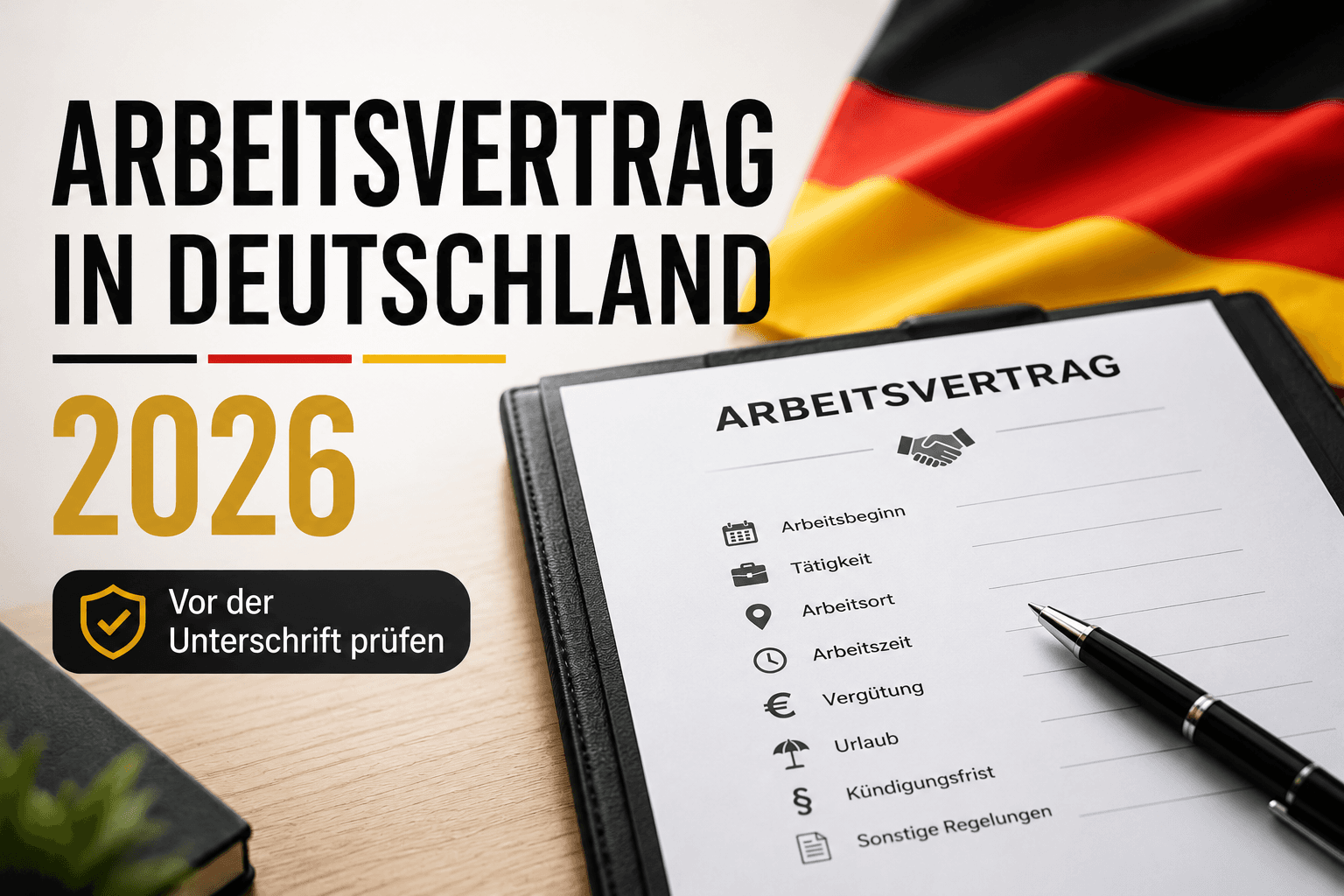
Employment Contract in Germany 2026: What to Check Before Signing, Probezeit, Salary, Working Hours and Kündigungsfrist
An employment contract (Arbeitsvertrag) is one of the most important documents when starting a job in Germany. It determines not only your salary, but also your working hours, duties, place of work, probation period, annual leave, notice period and other important employment conditions.
For someone starting work in Germany for the first time, an employment contract can seem complicated. It contains many legal and administrative terms, and sometimes even people with good German language skills may not fully understand what a particular clause will mean in practice.
That is why you should never simply sign an employment contract without reading it carefully.
Before signing, read the contract from beginning to end and make sure you understand the most important terms and conditions.
In this article, we will explain:
- what is usually included in an employment contract in Germany;
- what you should check before signing an Arbeitsvertrag;
- what Probezeit means;
- how the Kündigungsfrist works;
- what to look for in the sections covering salary and working hours;
- which documents your employer may require;
- and what all of this can look like in a real employment contract.
1. What Is an Arbeitsvertrag?
An Arbeitsvertrag is an employment contract between an employer (Arbeitgeber) and an employee (Arbeitnehmer).
It defines the rights and obligations of both parties.
An employment contract or the documentation of employment conditions will typically include information such as:
- the employer;
- the employee;
- the starting date of employment;
- the place of work;
- job title and duties;
- working hours;
- salary or other remuneration;
- bonuses, allowances and other components of remuneration;
- probation period;
- annual leave;
- termination and notice conditions;
- information about an applicable Tarifvertrag if a collective agreement applies to the employment relationship.
Germany's Nachweisgesetz requires employers to document the essential terms and conditions of employment.
This is important because an employment contract is not merely a formality.
It is a document that can later be used to determine what the employee and employer actually agreed upon.
2. Employment Contract in Germany – My Personal Experience
When I started working in Germany in 2022, I also had to go through the entire process — from finding a job to signing my employment contract.
That was when I realised that an Arbeitsvertrag contains many clauses that may initially seem unimportant.
For example:
- How long is the probation period?
- What is the notice period?
- Is the salary stated per month or per hour?
- How are overtime hours paid or compensated?
- How many days of annual leave am I entitled to?
- Does the contract refer to a Tarifvertrag?
- At which locations can the employer require me to work?
When you have only recently arrived in Germany, one thing often seems more important than anything else:
getting a job.
That makes it very easy to sign the contract quickly and think:
The main thing is that I have a job. I'll figure out the rest later.
But this is exactly the point when it is worth slowing down and reading the contract carefully.
Some clauses in your employment contract may turn out to be far more important several months or years later than they appeared on the day you signed it.
3. What Should You Check Before Signing an Employment Contract in Germany?
Before signing your Arbeitsvertrag, check at least the following points.
Employment Start Date – Arbeitsbeginn
The contract should clearly state the date on which your employment begins.
For example:
Beginn des Arbeitsverhältnisses: 01.09.2026
As a rule, the rights and obligations associated with the employment relationship also begin from this date.
Job Position and Duties – Tätigkeit
Check carefully which position and duties are stated in the employment contract.
The more broadly your responsibilities are described, the more important it is to understand what work your employer will actually expect you to perform.
If you were promised one type of work during the job interview but the contract states something substantially different, clarify this before signing the contract.
Place of Work – Arbeitsort
Check whether the contract specifies one particular place of work or allows the employer to assign you to different company locations.
This can be particularly important if the company has several branches, warehouses, construction sites or production facilities.
4. Salary – Gehalt or Stundenlohn
One of the most important parts of an employment contract is your pay or remuneration.
In Germany, you will commonly encounter two basic arrangements.
Monatsgehalt – Monthly Salary
A fixed gross monthly salary is agreed.
For example:
€3,200 gross per month
or, as it may appear in a German contract:
3.200 € brutto monatlich
This means that your contractual monthly gross salary is €3,200.
Stundenlohn – Hourly Wage
Your pay is determined by the number of paid working hours.
For example:
€16.50 gross per hour
or:
16,50 € brutto pro Stunde
In this case, your monthly income may vary depending on the number of paid hours and the specific terms of your employment contract.
5. Brutto Is Not the Same as Netto
This distinction is particularly important for people who are starting work in Germany for the first time.
If your employment contract states:
€3,200 brutto
this does not mean that €3,200 will arrive in your bank account.
Taxes and social security contributions are calculated and deducted from your gross salary depending on your individual circumstances.
The amount you ultimately receive is your Netto — your net salary after the relevant deductions have been calculated.
Therefore, when comparing jobs or employment contracts in Germany, do not confuse:
Bruttogehalt → gross salary before taxes and social security contributions
Nettogehalt → net salary after the relevant deductions.
6. Working Hours – Arbeitszeit
Check your employment contract to see how many hours per week you are required to work.
For example:
40 Stunden pro Woche
or:
40 hours per week
But the number of weekly hours alone does not tell you everything.
It is also important to find out:
- how shifts are organised;
- whether night work is required;
- whether you are expected to work on Saturdays or Sundays;
- how overtime is recorded;
- how overtime is compensated;
- whether there is an Arbeitszeitkonto — a working-time account.
Working hours in Germany are regulated not only by the employment contract but also by the Arbeitszeitgesetz and, where applicable, other regulations or a collective agreement.
7. Overtime – Überstunden
This is one section I would recommend reading particularly carefully.
Look for terms such as:
- Überstunden
- Mehrarbeit
- Arbeitszeitkonto
- mit dem Gehalt abgegolten
The important question is:
What happens if you work more hours than your employment contract requires?
Depending on the applicable conditions, overtime may:
- be paid;
- be compensated with time off;
- be credited to a working-time account;
- or be subject to specific provisions in your employment contract or Tarifvertrag.
It is not enough to know only your monthly salary.
You also need to understand how many working hours that salary covers and what happens to any additional hours you work.
8. What Is Probezeit?
Probezeit means a probationary period or probation period.
It gives both the employee and the employer an opportunity to determine whether the employment relationship is suitable for both sides.
For example, an employment contract may state:
Die ersten sechs Monate gelten als Probezeit.
This means:
The first six months are considered the probation period.
However, it is very important not to confuse two different concepts:
Probezeit and Kündigungsschutz.
They are not the same thing.
9. How Long Can Probezeit Last in Germany?
Many German employment contracts provide for a probation period of up to six months.
If a probation period has been agreed, § 622(3) of the German Civil Code (BGB) provides for a statutory notice period of two weeks during the agreed probation period, for a maximum of the first six months.
However, the employment contract may provide for a longer notice period, while an applicable Tarifvertrag may, under certain circumstances, contain different rules.
This does not mean that every employment contract in Germany automatically contains exactly the same two-week notice period during Probezeit.
Always read your own employment contract and check whether a Tarifvertrag applies to your employment relationship.
10. A Real Example: My Employment Contract Was Different
This is where my own experience shows why you should not automatically apply a general rule you have read online to your individual employment contract.
During my probation period, my employment contract provided for a notice period of:
one month to the end of the month.
This should not be understood as the general standard in Germany.
It was a specific condition in my own employment contract.
And this is a good example of why every employment contract should be read individually.
Online, you may read:
Probezeit = 2-week Kündigungsfrist.
But your own employment contract may provide for a longer notice period.
So the right question is not only:
“What is the notice period in Germany?”
It is also:
“What does my employment contract say, and does a Tarifvertrag apply to me?”
11. What Is Kündigungsfrist?
Kündigungsfrist means the notice period.
It determines how much time generally passes between giving ordinary notice of termination and the actual end of the employment relationship.
Under § 622 of the German Civil Code (BGB), the basic statutory notice period is:
four weeks to the 15th or to the end of a calendar month.
For termination by the employer, the statutory notice period may become longer depending on how long the employment relationship has existed.
For example, after two years of employment, the statutory notice period for termination by the employer is one month to the end of a calendar month. As the length of employment increases, the statutory notice period gradually becomes longer.
However, you should always check:
- your employment contract;
- the applicable law;
- any applicable Tarifvertrag.
You should therefore not assume that every employee in Germany has exactly the same Kündigungsfrist.
12. Kündigung Must Be in Writing
If an employment relationship is terminated by Kündigung, the required form of the notice is also important.
The German Federal Ministry of Labour and Social Affairs (BMAS) explains that a Kündigung must be made in writing.
This is an important practical point.
If a dispute arises about the termination of your employment, you should not rely solely on a verbal conversation.
13. Very Important: The 3-Week Deadline After a Kündigung
This is a rule worth knowing before you ever experience a problem at work.
If your employer gives you a written Kündigung and you believe the termination is invalid or you want a court to review its validity, a Kündigungsschutzklage — an action for protection against dismissal — generally has to be filed within three weeks after receiving the written notice of termination.
Missing this deadline can have serious consequences.
Therefore:
Received a Kündigung → do not postpone checking the situation until later.
Three weeks can pass very quickly.
14. Annual Leave – Urlaub
Your employment contract should also state your annual leave entitlement.
Look for terms such as:
- Urlaub
- Urlaubsanspruch
- Arbeitstage
Pay particular attention to whether your annual leave is stated in Arbeitstage, meaning working days, and how many days per week you actually work.
Do not look only at the number.
It is important to understand what that number means for your particular working schedule.
15. Tarifvertrag – A Clause You Should Not Ignore
Some employment contracts contain a reference to a Tarifvertrag.
This can be very important.
A Tarifvertrag may regulate matters such as:
- salary;
- working hours;
- allowances and additional payments;
- overtime;
- annual leave;
- Kündigungsfrist;
- other employment conditions.
Therefore, if you see terms such as:
Tarifvertrag
or
tarifliche Bestimmungen
in your employment contract, find out which Tarifvertrag applies and what it actually provides for.
In certain circumstances, provisions of a collective agreement may also be binding on a wider group of employers and employees.
16. What Information and Documents Are Usually Required When Starting a Job?
Once you have found a job, your employer will need certain information in order to register you correctly and process your salary.
Depending on your situation, this may include:
- personal details;
- your address;
- bank account details;
- Steuer-ID;
- Sozialversicherungsnummer;
- information about your Krankenkasse;
- work permit or residence documents if they are required in your particular case;
- for certain professions, qualifications, certificates or other supporting documents.
This is where you begin to see how the different parts of the German system are connected.
You find a job, but your employment contract is not an isolated document.
It is connected to the German tax system, health insurance, social security, your bank account and other administrative processes.
17. Steuer-ID, Sozialversicherungsnummer and Krankenkasse Are Not the Same Thing
People who have recently arrived in Germany often confuse these terms.
Steuer-ID
Your tax identification number.
It is used for tax administration in Germany.
Sozialversicherungsnummer
A number connected to the German social security system.
Krankenkasse
Your health insurance fund.
These are three different concepts, even though all three may become relevant at almost the same time when you start working in Germany.
DMS has separate detailed guides for each of these topics, so there is no need to explain the entire system again in an article about employment contracts.
18. What Should You Do If You Do Not Understand Something in Your Employment Contract?
Do not sign a clause you do not understand simply because you do not want to ask questions.
It is your employment contract.
If something is unclear:
- Ask your employer or HR department.
- Find out exactly what the particular term or clause means.
- Compare the written contract with what was agreed during the job interview.
- If necessary, seek professional advice.
The BMAS also recommends reading the employment contract carefully and asking questions if something is unclear or does not correspond to what was discussed verbally.
Pay particular attention to clauses concerning:
Gehalt, Arbeitszeit, Überstunden, Probezeit, Kündigungsfrist, Arbeitsort and Tätigkeit.
19. Important German Terms in an Employment Contract
Even if you already understand everyday German quite well, an employment contract may contain legal and administrative terms that are rarely used in normal conversation.
Here are some of the most important terms:
| German | English |
|---|---|
| Arbeitsvertrag | employment contract |
| Arbeitgeber | employer |
| Arbeitnehmer | employee |
| Arbeitsbeginn | start of employment |
| Arbeitsort | place of work |
| Tätigkeit | job duties / position |
| Arbeitszeit | working hours |
| Vergütung | remuneration / pay |
| Bruttogehalt | gross salary |
| Probezeit | probation period |
| Überstunden | overtime |
| Urlaub | annual leave / vacation |
| Kündigung | notice of termination |
| Kündigungsfrist | notice period |
| Tarifvertrag | collective agreement |
| befristet | fixed-term |
| unbefristet | permanent / open-ended |
It is worth learning these terms before signing an employment contract in Germany.
20. Befristet or Unbefristet?
Another very important point is the duration of your employment contract.
Unbefristeter Arbeitsvertrag
An open-ended or permanent employment contract.
The contract does not have a predetermined end date.
Befristeter Arbeitsvertrag
A fixed-term employment contract.
For example:
01.09.2026–31.08.2027
In this case, check particularly carefully:
- when the contract ends;
- which conditions apply to its termination;
- whether the contract provides for the possibility of an extension;
- which other rules apply to this particular type of employment relationship.
Germany's Nachweisgesetz specifically provides that, for fixed-term employment relationships, the documentation must state the end date or the foreseeable duration of the employment relationship.
21. Verbal Promises vs. What Is Actually Written in the Contract
Many things may be discussed during a job interview:
- salary;
- additional payments;
- working hours;
- shifts;
- home office;
- place of work;
- bonuses;
- a salary increase after the probation period.
But before signing, check:
Are the important agreements actually reflected in the documents you receive?
For example, you may be told during the interview:
“Your salary will increase after the Probezeit.”
But if there is nothing about this in the documents, it is worth clarifying the matter before signing the employment contract.
The same applies to any other promises that are important to you.
22. Quick Checklist Before Signing an Arbeitsvertrag
Before signing your employment contract, check:
- ☐ Are my name and personal details correct?
- ☐ Who exactly is my employer?
- ☐ When does the employment relationship begin?
- ☐ Is the contract befristet or unbefristet?
- ☐ What is my job title or position?
- ☐ What are my duties?
- ☐ Where is my place of work?
- ☐ How many hours per week do I have to work?
- ☐ What is my gross salary or hourly wage?
- ☐ When is my salary paid?
- ☐ How are overtime hours recorded and compensated?
- ☐ Is there a Probezeit?
- ☐ How long does the Probezeit last?
- ☐ What Kündigungsfrist applies?
- ☐ How many days of annual leave am I entitled to?
- ☐ Is shift work required?
- ☐ Does the employment contract refer to a Tarifvertrag?
- ☐ Does the written contract match what the employer promised during the job interview?
If you cannot answer one of these questions, check the employment contract again before signing it.
23. Common Mistakes When Signing an Employment Contract in Germany
1. Looking Only at the Salary
A high gross salary does not tell you everything about the actual employment conditions.
Working hours, overtime, annual leave, additional payments, place of work and the notice period can be just as important.
2. Not Checking the Working Hours
40 hours per week and 40 hours with regular additional shifts can be very different situations in practice.
It is therefore important to understand not only the number of hours stated in your Arbeitsvertrag, but also how your working time will actually be organised.
3. Ignoring the Overtime Clause
This is one of the clauses that may become particularly important later.
Check how Überstunden are recorded, whether they are paid or compensated with time off, and whether an Arbeitszeitkonto is used.
4. Confusing Brutto with Netto
Job offers and employment contracts in Germany usually refer to gross pay (Brutto).
This is not the same amount that will ultimately arrive in your bank account.
5. Not Checking the Kündigungsfrist
Many people only read this clause carefully when they are already planning to change jobs or resign.
It is much better to know your Kündigungsfrist before signing the employment contract.
6. Assuming That Probezeit Rules Are Identical for Everyone
The specific wording of your employment contract and any applicable Tarifvertrag can be important.
Do not rely only on general information about probation periods in Germany.
7. Relying Only on Verbal Promises
Important employment conditions should be checked in the documents you actually receive.
If your employer made an important promise during the job interview, clarify before signing how that agreement is reflected in the relevant documents.
24. How Does an Employment Contract Fit into Starting Your Life and Work in Germany?
If you have recently arrived in Germany, a typical path may look something like this:
Register your address – Anmeldung
↓
Receive your Steuer-ID
↓
Open a bank account
↓
Arrange your Krankenkasse
↓
Find a job
↓
Sign an Arbeitsvertrag
↓
Sozialversicherung
↓
Lohnabrechnung
In practice, some of these steps may take place in a different order or happen at the same time.
This is exactly why the DMS section about living and working in Germany is being developed as a system of interconnected guides rather than a collection of separate, unrelated articles.
This approach helps you understand step by step how documents, identification numbers, insurance, taxes and employment processes in Germany are connected.
25. Frequently Asked Questions About Employment Contracts in Germany
What Is an Arbeitsvertrag?
An Arbeitsvertrag is an employment contract between an employee and an employer that defines the terms and conditions of the employment relationship.
It may cover working hours, salary, duties, place of work, annual leave, Probezeit, Kündigungsfrist and other employment conditions.
What Is Probezeit?
Probezeit is an agreed probation period at the beginning of an employment relationship.
It gives both the employee and employer an opportunity to determine whether the employment relationship is suitable for both sides.
How Long Is the Probezeit in Germany?
Many employment contracts provide for a probation period of up to six months.
You should always check your own employment contract to determine exactly how long your Probezeit lasts.
What Is the Kündigungsfrist During Probezeit?
If a Probezeit has been agreed, § 622(3) BGB provides for a two-week notice period during the agreed probation period, for a maximum of the first six months.
However, the employment contract may provide for a longer notice period, while an applicable Tarifvertrag may contain different rules.
You should therefore always check which provisions actually apply to your employment relationship.
Is the Salary in an Employment Contract Brutto or Netto?
You should check the exact wording of your contract. However, remuneration in German employment contracts is generally stated as a gross amount (Brutto).
Look for terms such as:
- Bruttogehalt
- Monatsgehalt
- Stundenlohn
- Vergütung
What Is a Tarifvertrag?
A Tarifvertrag is a collective agreement that may regulate salary, working hours, additional payments, overtime, annual leave, notice periods and other employment conditions.
If your Arbeitsvertrag refers to a Tarifvertrag, find out which collective agreement applies and what rules it contains.
What Should I Do If I Do Not Understand My German Employment Contract?
Do not sign a clause if you do not understand what it means.
Ask your employer or HR department to explain it. If necessary, particularly when dealing with important or complex legal provisions, seek professional advice.
Pay particular attention to:
Gehalt, Arbeitszeit, Überstunden, Probezeit, Kündigungsfrist, Urlaub, Arbeitsort and Tätigkeit.
How Long Do I Have to Challenge a Kündigung?
If you want a court to review the validity of a dismissal by your employer, a Kündigungsschutzklage generally has to be filed within three weeks after you receive the written Kündigung.
This deadline should be taken very seriously.
26. Conclusion: Check Your Employment Contract in Germany Carefully Before Signing
An employment contract in Germany is not a document you should quickly sign and then put away in a drawer.
It determines very practical and important aspects of your working life:
how much you earn, how many hours you work, where you work, what your duties are, how much annual leave you receive and under what conditions your employment relationship can be terminated.
My own experience working in Germany taught me one simple principle:
Do not assume that your employment contract says exactly what you heard during the job interview or read online. Read your own contract.
Pay particular attention to:
Gehalt → Arbeitszeit → Überstunden → Probezeit → Urlaub → Kündigungsfrist → Tarifvertrag
If you understand these points, you can already avoid many of the misunderstandings people may encounter when starting work in Germany.
And if you come across unfamiliar German terms in your employment contract, DMS can help you continue learning practical German and understanding the information you need for work and everyday life in Germany, step by step.
Related practice
Continue with the learning pages and games connected to this article.