

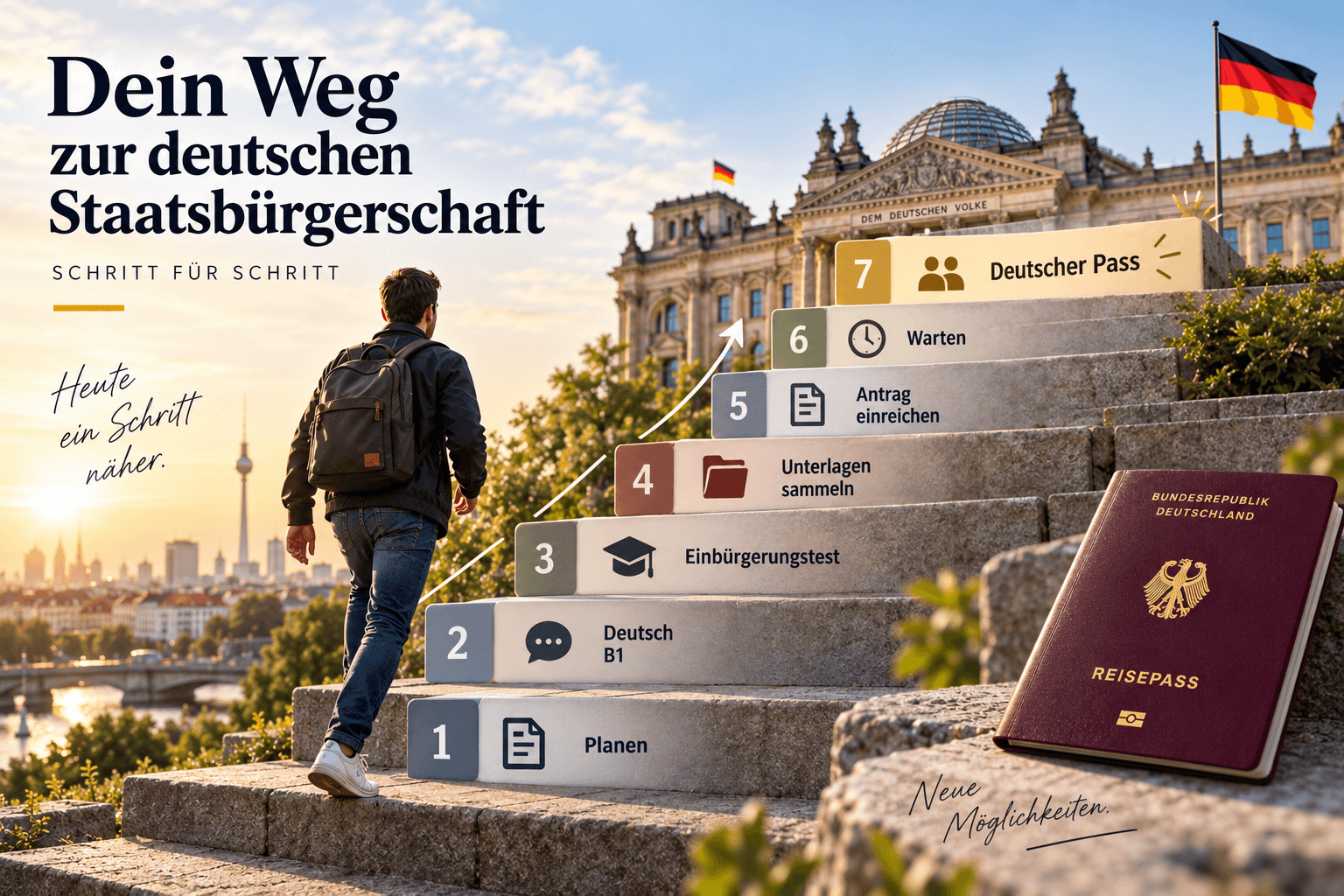
German Citizenship for EU Citizens in 2026: How to Get a German Passport Step by Step
If you are a citizen of Latvia or another EU country and live in Germany, you can generally apply for German citizenship after at least 5 years of lawful habitual residence in Germany. In addition, you will usually need German language skills at least at B1 level, knowledge of Germany’s legal and social system — often proven by passing the Einbürgerungstest — and you must meet the other naturalisation requirements. If you have already lived in Germany for 4 years, now is a good time to prepare your B1 proof, take the Einbürgerungstest, find your responsible Staatsangehörigkeitsbehörde and start collecting the required documents.
For example:
I am an EU citizen and have lived in Germany for 4 years. I work here, I am registered and I want to continue living in Germany. When can I apply for German citizenship? What do I need to do? And when can I actually get a German passport?
In this guide, we will go through the entire process step by step — from the first preparations to the Einbürgerungsantrag, the Einbürgerungsurkunde, and finally the German Personalausweis and Reisepass.
German Citizenship for EU Citizens in 2026 — Key Facts at a Glance
| Question | Answer |
|---|---|
| After how many years can I apply for German citizenship? | Generally after at least 5 years |
| Are 4 years in Germany enough? | Generally not yet |
| From which date are the 5 years counted? | From the beginning of lawful habitual residence — not automatically only from the Anmeldung date |
| Do I need B1 German? | Generally yes |
| Do I need the Einbürgerungstest? | Usually yes, unless the required knowledge is proven in another recognised way |
| How many questions are in the Einbürgerungstest? | 33 |
| How many correct answers do I need? | At least 17 |
| What happens if I fail the Einbürgerungstest? | You can take the test again |
| Where do I submit the Einbürgerungsantrag? | To the local Staatsangehörigkeitsbehörde |
| How much does naturalisation cost? | Usually €255 per person |
| Do I receive a German passport immediately after naturalisation? | No. First you become a German citizen and receive the Einbürgerungsurkunde. After that, you can apply for a Personalausweis and Reisepass |
Section 10 of the German Nationality Act, Staatsangehörigkeitsgesetz (StAG), provides that standard entitlement-based naturalisation generally requires at least 5 years of lawful habitual residence in Germany, together with the other statutory requirements.
I Have Lived in Germany for 4 Years — Can I Apply for German Citizenship Yet?
In the standard case, after four years you have not yet reached the required five-year residence period.
However, that does not mean you should simply wait for another year.
Your fourth year in Germany is a good time to:
- check whether you meet the naturalisation requirements;
- determine the exact starting date of your five-year residence period;
- check your B1 language proof;
- prepare for and take the Einbürgerungstest;
- identify your responsible Staatsangehörigkeitsbehörde;
- check its current document requirements;
- start collecting the necessary documents.
The goal is simple:
Once the required 5 years have been reached and the other conditions are fulfilled, most of the preparation should already be complete.
From Which Date Are the 5 Years for German Citizenship Counted?
This is one of the most important practical questions.
Are the five years counted from:
your Anmeldung? Your rental contract? Your employment contract? Your first day at work? Your plane or bus ticket?
The answer is not quite that simple.
Section 10 StAG uses the wording:
„seit fünf Jahren rechtmäßig seinen gewöhnlichen Aufenthalt im Inland“
The decisive concept is therefore rechtmäßiger gewöhnlicher Aufenthalt — lawful habitual residence in Germany.
Are the 5 Years Counted from the Anmeldung Date?
Anmeldung is a very important and clear form of evidence that you were living in Germany. However, the law does not state that the five-year period always begins automatically on the exact date of your Anmeldung.
What matters is when your actual and lawful habitual residence in Germany began.
For example:
Actual move to Germany: 01.05.2022
Anmeldung: 01.09.2022
There are four months between these dates.
If the person was already actually and lawfully living in Germany from May and Germany had become their habitual place of residence, the earlier period may also be relevant.
However, it may need to be proven.
Is a Rental Contract Enough?
A rental agreement can be useful evidence, but it does not automatically determine when habitual residence began.
For example, someone may sign a rental contract before actually moving to Germany.
That is why the overall set of evidence matters.
Is the Employment Contract Date the Start of the 5 Years?
Not automatically.
An employment contract for work in Germany can be an important piece of evidence.
However:
Working in Germany and having your habitual residence in Germany are not legally the same thing.
For naturalisation, the relevant factor is lawful habitual residence.
Does a Plane or Bus Ticket Prove the Start of Residence?
A ticket may show when you entered Germany.
But on its own, it does not prove that Germany became your habitual place of residence on that same day.
A person can also enter Germany for a holiday, business trip or temporary work assignment.
A ticket is therefore usually only supporting evidence.
Working in Germany Through a Latvian, Polish or Other EU Agency — Does This Time Count?
This is a common situation for EU workers.
For example:
An EU citizen comes to Germany to work through a foreign staffing or employment agency.
The employer is not a German company.
The employment contract was signed in Latvia, Poland, Lithuania or another EU country.
The payslips are not German.
The agency provides and pays for accommodation in Germany.
The person works every day at a German company.
Anmeldung is completed only several months later.
Does the period before Anmeldung automatically disappear from the required five years?
Not necessarily.
The key question is whether, during this period, the person’s lawful and actual habitual residence was already in Germany.
The fact that the employer is a foreign company or that payslips were issued in another EU country does not by itself answer that question.
How Can I Prove That I Lived in Germany Before Anmeldung?
If you need to prove an earlier period, a combination of documents may be useful:
- employment contract showing work in Germany;
- confirmation from the agency or employer that accommodation was provided in Germany;
- secondment or Entsendung documents;
- A1 certificate, if one was issued;
- payslips, even if issued in another EU country;
- work schedules or Einsatzort documents;
- confirmation from the German company that you actually worked there;
- bank and card payments made in Germany;
- health insurance documents;
- records of doctor visits;
- correspondence concerning accommodation provided in Germany;
- other documents that together show your actual life and habitual residence in Germany.
Depending on the individual case, the Staatsangehörigkeitsbehörde may ask for additional evidence.
Example: I Worked and Lived in Germany Before Anmeldung
Let us assume:
01.05.2022 — you arrive in Germany.
01.05.2022 — you start working at a German factory through a Latvian agency.
01.05.2022 — you begin living in an apartment in Germany paid for by the agency.
01.09.2022 — you complete your first Anmeldung.
If you can prove that your lawful and actual habitual residence was already in Germany from 1 May, it should not automatically be assumed that only 1 September can be legally relevant.
However, the final assessment of the specific period is made by the responsible Staatsangehörigkeitsbehörde.
Is It Worth Proving a Few Months Before Anmeldung?
Not always.
It is important to distinguish between what may be legally possible and what may be the most practical option.
If there are only a few months between your actual move and the clearly documented period starting with Anmeldung, and there is no urgent need to apply for citizenship as early as possible, it may be easier in practice to wait until you have five full years that can be clearly proven.
For example:
Actual move: 01.05.2022
Anmeldung: 01.09.2022
5 years from actual move: 01.05.2027
5 years from Anmeldung: 01.09.2027
In theory, you may try to prove the period from May to September.
However, this may require additional documents and explanations concerning:
- the foreign employer;
- your accommodation;
- the secondment;
- your actual presence in Germany;
- the legal basis of your residence.
This can result in additional questions during the processing of your Einbürgerungsantrag.
Practical Advice
If the earlier date is genuinely important, prepare the evidence and ask the Staatsangehörigkeitsbehörde to consider the period before Anmeldung as well.
If the difference is only a few months and there is no urgency, it may often be more practical to wait until you have five full years that are easy to prove and then submit the clearest and most complete application possible.
The processing of a naturalisation application can take 18 months or longer, and the authority may request additional evidence during the procedure.
For that reason, gaining a few months at the beginning of the application process is not always worthwhile if proving those months later makes the case more complicated.
Important: This does not mean that Anmeldung legally always determines the start of the five-year period. It is a practical approach for cases in which proving a few earlier months does not provide a significant benefit.
When Can a Period of Residence in Germany Be Interrupted?
Longer periods spent outside Germany can also affect the calculation of the required residence period.
Section 12b StAG regulates how stays abroad affect habitual residence. For EU citizens, the rules under the Freizügigkeitsgesetz/EU may also be relevant.
If you spent longer periods living outside Germany during those five years, you should not automatically calculate the required period only according to the calendar.
Such cases should be checked with the responsible Staatsangehörigkeitsbehörde.
What Are the Main Requirements for German Citizenship in 2026?
Five years of residence alone are not enough for standard entitlement-based naturalisation.
Generally, you must:
- have had lawful habitual residence in Germany for at least 5 years;
- prove your identity and current citizenship;
- have a residence status or right of residence that is sufficient for naturalisation;
- meet the statutory requirements regarding financial self-sufficiency;
- prove German language skills at least at B1 level;
- prove knowledge of Germany’s legal and social system and living conditions;
- declare your commitment to Germany’s free democratic constitutional order and make the declarations required by law;
- meet the remaining legal requirements and have no grounds excluding naturalisation.
Do EU Citizens Need an Aufenthaltstitel for German Citizenship?
The situation of EU citizens is different from that of many third-country nationals.
EU citizens benefit from EU freedom of movement rights in Germany.
During the naturalisation process, the authorities assess whether the person has a right of residence that satisfies the requirements for naturalisation.
A Latvian or other EU citizen therefore normally does not need an Aufenthaltstitel in the same form as a third-country national.
However, the legal basis of residence still remains relevant during the Einbürgerung process.
Do I Need B1 German for German Citizenship?
In the standard case — yes.
Section 10 StAG requires sufficient German language skills, and B1 is the standard level used for this requirement.
However, B1 does not always have to be proven with one specific language certificate.
Depending on your situation, German school certificates, education completed in Germany in German, or other recognised evidence may also be accepted.
Before registering for a new B1 exam, check whether you may already have valid proof.
Einbürgerungstest — What Do I Need to Know?
To obtain German citizenship, you must also prove knowledge of Germany’s legal and social system and living conditions.
The standard way to do this is the Einbürgerungstest.
The test consists of:
- 33 questions;
- four answer options for each question;
- only one correct answer;
- 60 minutes to complete the test.
For naturalisation, you need at least:
17 correct answers out of 33.
The fee for taking the Einbürgerungstest is €25.
Can I Take the Einbürgerungstest Before I Have Lived in Germany for 5 Years?
Yes.
The five-year residence requirement does not mean that you have to wait until your fifth anniversary before preparing for naturalisation.
In practice, it makes sense to complete the Einbürgerungstest during the preparation period.
If you have lived in Germany for four years, you can use the coming months for:
learning → practice simulations → official Einbürgerungstest → preparation of the remaining documents.
What Happens If I Fail the Einbürgerungstest?
This is a common concern.
Failing the Einbürgerungstest does not mean that you permanently lose your chance of obtaining German citizenship.
If you do not achieve the required 17 correct answers, you have simply not obtained the required proof of knowledge in that attempt.
You can then:
analyse your mistakes → continue studying → register again → retake the Einbürgerungstest.
For example:
1st attempt: 15/33 → failed
↓
review difficult topics
↓
complete full practice simulations
↓
2nd attempt: 25/33 → passed
One unsuccessful attempt by itself is not a permanent obstacle to naturalisation.
What Should I Do During My Fourth Year in Germany?
If you have lived in Germany for about four years, create a clear preparation plan.
-
1. Check Your Residence Period
Determine from which date you can clearly prove your lawful habitual residence in Germany.
If there is a period before Anmeldung, consider whether proving it is actually important for you.
-
2. Find Your Staatsangehörigkeitsbehörde
The Einbürgerungsantrag is submitted to your local Staatsangehörigkeitsbehörde, not to BAMF.
You can find out which authority is responsible through your Stadtverwaltung or Kreisverwaltung.
Some authorities also allow applications to be submitted digitally.
-
3. Check Your B1 Proof
Check whether you already have a recognised B1 certificate or another accepted proof of German language skills.
If not, arrange it in good time.
-
4. Take the Einbürgerungstest
Do not unnecessarily leave the test until the end of the naturalisation process.
Prepare early and try to pass it before submitting your application.
-
5. Start Collecting Documents
Check the specific requirements of your Staatsangehörigkeitsbehörde and begin preparing the required documents.
Which Documents May Be Required for Einbürgerung?
The exact set of documents depends on your personal circumstances and the responsible authority.
In general, evidence may be required for:
- identity;
- current citizenship;
- marital status;
- residence in Germany;
- right of residence;
- employment and income;
- financial self-sufficiency;
- German language skills;
- knowledge about Germany.
Depending on your situation, documents relating to employment, pension insurance, education, marriage, children or other matters may also be required.
Documents issued abroad may need an appropriate translation.
Always check the current document list of your Staatsangehörigkeitsbehörde before submitting your application.
How Much Does German Naturalisation Cost?
Naturalisation usually costs:
€255 per person.
For a minor child without their own income who is naturalised together with their parents, the fee is usually:
€51.
Additional costs may arise for the Einbürgerungstest, language certificates, identity documents, translations and other required evidence.
What Happens After Submitting the Einbürgerungsantrag?
In simplified form, the process looks like this:
Einbürgerungsantrag
↓
review of the application and documents
↓
additional documents requested if necessary
↓
other required checks and declarations
↓
decision
↓
Einbürgerungsurkunde
↓
German Personalausweis / Reisepass
How Long Does an Einbürgerungsantrag Take?
You should be prepared for a longer process.
According to federal information, you should expect:
18 months of processing time or longer.
The actual duration depends on the Bundesland, the responsible Staatsangehörigkeitsbehörde, the complexity of the case and whether the application is complete.
The authority may request additional documents during the procedure.
A useful principle is:
Do not focus only on applying as early as possible — also make sure your application is as complete and easy to review as possible.
When Do I Actually Become a German Citizen?
The German passport itself is not the naturalisation decision.
After successful completion of the naturalisation procedure, you receive your:
Einbürgerungsurkunde.
Once the Einbürgerungsurkunde is formally issued to you, you become a German citizen.
You can then apply for a German:
Personalausweis
and/or
Reisepass.
So, in simplified form:
5 years → Einbürgerungsantrag → review → Einbürgerungsurkunde → German passport.
Can I Keep My Current Citizenship?
Under German law, multiple citizenship is generally permitted.
Germany no longer generally requires people to give up their previous citizenship when naturalising.
However, you should also check the law of your current country of citizenship.
That country may have its own rules concerning the acquisition of another nationality.
Therefore, always check both:
What does Germany allow?
and
What does my current country of citizenship allow?
Practical Example: EU Citizen Living in Germany Since 2022
Let us assume:
Arrival in Germany: 2022
Current year: 2026
Residence: approximately 4 years
Goal: German citizenship
Now
Check your residence history.
Determine from which date you can clearly prove rechtmäßiger gewöhnlicher Aufenthalt.
Check your B1 proof.
Prepare for the Einbürgerungstest.
Find your Staatsangehörigkeitsbehörde.
Start collecting documents.
Before Reaching 5 Years
Take the Einbürgerungstest.
Prepare any missing documents.
Check your authority’s current requirements.
If there are a few difficult-to-prove months before Anmeldung, consider whether you actually need to rely on them.
Once the Required 5 Years Have Been Reached
Check that you still meet the other naturalisation requirements.
Submit the most complete Einbürgerungsantrag possible.
Keep copies of all documents submitted and all correspondence with the authority.
At the End of the Process
Receive your Einbürgerungsurkunde.
Then apply for your German Personalausweis and Reisepass.
German Citizenship Checklist for EU Citizens
Before submitting your Einbürgerungsantrag, check:
- Have I completed the required 5 years in Germany?
- Can I clearly prove this period?
- Was my residence lawful throughout this time?
- Can I prove my identity and current citizenship?
- Do I have a right of residence that qualifies for naturalisation?
- Do I have B1 or another recognised language certificate?
- Have I passed the Einbürgerungstest or do I have another accepted proof of knowledge?
- Do I meet the requirements regarding financial self-sufficiency?
- Do I know which Staatsangehörigkeitsbehörde is responsible for me?
- Have I checked its current document requirements?
- Is my application as complete as possible?
- Have I kept copies of all submitted documents?
Frequently Asked Questions About German Citizenship
After How Many Years Can an EU Citizen Apply for German Citizenship?
For standard entitlement-based naturalisation, one of the central requirements is at least 5 years of lawful habitual residence in Germany.
I Have Lived in Germany for 4 Years. What Should I Do Now?
Use this time to check when your five-year period began, prepare your B1 proof, take the Einbürgerungstest, identify your Staatsangehörigkeitsbehörde and collect the necessary documents.
Are the 5 Years Counted from Anmeldung?
Not necessarily.
The law refers to rechtmäßiger gewöhnlicher Aufenthalt, not simply the Anmeldung date.
However, Anmeldung is one of the clearest and most practically important forms of evidence of residence.
I Lived and Worked in Germany Before Anmeldung. Can This Time Count?
It may be possible if you can prove that your lawful habitual residence was already actually in Germany during that period.
The Staatsangehörigkeitsbehörde assesses the specific facts of the case.
I Work Through a Latvian or Polish Agency. Is a Foreign Employment Contract a Problem?
A foreign employment contract does not by itself determine where your habitual residence was.
What matters is the overall combination of facts and evidence.
Is It Worth Proving 3–4 Months Before Anmeldung?
If those months are important, you can prepare evidence and ask the authority to consider them.
If there is no urgency, it may be more practical to wait until you have five years that are easy to prove and avoid unnecessary additional explanations.
Do I Need B1 for German Citizenship?
In the standard case, yes.
Section 10 StAG uses B1-level German as the standard requirement, although other recognised forms of proof or statutory exceptions may apply in some situations.
How Many Questions Are in the Einbürgerungstest?
There are 33 questions, and you have 60 minutes to complete the test.
How Many Correct Answers Do I Need in the Einbürgerungstest?
For naturalisation, you need at least 17 correct answers out of 33.
What Happens If I Fail the Einbürgerungstest?
It does not mean that you lose your chance of becoming a German citizen.
You can take the test again.
How Much Does the Einbürgerungstest Cost?
€25.
How Much Does Einbürgerung Cost?
Usually €255 per person.
For a minor child without their own income who is naturalised together with their parents, the fee is usually €51.
Where Do I Submit the Einbürgerungsantrag?
To your local Staatsangehörigkeitsbehörde.
You can find the responsible authority through your Stadtverwaltung or Kreisverwaltung.
How Long Does an Einbürgerungsantrag Take?
Federal information advises applicants to expect 18 months or longer.
The actual processing time depends on the authority and the individual case.
Do I Automatically Receive German Citizenship After 5 Years?
No.
Five years of residence is only one of the requirements.
You must also meet the other conditions and submit an Einbürgerungsantrag.
When Can I Get a German Passport?
After successful naturalisation and receiving your Einbürgerungsurkunde, you can apply for a German Reisepass and Personalausweis.
While You Wait for the 5-Year Period — Prepare for the Einbürgerungstest with DMS
If you still have several months before reaching the required five-year residence period, you can use that time productively.
With Deutsch mit Spaß, you can:
- practise Einbürgerungstest questions;
- select your Bundesland;
- use different question modes;
- complete a full 33-question simulation;
- repeat questions you answered incorrectly;
- track your progress.
The goal is simple:
By the time you are ready to submit your Einbürgerungsantrag, you have already passed the Einbürgerungstest.
Continue with DMS Einbürgerung Guides
Einbürgerungstest — Complete Guide, Questions, Tips and Preparation (2026)
A full explanation of the test procedure and preparation.
Einbürgerungstest — Common Mistakes and How to Pass on the First Attempt
Practical tips for avoiding the most common mistakes.
Einbürgerungstest: 30-Day Study Plan (2026)
A step-by-step preparation plan for the test.
Einbürgerungstest FAQ (2026)
Answers to common questions about the test, results and retakes.
Einbürgerung Processing Time 2026: How Long Does It Take and What Can You Do If the Authority Does Not Reply?
What happens after you apply — Bearbeitungszeit, Sachstandsanfrage and long processing times.
German Citizenship for EU Citizens — The Most Important Points
If you are an EU citizen, one of the main requirements for German citizenship in the standard case is at least 5 years of lawful habitual residence in Germany. The start of this five-year period is not necessarily determined automatically only by the date of your first Anmeldung, although Anmeldung is one of the clearest forms of evidence of residence. If you were already actually and lawfully living in Germany before Anmeldung, it may be possible, depending on the circumstances, to prove this earlier period with other documents. However, if only a few months are involved and there is no particular urgency, it may often be more practical to wait until you have five full and clearly provable years and then submit the clearest possible application.
If you have already lived in Germany for 4 years, use the coming months to prepare your B1 proof, Einbürgerungstest and documents. If you do not pass the Einbürgerungstest on your first attempt, this does not mean you lose your chance of obtaining German citizenship — the test can be repeated. After successfully completing the Einbürgerung process, you receive your Einbürgerungsurkunde and can then apply for a German Personalausweis and Reisepass.
This article provides general information about the German naturalisation process in 2026 and does not replace individual legal advice. In your specific case, check the calculation of your residence period, required documents and naturalisation conditions with your responsible Staatsangehörigkeitsbehörde.
Related practice
Continue with the learning pages and games connected to this article.