

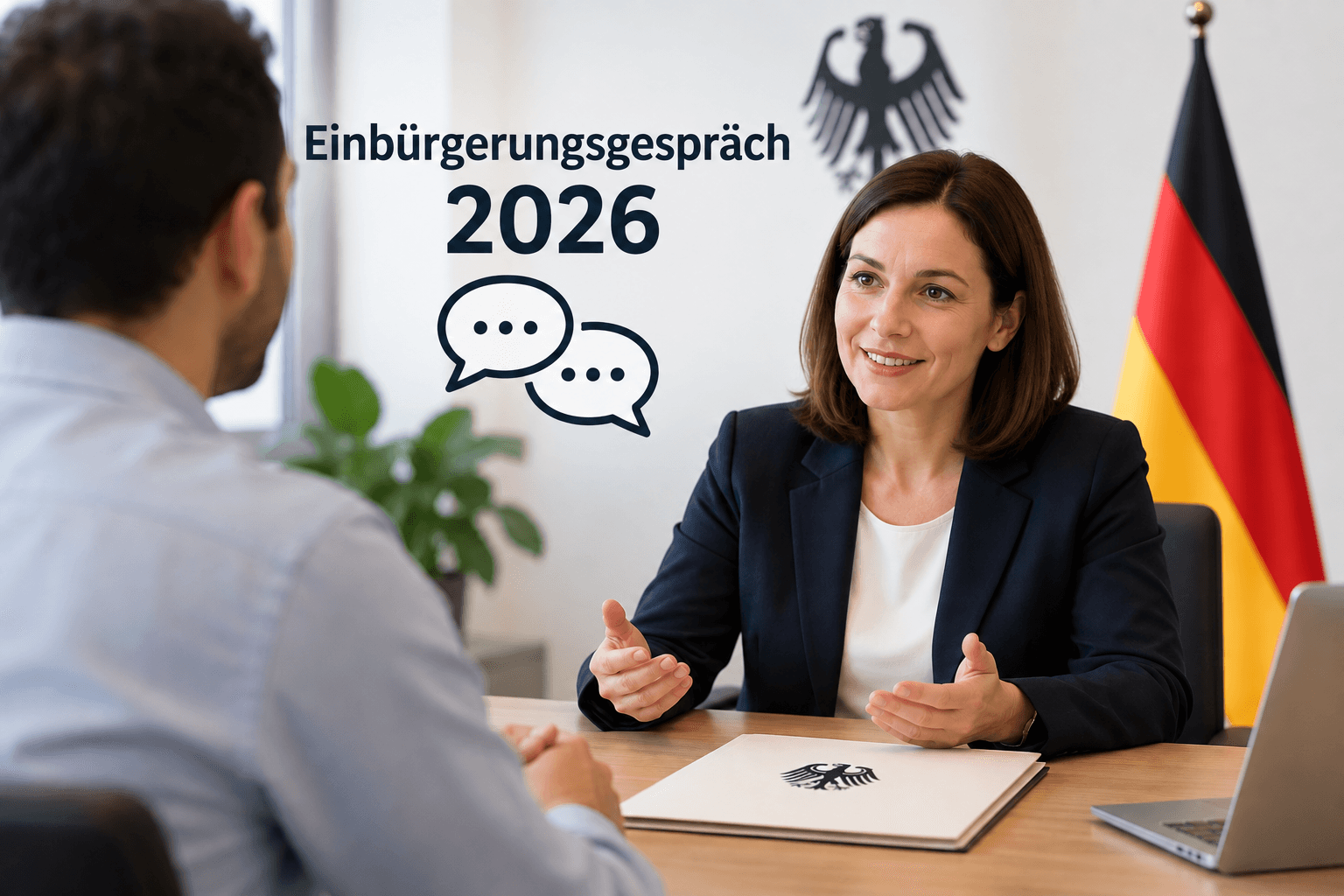
German Citizenship 2026: What Questions Are Asked in the Interview? Real Experiences from Baden-Württemberg
You have passed the Einbürgerungstest or the “Leben in Deutschland” test, submitted your documents, and after a long wait you receive an invitation to a personal interview at the citizenship authority.
Then comes a very practical question:
What questions are asked during an Einbürgerungsgespräch?
Is it simply a document check? Is it a kind of second citizenship test? Do you need to explain how the German state and democracy work? And why might you still be asked questions if you have already passed the Einbürgerungstest or “Leben in Deutschland”?
We looked at several real experiences shared by citizenship applicants in Baden-Württemberg, including cases from Stuttgart, Landkreis Karlsruhe and Ludwigsburg.
One thing becomes particularly clear:
An Einbürgerungsgespräch can be very different depending on the authority and the individual case.
For one applicant, the interview focused on two topics that had been announced in advance. Another applicant was asked around 10–15 questions about democracy, parliament, elections, courts and Germany’s political system.
That is why it is worth preparing for the Einbürgerungsgespräch even if you have already successfully completed the Einbürgerungstest or “Leben in Deutschland”.
What is an Einbürgerungsgespräch?
An Einbürgerungsgespräch is a personal interview held as part of the German naturalization process at the responsible Staatsangehörigkeitsbehörde — the citizenship authority.
It should not automatically be understood as a second Einbürgerungstest.
The Einbürgerungstest is primarily used to demonstrate the required knowledge of Germany’s legal and social system and living conditions in the country.
However, the naturalization process also includes a commitment to the freiheitliche demokratische Grundordnung (FDGO) — Germany’s free democratic constitutional order.
For this reason, the democratic system and Germany’s fundamental values may also be discussed during the naturalization process.
Topics may include:
- elections and electoral principles;
- fundamental rights and human rights;
- democracy and Germany’s form of government;
- state power and the separation of powers;
- government, state institutions and political parties.
Naturalization also requires an acknowledgement of Germany’s special historical responsibility for the National Socialist regime and its consequences.
This means that simply recognizing the correct answer from four options may not always be enough.
During a personal interview, you may need to explain a democratic principle in your own words.
Real Case 1: Stuttgart — Menschenwürde and Gewaltenteilung
In one 2026 naturalization case from Stuttgart, the applicant was told before the personal interview to prepare particularly well for two topics:
- Menschenwürde — human dignity;
- Gewaltenteilung — separation of powers.
The interview itself also focused on these topics.
One of the questions was:
“Erklären Sie in einfachen Worten, was Menschenwürde bedeutet.”
“Explain in simple words what human dignity means.”
This was followed by another question about the historical significance of Menschenwürde.
The second main topic was:
“Was bedeutet Gewaltenteilung? Warum ist sie wichtig?”
“What does separation of powers mean, and why is it important?”
The applicant was also asked to give examples related to the executive branch.
The entire interview lasted approximately 20 minutes.
The applicant received the Einbürgerungsurkunde — the naturalization certificate — on the same day.
Real Case 2: Stuttgart — the Same Two Topics Again
Another independently shared experience from Stuttgart in May 2026 shows a very similar pattern.
Once again, two topics were already mentioned in the invitation letter:
- Menschenwürde
- Gewaltenteilung
The applicant later described the interview as straightforward and stress-free.
The conversation covered exactly the topics that had been announced in the invitation. The necessary formalities followed, and the applicant received the Einbürgerungsurkunde.
Two independent experiences from Stuttgart within a short period therefore show a very similar interview format.
However, this does not mean that every applicant in Stuttgart will always be asked only about these two topics.
Experiences from other citizenship authorities show how different the interviews can be.
Real Case 3: Landkreis Karlsruhe — Around 10–15 Questions
The experience of one applicant from Landkreis Karlsruhe was considerably more extensive.
She received German citizenship after a process lasting approximately 22 months.
During the personal interview, she was asked around 10–15 questions.
Later, she was asked whether the questions had already been familiar to her from the Einbürgerungstest or “Leben in Deutschland”.
Her estimate was:
about 50/50.
Some of the questions seemed familiar, but she said there were also questions she had never heard before.
Most importantly, she was later able to remember specific questions from her Einbürgerungsgespräch.
13 Questions That Were Actually Asked During an Einbürgerungsgespräch
-
Welche Staatsform hat die Bundesrepublik?
What form of government does the Federal Republic of Germany have? -
Was ist der Bundestag?
What is the Bundestag? -
Welche Wahlen und Parlamente gibt es noch?
What other elections and parliaments are there in Germany? -
Was bedeutet parlamentarische Opposition?
What does parliamentary opposition mean? -
Was ist die wichtigste Aufgabe des Bundesrates?
What is one of the main responsibilities of the Bundesrat? -
Was bedeutet Gewaltenteilung?
What does separation of powers mean? -
Was sind die wichtigsten Merkmale von Wahlen?
What are the main principles of democratic elections? -
Was sind die wichtigsten Inhalte des Grundgesetzes?
What are the main principles and key elements of Germany’s Basic Law, the Grundgesetz? -
Was bedeutet Parlament?
What does “parliament” mean? -
Was ist das wichtigste Merkmal deutscher Gerichte?
What is one of the most important characteristics of German courts? -
Was bedeutet Unabhängigkeit der Gerichte?
What does judicial independence mean? -
Welches ist das höchste deutsche Gericht?
What is Germany’s highest court? -
Was ist Demokratie?
What is democracy?
This example clearly shows why it makes sense to prepare for more than just two or three concepts.
In this particular Landkreis Karlsruhe case, the applicant needed a much broader understanding of German democracy and the country’s political system.
Real Case 4: A Broader Range of Questions in the Karlsruhe Area
Another experience from the Karlsruhe area included an even broader range of topics discussed during the interview.
These included:
- freiheitliche demokratische Grundordnung (FDGO) — the free democratic constitutional order;
- democracy;
- the difference between democracy and dictatorship;
- human dignity in the Grundgesetz;
- protection against arbitrary action by state authorities;
- the Grundgesetz;
- independent courts;
- electoral principles;
- separation of powers;
- extremism;
- Germany’s historical responsibility;
- coalition governments;
- opposition;
- fundamental democratic principles.
Questions were also asked about the current political situation, for example about the current Federal Chancellor and the Federal Government.
This example shows why preparation should not be limited to memorizing a few definitions.
It is more important to understand how Germany’s democratic system works in practice.
If you are preparing for questions about the current government or current officeholders, check this information shortly before your interview because it can change over time.
“I Have Already Passed Leben in Deutschland. Why Am I Still Being Asked Questions?”
This is one of the most common practical questions.
Among the experiences we reviewed were applicants who had already passed “Leben in Deutschland” but were still asked questions about democracy and the fundamental principles of the German state later in the naturalization process.
One applicant from Landkreis Karlsruhe, for example, wrote that she had passed “Leben in Deutschland” a long time before.
She therefore wondered why she had to answer questions again — this time orally.
The key point is that these relate to different requirements within the naturalization process.
A successfully completed Einbürgerungstest generally serves as evidence of the required knowledge of Germany’s legal and social system and living conditions.
This is separate from other requirements, including the commitment to the freiheitliche demokratische Grundordnung and acknowledgement of Germany’s special historical responsibility.
Passing the test therefore does not automatically mean that there cannot be a personal discussion of these topics later in the naturalization process.
Einbürgerungstest vs. Einbürgerungsgespräch: What Is the Difference?
The Einbürgerungstest is a standardized test.
It consists of 33 questions, each with four possible answers. To demonstrate the knowledge required for naturalization, at least 17 questions must be answered correctly.
A personal interview can be very different.
An official might ask:
“Was bedeutet Gewaltenteilung?”
“What does separation of powers mean?”
Now there is no A, B, C or D.
You have to formulate the answer yourself.
A simple possible answer would be:
“Die Staatsgewalt ist auf Legislative, Exekutive und Judikative verteilt. So soll verhindert werden, dass eine Stelle zu viel Macht bekommt.”
You do not need to speak like a lawyer.
What matters is showing that you understand the basic principle and can explain it in your own words.
Which Topics Keep Appearing in Real Experiences?
When comparing the cases we reviewed, several topics appear repeatedly.
Menschenwürde — Human Dignity
It may not be enough simply to know that Menschenwürde is an important concept in the Grundgesetz.
You should also be able to explain what it means.
A simple possible answer:
“Jeder Mensch hat die gleiche Würde. Der Staat muss die Würde und die Rechte jedes Menschen schützen.”
Gewaltenteilung — Separation of Powers
Here too, understanding the idea is more useful than memorizing a complicated definition.
For example:
“Die Staatsgewalt ist auf verschiedene Bereiche verteilt. Dadurch soll verhindert werden, dass eine Person oder Institution zu viel Macht bekommt.”
Demokratie — Democracy
A simple explanation could be:
“In einer Demokratie können die Bürger ihre politischen Vertreter frei wählen. Die Staatsorgane müssen sich an das Grundgesetz und die Gesetze halten.”
Grundgesetz — Germany’s Basic Law
A short explanation could be:
“Das Grundgesetz ist die Verfassung Deutschlands. Es schützt die Grundrechte und regelt wichtige Grundlagen des Staates.”
Wahlen und Wahlgrundsätze — Elections and Electoral Principles
You may not only be asked whether elections take place in Germany.
The principles of democratic elections may also be discussed.
For example, it is useful to understand what free, equal and secret elections mean.
Unabhängigkeit der Gerichte — Judicial Independence
A simple explanation:
“Gerichte entscheiden unabhängig. Die Regierung darf Richtern nicht vorschreiben, wie sie in einem konkreten Fall entscheiden sollen.”
Opposition — Political Opposition
For example:
“Zur Opposition gehören Parteien und Fraktionen, die die Regierung nicht tragen. Sie kontrollieren und kritisieren die Regierung und können eigene Vorschläge machen.”
Historische Verantwortung Deutschlands — Germany’s Historical Responsibility
The naturalization process also includes acknowledgement of Germany’s special historical responsibility for the National Socialist regime and its consequences.
In this context, German citizenship law specifically refers to:
- the protection of Jewish life;
- peaceful coexistence between peoples;
- the prohibition of waging a war of aggression.
These issues are therefore not simply topics from German history.
They form part of the legal requirements of the naturalization process.
Do You Need to Memorize 50 or 100 Answers?
No. Understanding the main topics is much more important.
There are many lists online and on social media containing possible questions for an Einbürgerungsgespräch.
In one Baden-Württemberg discussion we reviewed, a preparation guide containing 50 possible questions was also shared.
It included topics such as:
Menschenwürde, Demokratie, Grundrechte, Grundgesetz, Gleichberechtigung, Gewaltenteilung, Diskriminierung, Opposition, Antisemitismus, Germany’s historical responsibility, judicial independence, Religionsfreiheit, Rassismus, Pressefreiheit, Minderheitenschutz, free elections and FDGO.
However, it is important to understand that:
such preparation lists are not an official question catalogue for the Einbürgerungsgespräch.
They also do not mean that you will be asked exactly these questions during your interview.
A more practical approach is to understand the main topics and learn to explain each of them in two or three simple sentences in German.
How Can You Prepare for the Einbürgerungsgespräch in Practice?
Do not just read prepared answers.
Try answering questions out loud and without multiple-choice options.
For example:
Was bedeutet Menschenwürde?
Answer in your own words.
Warum ist Menschenwürde wichtig?
Was bedeutet Gewaltenteilung?
Warum brauchen wir Gewaltenteilung?
Was bedeutet Demokratie?
Warum müssen Gerichte unabhängig sein?
Welche Aufgabe hat die Opposition?
Was ist das Grundgesetz?
This trains exactly the skill that may be needed in a personal interview:
not simply recognizing the correct answer, but formulating a clear answer in German yourself.
10 Topics We Would Prepare First
Based on the real experiences we reviewed and the official topics relevant to the naturalization process, we would start with these areas:
- Menschenwürde
- Gewaltenteilung
- Demokratie
- Grundgesetz
- Grundrechte und Menschenrechte
- Wahlen und Wahlgrundsätze
- Bundestag, Bundesrat und Parlament
- Regierung und Opposition
- Unabhängigkeit der Gerichte
- FDGO und historische Verantwortung Deutschlands
Do not start with complicated legal definitions.
Instead, ask yourself one simple question:
Can I explain this concept in two or three simple sentences in German?
If the answer is yes, you already have a good foundation for the personal interview.
Is the Einbürgerungsgespräch the Same Everywhere?
No.
The real experiences show this particularly clearly.
In the Stuttgart cases we reviewed, the interviews focused mainly on Menschenwürde and Gewaltenteilung.
In the documented Landkreis Karlsruhe cases, the range of questions was considerably broader and included democracy, parliament, the Bundesrat, elections, the Grundgesetz, courts, opposition and the FDGO.
One applicant from Ludwigsburg, on the other hand, described the interview as involving general questions about Germany and things people know from everyday life and the news.
For this reason, one person’s experience on Facebook, in a forum or in an online group should never be treated as a guaranteed preview of your own interview.
The responsible authority, the individual case and the exact interview process can differ.
If specific topics are mentioned in your invitation letter, you should of course pay particular attention to them.
The Most Important Thing: Understand, Don’t Just Memorize
The real experiences include surprisingly short questions:
Was ist Demokratie?
Was bedeutet Menschenwürde?
Warum ist Gewaltenteilung wichtig?
Was bedeutet Unabhängigkeit der Gerichte?
On paper, these questions may look simple.
But during a personal interview, there will be no four answer options next to them.
Good preparation therefore means more than simply knowing the correct answer. You should also be able to explain it calmly, clearly and in your own words in German.
Conclusion: How to Prepare for the Einbürgerungsgespräch
Passing the Einbürgerungstest or “Leben in Deutschland” is an important part of the German naturalization process. However, passing the test does not automatically mean that there will be no later discussion about Germany’s democratic constitutional order and fundamental values.
The real experiences from Baden-Württemberg that we reviewed show different situations:
- Stuttgart: In several documented cases, Menschenwürde and Gewaltenteilung were the main topics.
- Landkreis Karlsruhe: In the documented cases, the range of questions was considerably broader and included democracy, parliament, elections, the Grundgesetz, courts and Germany’s political system.
- Ludwigsburg: One applicant described the interview as involving general questions about Germany and topics familiar from everyday life and the news.
There is therefore no single universal list of questions that you can simply memorize and be guaranteed to be prepared for every Einbürgerungsgespräch.
A more useful approach is:
Understand the fundamental principles of German democracy and practise explaining them in your own words using simple German sentences.
Note: The practical examples described in this article are based on publicly shared experiences of naturalization applicants in Baden-Württemberg in 2026. They are not an official catalogue of questions and do not mean that the same questions will be asked by another authority or in another naturalization case. Always check the current requirements and instructions in the documents provided by your Staatsangehörigkeitsbehörde and in official sources.
Related practice
Continue with the learning pages and games connected to this article.