

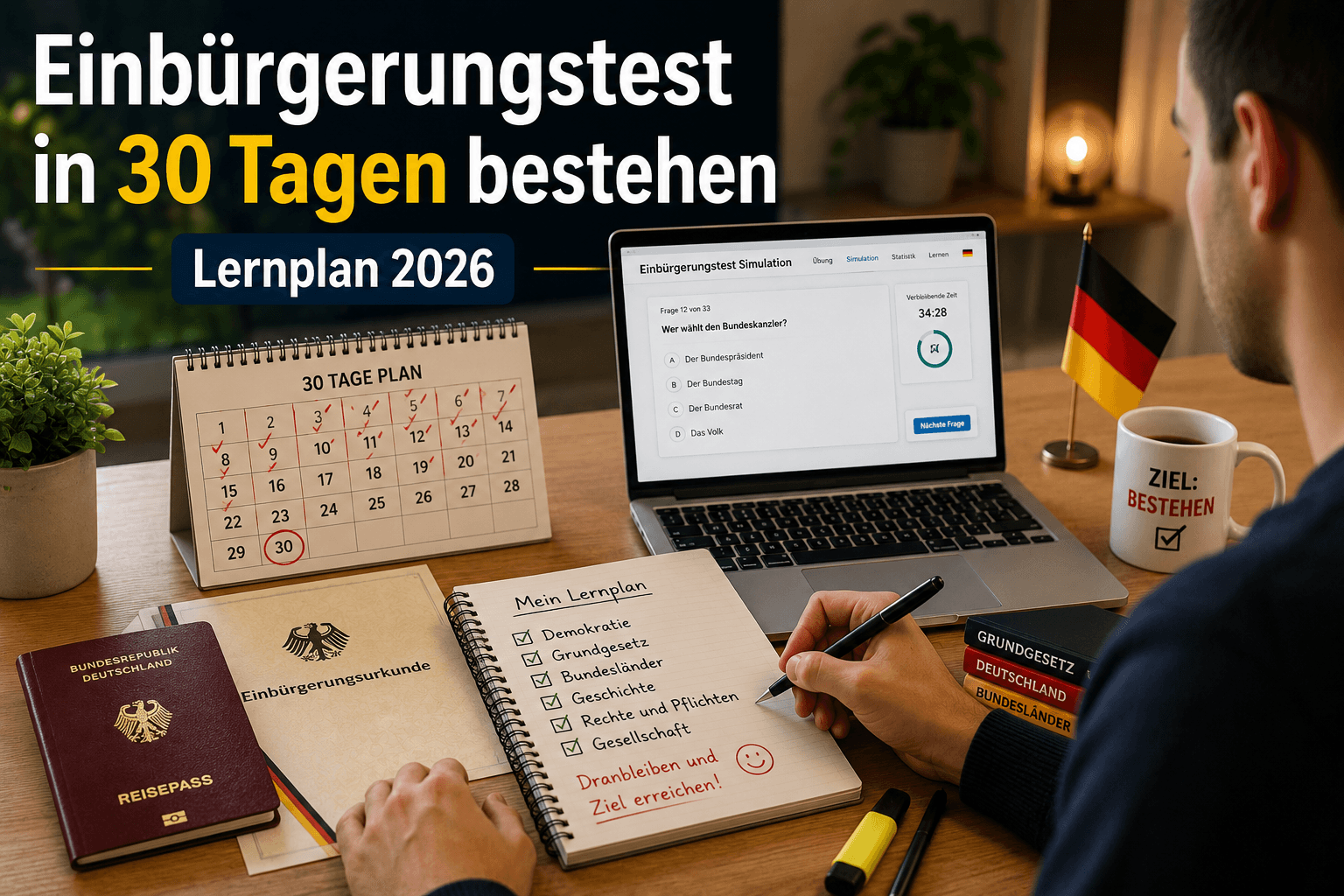
30-Day Study Plan for the German Citizenship Test (2026) — How to Pass the Einbürgerungstest on Your First Attempt
Planning to take the Einbürgerungstest in Germany? Many people are unsure where to start, how much time they need, and how to study all the questions effectively. The good news is that most candidates successfully pass the exam when they prepare consistently and follow a structured learning plan.
In this guide, you will find a practical 30-day study plan that helps you prepare step by step for the German citizenship test and increases your chances of passing on your first attempt.
Is 30 Days Enough?
Yes.
The official Einbürgerungstest question catalog contains 310 questions, but only 33 questions appear on the actual exam.
For most candidates, one month is enough time to:
- become familiar with all questions;
- understand the most important topics;
- complete exam simulations;
- strengthen and retain knowledge.
The key is to study regularly rather than trying to learn everything at the last minute.
Key Facts About the Exam
| Question | Answer |
|---|---|
| Number of questions on the exam | 33 |
| Required correct answers | 17 |
| Federal state questions | 3 |
| Question catalog size | 310 |
| Exam duration | 60 minutes |
| Answer choices per question | 4 |
Days 1–7 — Get Familiar with the Questions
The goal of the first week is not to memorize everything.
Instead, focus on understanding:
- how the questions are structured;
- which topics appear repeatedly;
- which areas seem easy to you;
- which topics require more attention.
At this stage, it is recommended to:
- review the entire question catalog;
- complete short practice tests;
- take notes on difficult questions.
Days 8–14 — Learn the Core Topics
During the second week, focus on the main subjects covered in the citizenship test.
The most important topics include:
- democracy;
- elections;
- the German Basic Law (Grundgesetz);
- federal states;
- citizens' rights;
- citizens' responsibilities;
- German history;
- society and social life.
At this stage, understanding the concepts is more important than memorizing answers mechanically.
Days 15–21 — Analyze Your Mistakes
In the third week, start working systematically on your mistakes.
Many candidates make one common mistake — they only review the questions they answered correctly.
A much more effective approach is to:
- analyze incorrect answers;
- understand why they were wrong;
- revisit the most challenging topics.
This is usually the stage where the fastest improvement occurs.
Days 22–26 — Take Full Exam Simulations
Now it is time to practice under realistic exam conditions.
It is recommended to complete several full exam simulations:
- 33 questions;
- limited time;
- no external assistance.
This helps you become familiar with the exam format and significantly reduces stress on exam day.
Days 27–29 — Review Federal State Questions
Many candidates focus only on the general question catalog.
However, the exam also includes questions about your specific federal state.
Make sure to review:
- your state's questions;
- important facts;
- commonly tested topics.
These questions can make a crucial difference in your final result.
Day 30 — Final Preparation
On the last day, avoid trying to learn new information.
Instead:
- review the main topics;
- revisit previous mistakes;
- complete one final simulation;
- get enough sleep.
Feeling well-rested on exam day is often just as important as having the necessary knowledge.
How Much Time Should You Study Each Day?
One of the most common questions is how much time should be devoted to preparation each day.
In reality, consistency is more important than duration. It is better to study for 20–30 minutes every day than for several hours only on weekends.
| Preparation Level | Recommended Study Time Per Day |
|---|---|
| Minimum | 15–20 minutes |
| Recommended | 30 minutes |
| Intensive | 45–60 minutes |
| Final week before the exam | 30–60 minutes |
For most candidates, approximately 30 minutes of focused daily study is more than sufficient.
What Should You Achieve After 30 Days?
If you follow this study plan, after one month most candidates will:
- be familiar with all 310 official questions;
- understand the key topics related to German democracy and society;
- regularly score more than 17 correct answers in simulations;
- know their federal state's questions well;
- have completed multiple full exam simulations;
- feel significantly more confident about the exam.
Confidence and practical experience with simulations are often the factors that help candidates pass on their first attempt.
What Should You Avoid?
Studying Only During the Last Few Days
This creates unnecessary stress and often leads to poorer results.
Ignoring Federal State Questions
These questions are a mandatory part of the exam.
Studying Only Theory
Without simulations, it is harder to adapt to the actual exam format.
Reviewing Only Correct Answers
The greatest improvement comes from analyzing mistakes.
How Many Exam Simulations Should You Complete?
Most candidates feel confident after completing:
- 10–20 short practice tests;
- 5–10 full exam simulations.
The more simulations you complete, the lower your stress level will be on exam day.
Why Are Exam Simulations More Effective Than Simply Reading Questions?
Many candidates read through the question catalog several times and assume they are ready for the exam.
In practice, however, simulations usually produce much better results.
Exam simulations help you:
- become familiar with the exam format;
- reduce exam-day stress;
- identify weak areas more quickly;
- track your progress;
- test your knowledge under realistic conditions.
Reading helps you learn information, while simulations help determine whether that knowledge has truly been retained.
That is why successful preparation typically includes not only reading questions but also regularly completing tests and exam simulations.
Is It Possible to Pass on the First Attempt?
Yes.
Most candidates who:
- study consistently;
- review their mistakes;
- use exam simulations;
- prepare for at least several weeks,
successfully pass the Einbürgerungstest on their first attempt.
Frequently Asked Questions About the 30-Day Study Plan
Is 30 Days Really Enough?
Yes. For most candidates, one month is sufficient to prepare systematically for the Einbürgerungstest.
Can I Prepare in 14 Days?
Yes, but it requires significantly more study time each day and a much more intensive preparation schedule.
Do I Need to Learn All 310 Questions?
No. You do not need to memorize every question word for word, but it is highly recommended to review the entire official question catalog.
How Many Simulations Should I Complete?
Most candidates feel prepared after 5–10 full simulations and several shorter practice tests.
What Is Most Important During the Final Week?
During the final week, focus on:
- incorrect answers from previous tests;
- federal state questions;
- full exam simulations;
- reviewing key topics.
Helpful Articles and Tools in Our Blog
If you are preparing for the Einbürgerungstest, we also recommend reading the following related articles in the Deutsch mit Spaß blog section. Together, they create a complete citizenship learning ecosystem and help you prepare for the German citizenship test step by step.
- Einbürgerungstest – Complete Guide, Questions, Tips, and Preparation (2026);
- Einbürgerungstest – Common Mistakes and How to Pass the German Citizenship Test on Your First Attempt (2026);
- Einbürgerungstest FAQ (2026) — 30 Most Frequently Asked Questions and Answers;
- Einbürgerungstest Simulations and Exam Training;
- Federal State Question Training;
- German Citizenship Exam Center.
These articles are interconnected and cover the most important citizenship test topics, including exam questions, common mistakes, federal state questions, simulations, and practical preparation for obtaining German citizenship.
Why Use Deutsch mit Spaß Exam Simulations?
On the Deutsch mit Spaß platform, you can:
- practice official-style questions;
- select your federal state;
- track your progress;
- review incorrect answers;
- complete full exam simulations.
This helps you prepare in a structured, systematic, and confident way.
Conclusion
The Einbürgerungstest is not an exam that requires months of preparation courses. With a clear study plan, regular practice, and realistic simulations, most candidates can successfully prepare within a single month.
If you start studying systematically today, you will be much closer to obtaining German citizenship in just 30 days. On the Deutsch mit Spaß platform, you can practice questions, complete exam simulations, and track your progress step by step on your journey toward passing the Einbürgerungstest successfully.
Related practice
Continue with the learning pages and games connected to this article.