

German for Jobs in Germany (2026) — Workplace German, Important Vocabulary and Work Situations
For many people, working in Germany means not only learning basic German but also understanding the work environment and professional communication in everyday life.
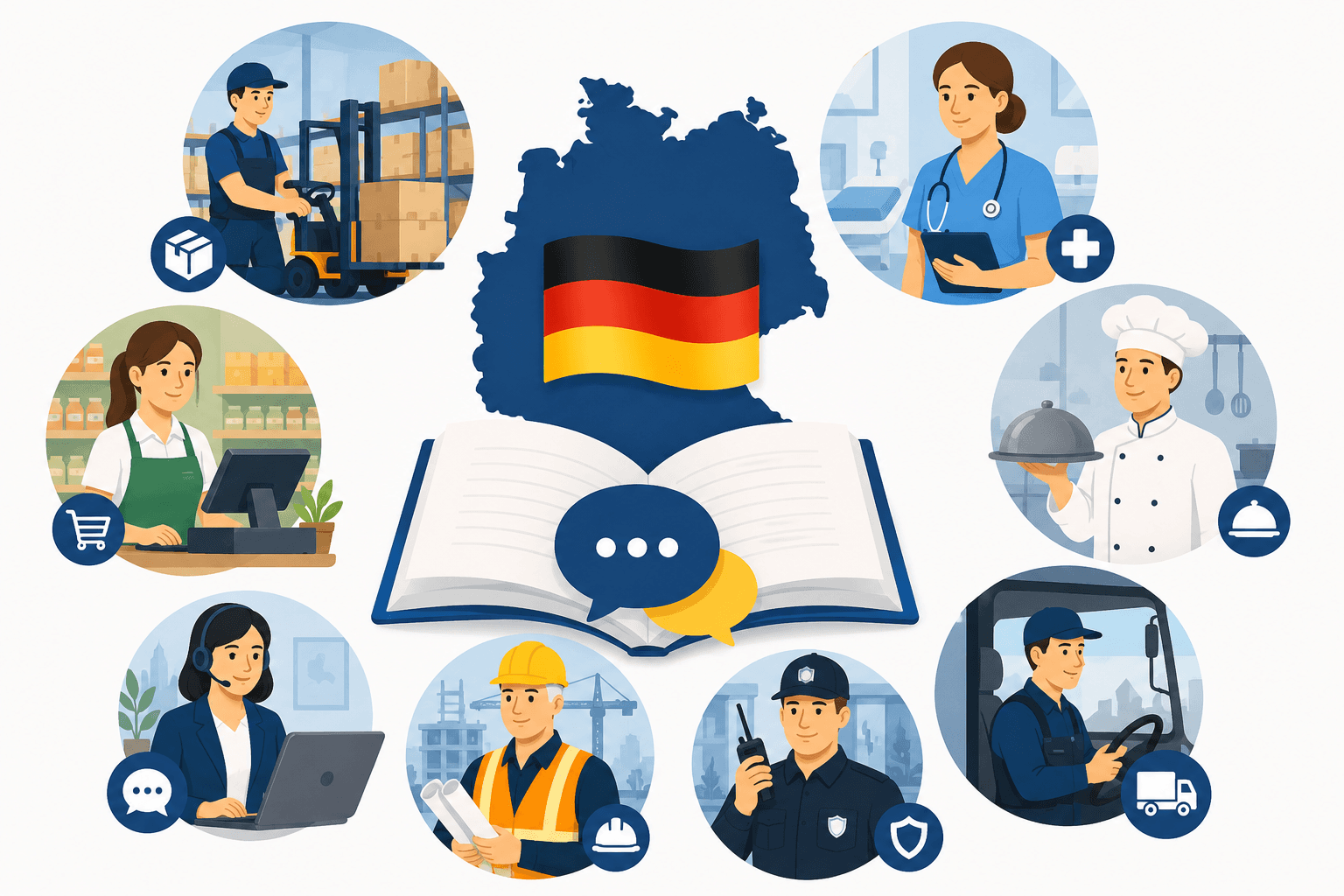
In warehouses, healthcare, restaurants, construction, transport, or customer service, people frequently use specific vocabulary, work situations, and instructions that are not always taught in traditional German courses.
Even people who understand German in everyday life often face difficulties at work. The reason is usually not grammar. Much more often, the challenge comes from professional terminology, work situations, and vocabulary specific to a particular industry.
That is exactly why workplace German in Germany often differs from traditional language learning.
Why is workplace German important?
Many people initially try to memorize as many individual words as possible.
However, in a real work environment, it is much more important to:
- understand instructions
- communicate with colleagues
- understand safety regulations
- react correctly in workplace situations
- understand professional terminology
Common words frequently heard at work:
- Arbeitsvertrag
- Schicht
- Pause
- Sicherheit
- Arbeitskleidung
- Lieferung
- Verantwortung
- Termin
- Aufgabe
- Mitarbeiter
If these words are unfamiliar, even simple work situations can become difficult.
What German language level is usually required for working in Germany?
Requirements can vary depending on the profession.
A1–A2
- simple physical work
- some warehouse jobs
- assistant/helper positions
A2–B1
- warehouse and logistics
- gastronomy
- manufacturing
- customer service
B1–B2
- customer communication
- office work
- some technical professions
B2–C1
- healthcare and caregiving
- medicine
- more advanced professional communication
However, in practice, understanding professional terms and workplace situations is often more important than grammar level alone.
The Most Popular Professional Fields in Germany
Workplace German is necessary in many industries, but the vocabulary and situations used can vary significantly depending on the profession.
Warehouse and Logistics
Common terms:
- Gabelstapler
- Palette
- Lieferung
- Lager
- Versand
- Kommissionierung
- Wareneingang
- Warenausgang
Healthcare and Caregiving
Common terms:
- Patient
- Pflege
- Medikament
- Blutdruck
- Untersuchung
- Behandlung
- Termin
Gastronomy and Food Industry
Common terms:
- Lebensmittel
- Hygiene
- Allergene
- Bestellung
- Küche
- Reinigung
- Temperatur
Construction
Common terms:
- Baustelle
- Werkzeug
- Helm
- Material
- Gefahr
- Sicherheit
Drivers and Transport
Common terms:
- Fahrer
- Transport
- Lieferung
- Route
- LKW
- Beladung
Retail and Customer Service
Common terms:
- Kunde
- Kasse
- Produkt
- Angebot
- Rechnung
- Rabatt
Security and Safety Services
Common terms:
- Kontrolle
- Sicherheit
- Notfall
- Alarm
- Überwachung
Manufacturing and Factories
Common terms:
- Maschine
- Produktion
- Kontrolle
- Sicherheit
- Schicht
Hotels and Hospitality
Common terms:
- Rezeption
- Reservierung
- Gast
- Service
- Zimmer
Common Workplace Situations in Germany
- receiving a work assignment
- asking for help
- understanding safety instructions
- reporting a problem
- communicating with customers
- understanding colleagues’ instructions
Understanding situations often creates the biggest difference in real work environments.
Why Is Memorizing Words Often Not Enough?
Many people try to learn vocabulary from lists.
However, in real work situations, a person does not hear:
"Word number 1"
They hear:
"The delivery still needs to go to the warehouse today."
"Please check the temperature."
"The patient needs help."
That is why learning through topics and real workplace situations is significantly more effective.
Learn German by Professions and Workplace Situations
In the Topics section of the Deutsch mit Spaß platform, users can learn workplace German through specific professions and real work situations.
- work and professions
- warehouse and logistics
- healthcare and medicine
- food and gastronomy
- safety
- work environment
- professions
Additional features include:
- professional vocabulary catalogs
- Word Search
- situation-based learning
Frequently Asked Questions (FAQ)
Is it possible to work in Germany without speaking German?
In some jobs, it is possible. However, even basic German skills can significantly improve daily work and communication.
Which professions in Germany require the lowest German level?
It depends on the type of work, but warehouses, manufacturing, and some assistant positions often require only a basic level initially.
Which German words are used most frequently at work?
Commonly used words include: Arbeit, Schicht, Sicherheit, Lieferung, Mitarbeiter, Aufgabe and Termin.
Is workplace German different from everyday German?
Yes. Workplace communication uses profession-specific terminology and situations much more frequently.
What is the fastest way to improve workplace German?
Regularly practice topic-based learning, professional vocabulary, and real workplace situations.
Related Topics
- German for Warehouse Workers
- German for Caregivers
- Staplerschein
- Hygiene
- First Aid
- Work and Professions
- Warehouse and Logistics
- Healthcare and Medicine
- Professional German for Work in Germany
Related practice
Continue with the learning pages and games connected to this article.