

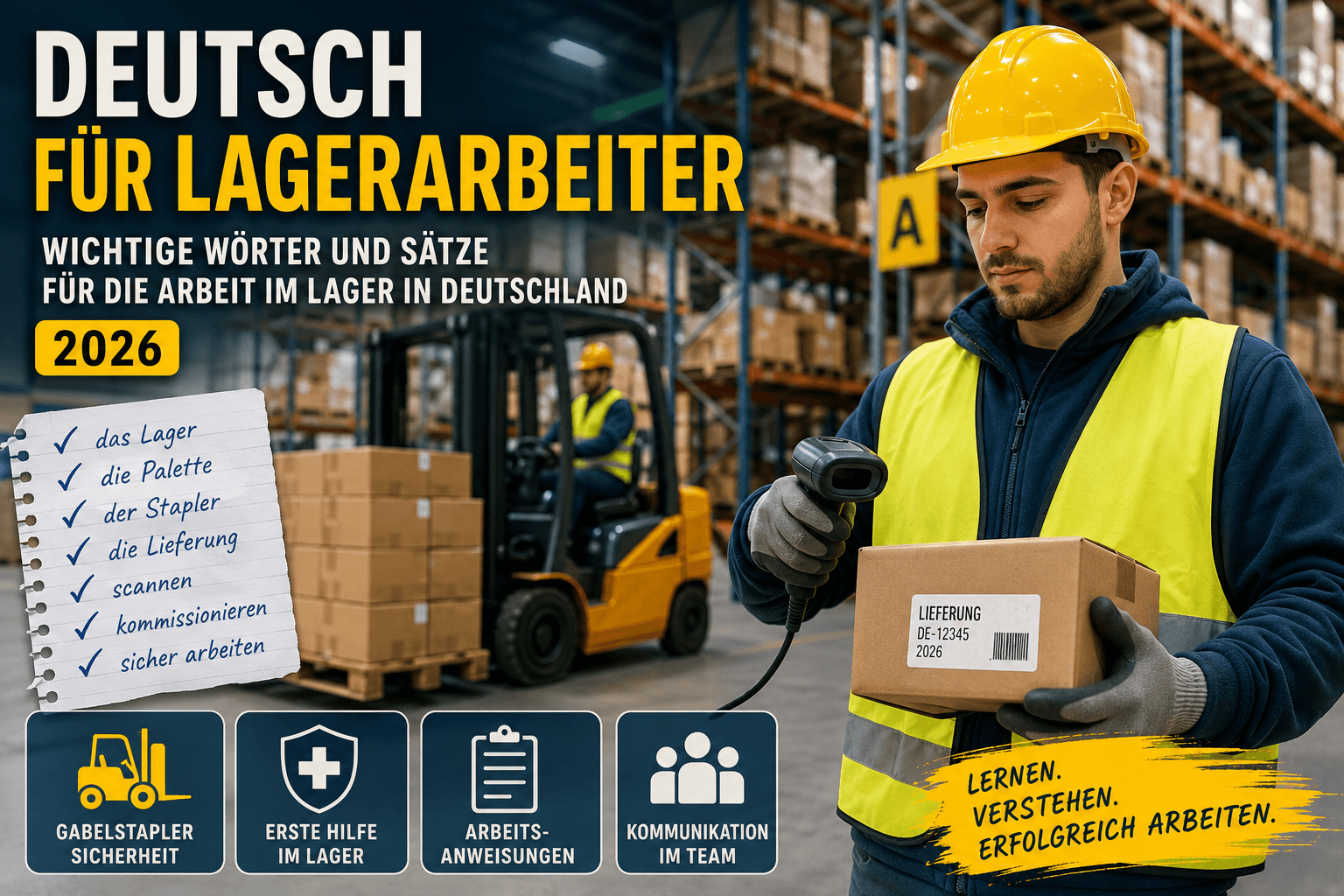
German for Warehouse Workers — The Most Important German Words for Warehouse Jobs in Germany (2026)
A practical guide for people planning to work in Germany in warehouses, logistics, or as forklift drivers.
Warehouse work (Lagerarbeit) is one of the most popular employment sectors for people moving to Germany. Logistics centers, delivery companies, and large warehouses continuously search for new employees, especially for:
- Amazon warehouses
- food logistics
- delivery centers
- manufacturing companies
- forklift jobs (Staplerfahrer)
In many workplaces, perfect German is not required. However, work-related German and basic communication skills are extremely important.
Employees should be able to:
- understand instructions
- follow safety regulations
- communicate with colleagues
- react appropriately in workplace situations
In this article you will find:
- the most important German words for warehouse work
- commonly used phrases
- German language for forklift jobs
- typical workplace situations
- tips on preparing faster for work in Germany
What does warehouse work in Germany look like?
A typical working day in a warehouse often includes:
- receiving goods
- moving pallets
- order picking
- scanning
- packaging
- preparing deliveries
- shift work
In many companies employees use:
- scanners
- logistics systems
- forklifts
- digital order lists
This is exactly why even basic German skills help people understand the work environment much faster and feel more confident.
Why is German important in warehouse work?
Even if English or Russian is used at work, German helps you:
- understand tasks better
- integrate into the team faster
- avoid mistakes
- follow safety requirements
- get better-paid jobs
- receive more responsibility
Many employers in Germany highly value employees who actively try to learn German.
German becomes especially important:
- when working with forklifts
- during shift work
- in goods receiving departments
- when communicating with supervisors
The most important German words for warehouse work
| German | English |
|---|---|
| das Lager | warehouse |
| die Palette | pallet |
| der Scanner | scanner |
| die Lieferung | delivery |
| der Karton | box |
| das Paket | package |
| der Stapler | forklift |
| die Schicht | shift |
| die Pause | break |
| die Sicherheit | safety |
| die Ladung | load |
| der Fahrer | driver |
| der Mitarbeiter | employee |
| der Chef | manager / supervisor |
| die Bestellung | order |
| der Versand | shipping |
| die Lagerlogistik | warehouse logistics |
| der Wareneingang | goods receiving |
| die Kommissionierung | order picking |
The most important warehouse verbs
| German | English |
|---|---|
| laden | load |
| entladen | unload |
| transportieren | transport |
| kontrollieren | inspect / check |
| heben | lift |
| senken | lower |
| scannen | scan |
| sortieren | sort |
| tragen | carry |
| verpacken | pack |
Warehouse work and Staplerschein
In many warehouses in Germany, forklift drivers (Staplerfahrer) are among the most in-demand employees. A Staplerschein certificate often increases job opportunities and helps people find better-paid positions.
Frequently used words:
| German | English |
|---|---|
| der Gabelstapler | forklift |
| die Gabel | fork |
| heben | lift |
| senken | lower |
| laden | load |
| entladen | unload |
Safety and First Aid in the warehouse
In the workplace it is also important to understand safety and first aid terminology.
| German | English |
|---|---|
| der Unfall | accident |
| die Verletzung | injury |
| der Notruf | emergency call |
| die Erste Hilfe | first aid |
| der Verband | bandage |
Ignoring safety regulations in a warehouse can lead to serious consequences, which is why understanding these terms is often just as important as understanding work tasks.
Frequently used workplace phrases
In warehouse work
- Wo soll ich die Palette hinstellen? — Where should I place the pallet?
- Dieser Scanner funktioniert nicht. — This scanner is not working.
- Die Lieferung ist verspätet. — The delivery is delayed.
- Kannst du mir helfen? — Can you help me?
- Wir müssen schneller arbeiten. — We need to work faster.
Working with forklifts
- Vorsicht! — Be careful!
- Die Ladung ist schwer. — The load is heavy.
- Bitte langsam fahren. — Please drive slowly.
- Ist der Stapler frei? — Is the forklift available?
- Wo ist die nächste Palette? — Where is the next pallet?
Typical situations in a warehouse
- Ich finde die Lieferung nicht. — I cannot find the delivery.
- Wo ist der Wareneingang? — Where is the goods receiving area?
- Der Scanner funktioniert nicht. — The scanner is not working.
- Ich brauche Hilfe beim Transport. — I need help with transportation.
- Welche Schicht habe ich morgen? — Which shift do I have tomorrow?
What level of German is required for warehouse work?
A1–A2 level
Usually sufficient for:
- simple tasks
- basic communication
- working in international teams
B1 level
Often helps to:
- get more stable jobs
- understand instructions
- communicate with supervisors
- work in positions with greater responsibility
B2 level
May be required for:
- team leaders
- logistics specialists
- administrative work
Can you work in a warehouse in Germany without German?
In some warehouses this is possible, especially in international teams. However, in reality German almost always helps you:
- find work faster
- understand safety rules better
- earn a higher salary
- feel more confident at work
Many people start with minimal German knowledge and learn the language during the job itself.
Practice warehouse German with thematic sections
To learn German faster for warehouse work in Germany, reading words once is not enough.
It is much more effective to practice them in real workplace situations.
On the Deutsch mit Spaß platform you can use thematic sections such as:
- logistics
- transportation
- professions
- technology
- work environment
- everyday communication
After learning the topics, users can continue practicing through:
- Word Search games
- dictionaries
- listening exercises
- practical situations
This helps people learn not only vocabulary but also practical communication skills for working in Germany.
Frequently Asked Questions
Is A1 enough for warehouse work in Germany?
For some jobs yes, but A2 or B1 significantly expands job opportunities.
What is a Staplerschein?
A Staplerschein is a forklift driver certificate in Germany that is often required for forklift work.
Do I need a Staplerschein for warehouse work?
Not always, but it frequently helps increase employment opportunities.
What is the average warehouse salary in Germany?
Salary depends on the region, company, and responsibilities. Additional skills and language knowledge often increase earnings.
Can I work at an Amazon warehouse without German?
In some cases yes, but German significantly makes work easier.
Which German words should I learn during the first week?
It is recommended to start with words related to:
- deliveries
- scanning
- safety
- work teams
- daily communication
Conclusion
Working in a warehouse in Germany becomes much easier if you understand commonly used German words and phrases.
Perfect German is not required on the first day — the most important things are:
- understanding instructions
- following safety rules
- being able to communicate with colleagues
With regular practice, progress usually appears much faster than people initially expect.
The sooner you start learning German for warehouse work in Germany, the easier it will be to:
- find a job
- feel confident in the workplace
- grow professionally in Germany
Related practice
Continue with the learning pages and games connected to this article.