

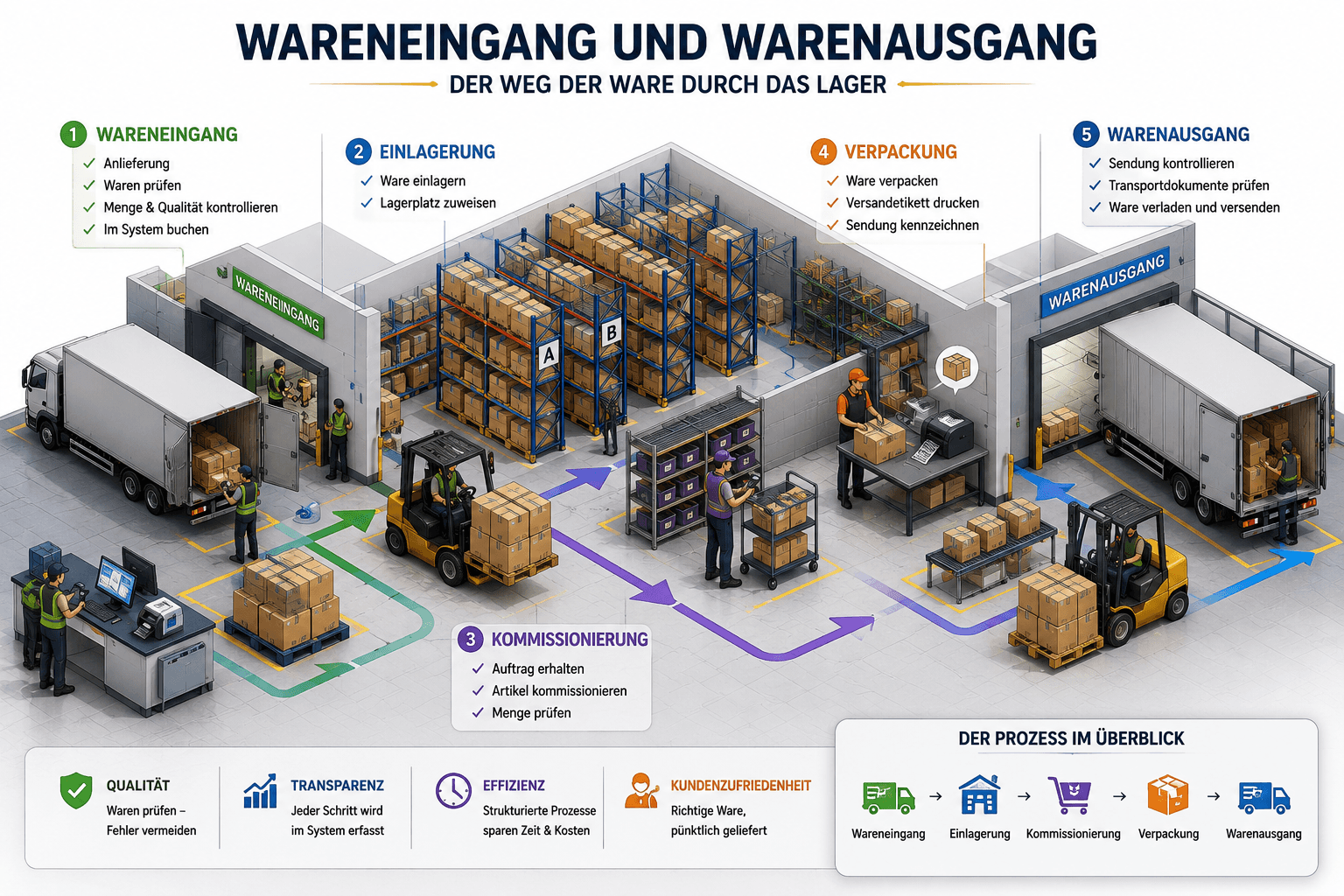
Goods Receiving and Goods Dispatch in Germany (2026) – Duties, Work Processes, Salary, Common Mistakes and Career Opportunities
Every day, thousands of products are received, inspected, stored, and shipped in warehouses across Germany. To ensure that these processes run accurately, safely, and on time, companies rely on employees working in Goods Receiving (Wareneingang) and Goods Dispatch (Warenausgang). :contentReference[oaicite:0]{index=0}
Whether products are delivered to retail stores, manufacturing companies, or private customers, almost every shipment passes through these two essential warehouse departments. :contentReference[oaicite:1]{index=1}
In this article, you will learn:
- what Goods Receiving (Wareneingang) is;
- what Goods Dispatch (Warenausgang) is;
- how the work processes operate;
- what employees in these departments do;
- how much you can earn;
- which mistakes are most common;
- what career opportunities exist in logistics.
Is This Job Right for You?
This profession is often a good choice for people who:
- ✅ want to work in logistics
- ✅ are careful and detail-oriented
- ✅ enjoy working in a team
- ✅ are looking for stable employment in Germany
- ✅ are interested in warehouse operations
This job may be less suitable if you:
- ❌ dislike active, physical work
- ❌ do not enjoy checking documents
- ❌ dislike being responsible for accuracy
What Is Goods Receiving (Wareneingang)?
Goods Receiving (Wareneingang) refers to the process of accepting incoming deliveries into a company.
All products arriving at a warehouse from suppliers first enter the goods receiving area.
Here, employees check:
- whether the delivery is correct;
- whether the quantity matches the order;
- whether the goods are damaged;
- whether all documents are accurate and complete.
Only after these checks are completed are the goods stored or transferred to production.
What Does a Goods Receiving Employee Do?
Typical daily duties include:
- accepting deliveries;
- unloading trucks;
- checking documents;
- counting products;
- inspecting goods for damage;
- scanning products into the system;
- labeling goods;
- organizing storage locations.
Many warehouses use:
- handheld scanners;
- tablets;
- warehouse management systems (WMS);
- forklifts and warehouse vehicles.
How Does the Goods Receiving Process Work?
1. Delivery Arrival
A truck arrives at the company.
2. Document Verification
Employees check:
- delivery notes;
- purchase orders;
- shipping documents.
3. Quantity Check
The delivered quantity is compared with the order.
4. Quality Inspection
Employees inspect:
- transport damage;
- packaging;
- product quality.
5. System Registration
The goods are entered into the warehouse system.
6. Storage
Products are moved to their designated storage locations.
Why Is Goods Receiving So Important?
Mistakes in goods receiving can lead to:
- incorrect inventory levels;
- inventory discrepancies;
- delayed orders;
- customer complaints;
- financial losses.
That is why many companies place special emphasis on maintaining high-quality goods receiving procedures.
What Is Goods Dispatch (Warenausgang)?
Goods Dispatch (Warenausgang) refers to the preparation and shipment of goods to customers.
It is the final stage before products leave the company.
The dispatch department ensures that:
- the correct product;
- in the correct quantity;
- reaches the correct customer;
- at the correct time.
What Does a Goods Dispatch Employee Do?
Typical responsibilities include:
- receiving completed orders;
- checking order accuracy;
- packing products;
- labeling shipments;
- preparing transport documents;
- organizing shipments;
- loading vehicles.
The dispatch department often works closely with:
- order picking (Kommissionierung);
- packaging departments;
- transportation and shipping teams.
How Does the Shipping Process Work?
1. Order Transfer
Picked orders arrive in the dispatch area.
2. Verification
Employees check:
- product quantities;
- item codes;
- shipping documents.
3. Packaging
The products are prepared for transportation.
4. Labeling
Shipping labels and delivery information are attached.
5. Loading
Goods are loaded onto vehicles.
6. Shipment
The order is sent to the customer.
Goods Receiving vs. Goods Dispatch – What Is the Difference?
| Goods Receiving | Goods Dispatch |
|---|---|
| Goods enter the company | Goods leave the company |
| Inspection and acceptance | Inspection and shipment |
| Works with suppliers | Works with customers and carriers |
| Focus on incoming goods | Focus on outgoing deliveries |
How Does a Product Move Through a Warehouse?
Supplier
↓
Goods Receiving
↓
Warehouse Storage
↓
Order Picking
↓
Packaging
↓
Goods Dispatch
↓
Customer
These processes form the foundation of modern supply chains.
Where Can You Work?
- Amazon and other e-commerce warehouses;
- logistics centers;
- the automotive industry;
- food warehouses;
- pharmaceutical companies;
- building materials warehouses;
- manufacturing facilities;
- wholesale distribution centers.
Salary in Germany
Salary depends on factors such as:
- region;
- employer;
- experience;
- shift work;
- industry.
| Experience | Gross Monthly Salary |
|---|---|
| Entry-level employee | €2,350–€2,600 |
| Experienced employee | €2,600–€2,900 |
| Shift worker | €2,800–€3,300 |
| Large companies | Up to €3,500 |
Additional pay is often provided for night shifts, weekends, and public holidays.
Do You Need German Language Skills?
In some warehouses, it is possible to start with minimal German skills.
However, German language knowledge helps you:
- understand safety regulations;
- avoid costly mistakes;
- earn a higher salary;
- qualify for more responsible positions;
- communicate more effectively with colleagues and supervisors.
Important Logistics Terms
| German Term | English Meaning |
|---|---|
| Wareneingang | Goods Receiving |
| Warenausgang | Goods Dispatch |
| Lieferschein | Delivery Note |
| Bestellung | Order |
| Lagerplatz | Storage Location |
| Scanner | Scanner |
| Inventur | Inventory Count |
| Palette | Pallet |
| Versand | Shipping |
| Kommissionierung | Order Picking |
Conclusion
Goods Receiving and Goods Dispatch are two of the most important processes in any warehouse operation. They ensure that products are correctly received, stored, and delivered to customers on time.
If you want to build a successful career in German logistics, understanding these processes, improving your German language skills, and gaining practical experience will significantly increase your chances of finding a good job, earning more, and advancing professionally.
Related practice
Continue with the learning pages and games connected to this article.