
Job Interview in Germany – 20 Common Questions, Answers and German Examples (A1–B1)
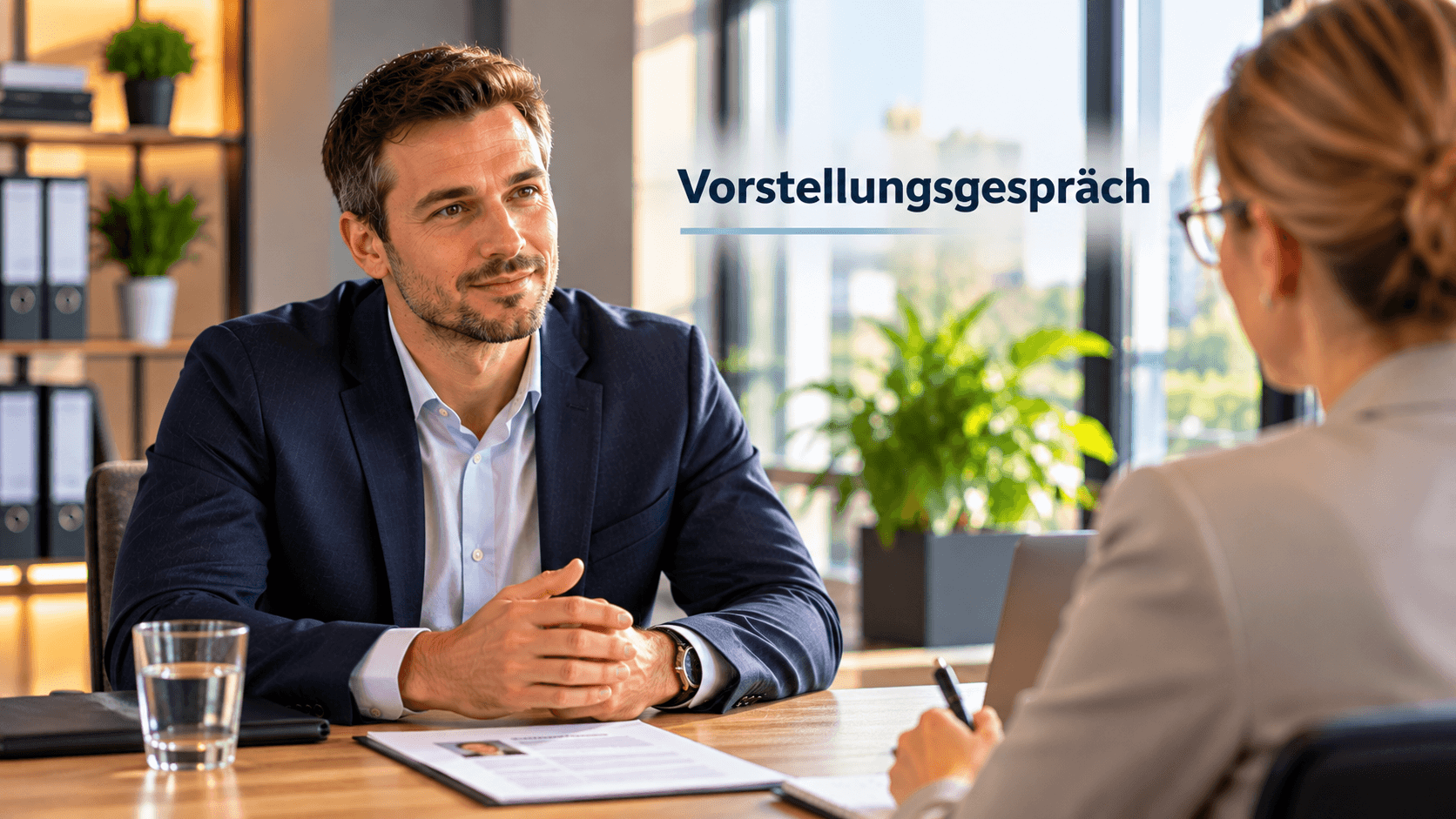
A job interview in Germany (Vorstellungsgespräch) is a conversation in which an employer evaluates a candidate’s professional experience, skills, motivation and suitability for a position. Common interview questions focus on previous work experience, German language skills, personal strengths, working hours and salary expectations.
Even if you are not yet confident speaking German, you can prepare for a job interview in advance. Many interview questions are repeated, making it useful to practise simple, clear answers in German.
In this guide, you will find:
- 20 common job interview questions in German, with sample answers and English translations;
- 10 simple answers for German language levels A1–A2;
- a complete example of a job interview dialogue;
- typical questions and answers for warehouse, production and care jobs;
- useful German phrases for situations when you do not understand a question;
- practical A1–B1 exercises and job interview preparation tips.
How Does a Job Interview in Germany Work?
A job interview is called a Vorstellungsgespräch (job interview) or Bewerbungsgespräch (employment interview) in German. It can take place in person, over the phone or via video call.
A typical job interview has five stages:
- Greeting and introductions. The employer and candidate introduce themselves.
- Questions about experience and qualifications. The employer wants to learn more about your professional background.
- Discussion of responsibilities, motivation and skills. The employer assesses how well you match the position.
- Discussion of employment conditions. Working hours, salary and the possible starting date are often discussed.
- Questions from the candidate. You have an opportunity to ask your own questions about the company and the job.
Not every interview follows exactly this structure. For example, an initial interview for a warehouse position may be considerably shorter than a detailed interview for a qualified specialist.
How long does a job interview in Germany last?
An initial interview may take approximately 15–30 minutes. A more detailed interview often lasts 45–60 minutes or longer. There is no fixed duration.
20 Common Job Interview Questions in German – With Answers and English Translations
What questions are asked during a job interview in Germany?
The following 20 questions cover some of the most common topics in German job interviews.
Each question includes a sample answer in German, an English translation and, where useful, a short explanation.
The answers are examples. Always adapt them to your actual professional experience and personal circumstances.
1. Erzählen Sie etwas über sich. – Tell me about yourself.
Sample answer in German:
„Mein Name ist Anna. Ich komme aus Lettland und lebe seit drei Jahren in Deutschland. Ich habe Erfahrung in der Produktion und suche eine langfristige Arbeitsstelle.“
English translation:
My name is Anna. I come from Latvia and have been living in Germany for three years. I have experience in production and am looking for a long-term job.
What does the employer want to know?
The employer wants to get a first impression of you.
Three or four sentences about your professional experience, skills and career goals are often enough.
2. Warum möchten Sie bei uns arbeiten? – Why do you want to work for our company?
Sample answer:
„Die Aufgaben passen gut zu meiner Erfahrung. Ich möchte meine Kenntnisse einsetzen und mich weiterentwickeln.“
English translation:
The responsibilities match my experience well. I would like to use my knowledge and continue developing professionally.
Tip: Before the interview, find out what the company does and what responsibilities the advertised position involves.
3. Welche Berufserfahrung haben Sie? – What work experience do you have?
Sample answer:
„Ich habe fünf Jahre in einem Lager gearbeitet. Ich habe Waren angenommen, Bestellungen zusammengestellt und Sendungen vorbereitet.“
English translation:
I worked in a warehouse for five years. I received goods, picked orders and prepared shipments.
Try to describe the tasks you performed for your previous employers as specifically as possible.
4. Was sind Ihre Stärken? – What are your strengths?
Sample answer:
„Ich bin zuverlässig, pünktlich und arbeite sorgfältig.“
English translation:
I am reliable, punctual and work carefully.
If possible, provide a short example from your working life that demonstrates these qualities.
5. Was sind Ihre Schwächen? – What are your weaknesses?
Sample answer:
„Bei neuen Aufgaben brauche ich manchmal etwas Zeit. Ich mache mir deshalb Notizen und stelle Fragen.“
English translation:
Sometimes I need a little time when learning new tasks. That is why I take notes and ask questions.
Choose an honest answer and explain what you do to improve.
6. Warum haben Sie Ihre letzte Arbeitsstelle verlassen? – Why did you leave your previous job?
Sample answer:
„Ich suche eine neue berufliche Herausforderung und möchte meine Erfahrung erweitern.“
English translation:
I am looking for a new professional challenge and would like to broaden my experience.
Only use this answer if it genuinely reflects your situation.
7. Warum sollten wir Sie einstellen? – Why should we hire you?
Sample answer:
„Ich habe praktische Erfahrung, bin motiviert und lerne schnell.“
English translation:
I have practical experience, I am motivated and I learn quickly.
This is an opportunity to explain which skills and personal qualities make you a suitable candidate.
8. Wie gut sprechen Sie Deutsch? – How well do you speak German?
Sample answer:
„Mein Deutsch ist ungefähr auf dem Niveau A2. Ich lerne regelmäßig und verstehe einfache Arbeitsanweisungen.“
English translation:
My German is approximately at A2 level. I study regularly and understand simple work instructions.
State your actual German language level. If you can understand basic workplace instructions, mention this during the interview.
9. Können Sie im Schichtdienst arbeiten? – Can you work shifts?
Sample answer:
„Ja, ich kann in Früh- und Spätschicht arbeiten.“
English translation:
Yes, I can work early and late shifts.
This question is particularly common in interviews for production, logistics and warehouse jobs.
10. Sind Sie bereit, Überstunden zu machen? – Are you willing to work overtime?
Sample answer:
„Bei Bedarf kann ich gelegentlich Überstunden machen, wenn wir das vorher besprechen.“
English translation:
If necessary, I can occasionally work overtime, provided we discuss it beforehand.
This answer shows that you can be flexible under certain conditions.
11. Arbeiten Sie lieber allein oder im Team? – Do you prefer working alone or in a team?
Sample answer:
„Ich arbeite gerne im Team, kann meine Aufgaben aber auch selbstständig erledigen.“
English translation:
I enjoy working in a team, but I can also complete my tasks independently.
12. Wie gehen Sie mit Stress um? – How do you deal with stress?
Sample answer:
„Ich bleibe ruhig und erledige wichtige Aufgaben zuerst.“
English translation:
I stay calm and complete the most important tasks first.
13. Was wissen Sie über unser Unternehmen? – What do you know about our company?
Sample answer:
„Ich habe Ihre Website besucht und gelesen, dass Sie Metallteile herstellen.“
English translation:
I visited your website and read that you manufacture metal components.
This example is suitable for a metalworking company. Research the actual employer before your interview and adjust your answer accordingly.
14. Haben Sie einen Führerschein? – Do you have a driving licence?
Sample answer:
„Ja, ich habe einen Führerschein der Klasse B.“
English translation:
Yes, I have a category B driving licence.
15. Haben Sie einen Staplerschein? – Do you have a forklift operator certificate?
Sample answer:
„Ja, ich habe einen Staplerschein und Erfahrung mit Gabelstaplern.“
English translation:
Yes, I have a forklift operator certificate and experience operating forklifts.
If you obtained your certificate abroad, check whether additional requirements apply to operating a forklift at your future workplace in Germany.
16. Sind Sie körperlich belastbar? – Are you physically fit for demanding work?
Sample answer:
„Ja, ich bin körperliche Arbeit gewohnt und achte auf sicheres Arbeiten.“
English translation:
Yes, I am used to physical work and pay attention to safe working practices.
17. Wann können Sie anfangen? – When can you start?
Sample answer:
„Ich kann ab dem ersten November anfangen.“
English translation:
I can start on the first of November.
If you are already employed, you may need to consider your Kündigungsfrist (notice period).
18. Welche Gehaltsvorstellungen haben Sie? – What are your salary expectations?
Sample answer:
„Meine Gehaltsvorstellung liegt bei 3.000 Euro brutto im Monat.“
English translation:
My expected salary is €3,000 gross per month.
The €3,000 figure is only a language example, not a recommended salary for a particular occupation.
Before your interview, research typical salaries for your profession and region.
Also make sure you understand whether the discussion concerns gross monthly salary, gross annual salary or an hourly wage.
19. Wo sehen Sie sich in fünf Jahren? – Where do you see yourself in five years?
Sample answer:
„Ich möchte meine Kenntnisse verbessern und mehr Verantwortung übernehmen.“
English translation:
I would like to improve my knowledge and take on more responsibility.
20. Haben Sie noch Fragen an uns? – Do you have any questions for us?
Sample answer:
„Ja, wie sieht die Einarbeitung aus?“
English translation:
Yes, what does the training and onboarding process look like?
You can also ask:
„Wie sind die Arbeitszeiten geregelt?“
How are the working hours organised?
„Wann kann ich mit einer Rückmeldung rechnen?“
When can I expect to hear back?
Asking your own questions shows that you are interested in the position and its working conditions.
Job Interview in German at A1–A2 Level – 10 Simple Answers
Have you only recently started learning German but already want to prepare for a job interview?
Even with A1 or A2 German language skills, you can practise simple answers to common interview questions.
You do not need complicated grammar to explain who you are and describe your work experience clearly.
| Question in German | Simple answer in German | English translation |
|---|---|---|
| Wie heißen Sie? | Ich heiße Anna. | What is your name? – My name is Anna. |
| Woher kommen Sie? | Ich komme aus Lettland. | Where are you from? – I come from Latvia. |
| Wo wohnen Sie? | Ich wohne in Stuttgart. | Where do you live? – I live in Stuttgart. |
| Haben Sie Erfahrung? | Ja, ich habe drei Jahre Erfahrung. | Do you have experience? – Yes, I have three years of experience. |
| Was haben Sie gemacht? | Ich habe in einem Lager gearbeitet. | What did you do? – I worked in a warehouse. |
| Sprechen Sie Deutsch? | Ja, ein bisschen. Ich lerne Deutsch. | Do you speak German? – Yes, a little. I am learning German. |
| Können Sie im Team arbeiten? | Ja, ich arbeite gerne im Team. | Can you work in a team? – Yes, I enjoy working in a team. |
| Können Sie früh anfangen? | Ja, das ist möglich. | Can you start early? – Yes, that is possible. |
| Wann können Sie anfangen? | Ich kann ab sofort anfangen. | When can you start? – I can start immediately. |
| Haben Sie Fragen? | Ja, wie sind die Arbeitszeiten? | Do you have any questions? – Yes, what are the working hours? |
These sentences are intended as language exercises. They are not universal answers that every candidate should use regardless of their personal circumstances.
Practical exercise:
Choose five answers from the table and adapt them to your own life. Repeat the sentences aloud several times.
Then try answering the questions without looking at the table.
Job Interview Dialogue in German – Complete A1–A2 Example
What does a job interview in German sound like in practice?
Here is a simple job interview dialogue between an employer and a candidate applying for a warehouse position.
Employer:
„Guten Tag! Schön, dass Sie da sind.“
Good afternoon! It's nice to see you.
Candidate:
„Guten Tag! Vielen Dank für die Einladung.“
Good afternoon! Thank you very much for the invitation.
Employer:
„Können Sie sich bitte kurz vorstellen?“
Could you briefly introduce yourself?
Candidate:
„Ja, gerne. Ich heiße Martin. Ich komme aus Lettland und wohne in Deutschland. Ich suche eine Vollzeitstelle.“
Yes, of course. My name is Martin. I come from Latvia and live in Germany. I am looking for a full-time job.
Employer:
„Haben Sie schon in einem Lager gearbeitet?“
Have you worked in a warehouse before?
Candidate:
„Ja, ich habe zwei Jahre in einem Lager gearbeitet. Ich habe Waren verpackt und Bestellungen vorbereitet.“
Yes, I worked in a warehouse for two years. I packed goods and prepared orders.
Employer:
„Wie gut sprechen Sie Deutsch?“
How well do you speak German?
Candidate:
„Ich spreche ein bisschen Deutsch. Ich lerne jeden Tag.“
I speak a little German. I study every day.
Employer:
„Können Sie in Schichten arbeiten?“
Can you work shifts?
Candidate:
„Ja, Frühschicht und Spätschicht sind möglich.“
Yes, early and late shifts are possible for me.
Employer:
„Wann können Sie anfangen?“
When can you start?
Candidate:
„Ich kann ab nächster Woche anfangen.“
I can start next week.
Employer:
„Haben Sie noch Fragen?“
Do you have any questions?
Candidate:
„Ja, wie lange dauert die Einarbeitung?“
Yes, how long does the onboarding and training period take?
Employer:
„Das erklären wir Ihnen gerne. Vielen Dank für das Gespräch.“
We would be happy to explain that. Thank you for the interview.
Candidate:
„Vielen Dank. Auf Wiedersehen!“
Thank you very much. Goodbye!
How Can You Practise This Job Interview Dialogue?
First, read the entire dialogue and make sure you understand every question.
Then repeat the candidate's answers aloud.
During your next practice session, try to understand the questions without looking at the English translations and answer them yourself.
Finally, replace Martin's information with your own personal details and professional experience.
The goal is not to memorise Martin's life story. It is to learn how to tell your own story in German.
Job Interview Without Work Experience – What Should You Say?
Do you have no previous experience in the profession you are applying for?
You do not need to hide this during the interview.
Typical question:
„Haben Sie Erfahrung in diesem Bereich?“
Do you have experience in this field?
Possible answer:
„Ich habe noch keine Erfahrung in diesem Bereich, aber ich bin motiviert und lerne schnell.“
I do not have experience in this field yet, but I am motivated and learn quickly.
If you have previously worked in another profession, you can highlight transferable skills that are also useful in your new job.
These might include reliability, punctuality, responsibility, teamwork, technical knowledge and the willingness to learn new tasks.
Job Interview Questions and Answers for Different Professions
Interview questions vary depending on the profession and the employer.
Here are three practical examples for common types of jobs in Germany.
Warehouse Job Interview – Lagerarbeit (Warehouse Work) and Logistics
Typical question:
„Haben Sie Erfahrung mit Kommissionierung?“
Do you have experience with order picking?
Sample answer:
„Ja, ich habe Bestellungen zusammengestellt und Waren für den Versand vorbereitet.“
Yes, I have picked orders and prepared goods for shipping.
During a warehouse job interview, employers may also ask about shift work, physical fitness and experience operating forklifts.
Production Job Interview – Produktion (Manufacturing and Production)
Typical question:
„Können Sie Maschinen bedienen?“
Can you operate machinery?
Sample answer:
„Ja, ich habe Erfahrung mit Produktionsmaschinen und halte mich an die Sicherheitsvorschriften.“
Yes, I have experience operating production machinery and follow safety regulations.
Practical experience, reliability and compliance with workplace safety rules are often important topics in manufacturing interviews.
Care Job Interview – Pflege (Care Work)
Typical question:
„Warum möchten Sie in der Pflege arbeiten?“
Why do you want to work in care?
Sample answer:
„Ich arbeite gerne mit Menschen und möchte sie im Alltag unterstützen.“
I enjoy working with people and would like to support them in their daily lives.
Language and qualification requirements for care positions may be higher than those for some other types of work.
What Should You Do If You Don't Understand a Question in German During a Job Interview?
One of the most difficult situations for people learning German is being asked a question they do not understand during an interview.
In this situation, it is better to ask politely for clarification than to answer based on a guess.
These ten useful German phrases can help you during a job interview:
| Useful German phrase | English translation |
|---|---|
| Können Sie das bitte wiederholen? | Could you please repeat that? |
| Können Sie bitte langsamer sprechen? | Could you please speak more slowly? |
| Können Sie das bitte einfacher erklären? | Could you please explain that more simply? |
| Was bedeutet dieses Wort? | What does this word mean? |
| Habe ich Sie richtig verstanden? | Have I understood you correctly? |
| Einen Moment bitte. | One moment, please. |
| Ich muss kurz überlegen. | I need a moment to think. |
| Mein Deutsch ist noch nicht perfekt. | My German is not perfect yet. |
| Ich lerne jeden Tag Deutsch. | I study German every day. |
| Vielen Dank für Ihre Erklärung. | Thank you very much for your explanation. |
Important: If your job requires you to understand safety instructions or technical work instructions, the employer must be able to ensure that your language skills are sufficient for those tasks.
Essential German Vocabulary for a Job Interview
When preparing for a job interview in German, it is useful to know some common employment-related terms.
You will often encounter these words in job advertisements, application documents and conversations with employers.
| German term | English meaning |
|---|---|
| das Vorstellungsgespräch | job interview |
| die Bewerbung | job application |
| der Lebenslauf | CV, résumé |
| die Berufserfahrung | professional experience, work experience |
| die Qualifikation | qualification |
| die Ausbildung | vocational education or training |
| die Kenntnisse | knowledge |
| die Fähigkeiten | skills and abilities |
| die Stärken | strengths |
| die Schwächen | weaknesses |
| die Zuverlässigkeit | reliability |
| die Pünktlichkeit | punctuality |
| die Teamfähigkeit | ability to work in a team |
| die Schichtarbeit | shift work |
| die Überstunden | overtime |
| das Gehalt | salary |
| das Bruttogehalt | gross salary before taxes and social security contributions |
| die Probezeit | probationary period |
| die Kündigungsfrist | notice period |
| die Einarbeitung | onboarding and initial job training |
How to Prepare for a Job Interview in Germany – 7 Practical Tips
Good preparation can help you feel more confident when speaking with a potential employer.
These seven steps will help you prepare for your next job interview in Germany.
-
Read the job advertisement carefully.
Pay particular attention to the responsibilities and requirements. Consider which ones match your previous professional experience.
-
Research the company.
Visit the employer's website. Find out what products the company manufactures or what services it provides.
-
Prepare a short self-introduction.
Three to five sentences are a good starting point. Explain who you are, what professional experience you have and what type of job you are looking for.
-
Practise the ten most important interview questions.
Start with the questions that are particularly relevant to your profession.
-
Say your answers aloud.
Simply reading prepared answers is not enough. Speaking practice helps you prepare for a real interview situation.
-
Prepare your own questions for the employer.
You can ask about working hours, training, responsibilities and other important employment conditions.
-
Check all practical details.
Confirm the interview date and time, the company's address, your travel arrangements and any documents you need to bring.
Practise Your German Job Interview – Can You Answer These 5 Questions?
Now it's your turn.
Try answering the following five common German interview questions without using prepared sample answers.
Question 1:
„Können Sie sich bitte vorstellen?“
Could you please introduce yourself?
Question 2:
„Welche Berufserfahrung haben Sie?“
What professional experience do you have?
Question 3:
„Warum möchten Sie bei uns arbeiten?“
Why do you want to work for our company?
Question 4:
„Wie gut sprechen Sie Deutsch?“
How well do you speak German?
Question 5:
„Wann können Sie anfangen?“
When can you start?
Three Practice Levels: A1, A2 and B1
You can answer these questions according to your current German language level.
A1 – Beginner
Answer each question with one short, simple sentence.
A2 – Elementary
Use two or three sentences and provide a little more information about your experience.
B1 – Intermediate
Expand your answer with an explanation or a specific example.
Example: How to Describe Your Work Experience at A1, A2 and B1 Levels
A1:
„Ich arbeite im Lager.“
I work in a warehouse.
A2:
„Ich habe zwei Jahre im Lager gearbeitet. Ich habe Waren verpackt.“
I worked in a warehouse for two years. I packed goods.
B1:
„Ich habe zwei Jahre in einem Logistikunternehmen gearbeitet. Dort war ich für die Verpackung und Versandvorbereitung zuständig.“
I worked for a logistics company for two years. I was responsible for packaging goods and preparing shipments.
Always adapt your answers to your actual work experience.
If you do not know the German words needed to answer a question, write them down and learn them before your next practice session.
How to Practise German for a Job Interview With Deutsch mit Spaß (DMS)
To succeed in a German job interview, simply recognising individual words is not enough.
You also need to understand questions and form appropriate answers yourself.
On the Deutsch mit Spaß (DMS) learning platform, you can develop several language skills that are useful when preparing for a job interview in Germany.
Expand Your German Vocabulary for Work and Careers
Learn German words related to professions, job responsibilities, personal qualities and everyday situations.
A broader vocabulary makes it easier to describe your professional experience and skills.
Review German Grammar
Practise verbs, sentence structure and past tense forms.
These skills are particularly useful when talking about your previous work experience during an interview.
Learn German With Word Games
Use Wordle, Wortpfad (Word Path), Silbenwerk (Syllable Workshop) and other German word games to recognise, combine and review vocabulary.
This allows you to combine language learning with enjoyable mental challenges.
Learn More About Working in Germany
Explore learning materials about professions, working conditions and the use of German in everyday professional situations.
DMS does not replace a live job interview simulation. However, it helps you build important language foundations for your preparation.
You can start for free: DMS offers free A1-level German learning. A Premium subscription provides broader access to learning opportunities and additional benefits.
Related DMS Articles About Working in Germany
If you are looking for a job in Germany, you may also find these topics useful:
- Working in Germany Without Speaking German – what employment opportunities are available?
- Temporary Agency Work (Zeitarbeit) in Germany – how does working through an employment agency work?
- Recognition of Foreign Professional Qualifications (Anerkennung) in Germany – what should you know?
Editorial note: Before publication, add verified internal links to the corresponding DMS articles.
Frequently Asked Questions About Job Interviews in Germany (FAQ)
Do I Have to Speak German at a Job Interview in Germany?
No, not always. Some companies may conduct interviews in English or another language.
However, German language skills are necessary for many positions, especially for communicating with colleagues and customers and understanding workplace instructions.
Can I Find a Job in Germany With A1 or A2 German?
Yes, this is possible for certain positions.
Whether A1 or A2 German is sufficient depends on the job responsibilities, the employer and the level of communication required.
For professions with higher language requirements, A1–A2 may not be enough.
How Do I Say in German That I Have No Work Experience?
You can say:
„Ich habe noch keine Berufserfahrung, aber ich bin bereit, Neues zu lernen.“
I do not have any professional experience yet, but I am willing to learn new things.
This is a simple sentence that is also suitable for candidates with basic German language skills.
How Do I Say in German That I Am Looking for a Full-Time Job?
„Ich suche eine Vollzeitstelle.“
I am looking for a full-time job.
How Do I Say in German That I Can Start Immediately?
„Ich kann ab sofort anfangen.“
I can start immediately.
Can I Ask About Salary During a Job Interview in Germany?
Yes. Salary is an important part of employment conditions.
If the employer has not yet explained the salary arrangements, you can raise the subject at an appropriate point during the interview.
What Should I Do If I Don't Understand the Employer's Question in German?
Politely ask the employer to repeat the question or explain it in simpler words.
For example:
„Können Sie das bitte einfacher erklären?“
Could you please explain that more simply?
Should I Memorise Job Interview Answers in German?
It is better to learn important phrases and understand what they mean.
This allows you to adapt your answers to the actual questions rather than simply repeating memorised sentences.
Conclusion: How to Prepare Successfully for a Job Interview in Germany
Successful job interview preparation begins with three essential things: understanding the responsibilities of the position, being able to describe your professional experience and knowing useful German phrases.
Even with limited German language skills, you can prepare simple and understandable answers in advance. What matters is that your answers are honest and relevant to the position you are applying for.
Use these 20 German job interview questions and answers as practical exercises, expand your German vocabulary and prepare step by step for your next interview.
With Deutsch mit Spaß, you can continue learning German, practise your vocabulary and prepare for everyday communication in the German workplace.
Related practice
Continue with the learning pages and games connected to this article.