

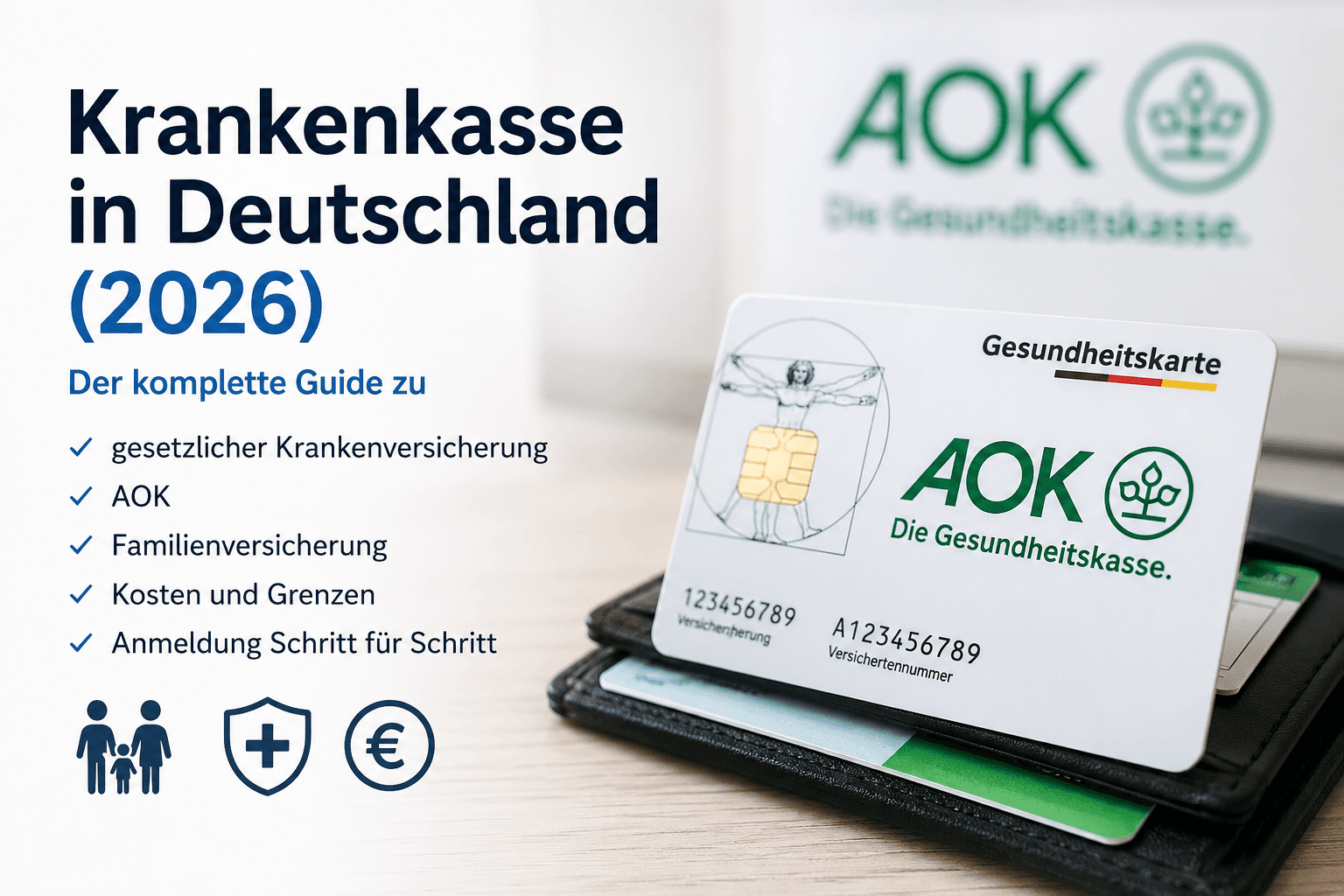
Krankenkasse in Germany (2026): Complete Guide to Health Insurance, AOK and Familienversicherung
If you move to Germany and start working here, one of the first important topics you need to deal with is Krankenversicherung, or health insurance.
If you are living in Germany for the first time, the system can initially seem complicated. What is a Krankenkasse? Does your employer choose it, or do you choose it yourself? When do you need to register? Do you need a Steuer-ID first? Is a German bank account required? How much does a Krankenkasse cost? Can your spouse and children be insured without additional contributions? And what happens when a child covered through Familienversicherung starts working?
In this guide, we explain the German health insurance system step by step. In addition to the official framework, we also use our practical experience with AOK — from the first registration and receiving the Gesundheitskarte to Familienversicherung and the situation when a child starts working.
Krankenkasse in Germany explained briefly: the most important points in 60 seconds
In Germany, people are generally required to have health insurance.
A large proportion of employees are insured through the gesetzliche Krankenversicherung (GKV), the statutory health insurance system.
In 2026, employees who are subject to compulsory social insurance and whose regular annual salary does not exceed the Jahresarbeitsentgeltgrenze of €77,400 are generally required to be insured in the GKV.
The €603 per month figure, however, is the 2026 Minijob limit and should not be treated as a universal lower GKV threshold for every type of employment.
The most important points:
- Krankenversicherung means health insurance itself;
- Krankenkasse is the specific statutory health insurance fund;
- employees usually choose their Krankenkasse themselves;
- the employer needs to know which Krankenkasse the employee belongs to;
- the Steuer-ID is required by the employer for the normal ELStAM procedure;
- a German bank account is not a prerequisite for registering with a Krankenkasse;
- under certain conditions, a spouse and children can be insured without separate contributions through Familienversicherung;
- every family member insured through Familienversicherung receives their own Gesundheitskarte;
- the general GKV contribution rate in 2026 is 14.6%, plus the individual Zusatzbeitrag charged by the respective Krankenkasse;
- the officially defined average Zusatzbeitragssatz for 2026 is 2.9%, although the actual rate of an individual Krankenkasse may differ.
What is a Krankenkasse?
First, it is important to distinguish between two similar German terms.
Krankenversicherung = health insurance.
Krankenkasse = the specific statutory health insurance fund.
AOK, for example, is one of the groups of Krankenkassen operating within the GKV system.
So if an employer asks:
„Bei welcher Krankenkasse sind Sie versichert?“
they want to know which statutory health insurance fund you are insured with.
GKV and PKV: what is the difference?
Germany has two main health insurance systems.
Gesetzliche Krankenversicherung (GKV)
This is the statutory health insurance system.
At the beginning of 2026, around 74.2 million people were insured through the GKV. Of these, about 15.6 million were family members and children insured without separate contributions.
Private Krankenversicherung (PKV)
This is private health insurance.
Employees cannot simply leave compulsory GKV insurance and switch to PKV at any income level.
The standard Jahresarbeitsentgeltgrenze (JAEG), also called the Versicherungspflichtgrenze, is:
€77,400 per year in 2026.
If an employee’s regular annual income exceeds this limit and the other relevant conditions are met, they may have the option to remain in the GKV as freiwillig versichert or switch to PKV.
An annual salary above €77,400 ≠ automatic obligation to switch to PKV.
What do you need to arrange when starting work in Germany?
If you have just moved to Germany, several administrative steps often happen almost at the same time.
A practical sequence may look like this:
Residence / Anmeldung
↓
Steuer-ID
↓
job offer or Arbeitsvertrag
↓
choose and register with a Krankenkasse
↓
give Krankenkasse information to the employer
↓
Sozialversicherung registration
↓
start work
↓
German Bankkonto if needed
↓
Gesundheitskarte
↓
Familienversicherung for spouse and children if eligible
Important: this is not a legally mandatory sequence where each step always has to be fully completed before the next one can begin.
Several processes can run in parallel.
However, our practical experience followed a very similar order.
Why is the Steuer-ID important when starting work in Germany?
The Steueridentifikationsnummer, usually called the Steuer-ID, is your personal tax identification number.
Your employer uses it in the ELStAM system to electronically retrieve the information needed to calculate payroll tax, such as your Steuerklasse and Freibeträge.
After your first Anmeldung in Germany, a Steuer-ID is usually assigned.
However, there is an important detail.
If a new employee has not yet received a Steuer-ID, this does not mean there is no temporary solution in the German system.
In certain situations, the Finanzamt can issue a Bescheinigung für den Lohnsteuerabzug, which can temporarily replace the normal ELStAM procedure.
The Steuer-ID is therefore very important when starting employment, but it should not be confused with the Krankenversicherungsnummer or Sozialversicherungsnummer.
Steuer-ID, Sozialversicherungsnummer and Krankenversicherungsnummer are not the same
People who are new to Germany often confuse these numbers.
Steuer-ID
The personal tax identification number.
It is used in the German tax system, including by employers for the ELStAM procedure.
Sozialversicherungsnummer
The personal identification number used in the social insurance system, traditionally often referred to as the Rentenversicherungsnummer.
It is used throughout Germany’s social insurance system.
Krankenversicherungsnummer
The personal health insurance number.
It is linked to your Krankenversicherung status and can also be found on your Gesundheitskarte.
Steuer-ID ≠ Sozialversicherungsnummer ≠ Krankenversicherungsnummer.
These are three different identification numbers with different functions.
Do you need a Krankenkasse before starting work?
In practice, this often needs to be arranged before or directly when employment begins.
The employer needs to know which Krankenkasse the employee belongs to so that the required social insurance formalities can be completed correctly.
For someone starting work in Germany for the first time, the Krankenkasse can therefore be one of the most urgent administrative tasks.
You do not need to wait until every other part of your life in Germany has already been fully organised.
Practical experience: we needed AOK before a German bank account
In our case, the Krankenkasse had to be arranged before opening a German bank account.
The employer needed the AOK information to complete the social insurance formalities connected with starting the job.
At that point, there was no German bank account yet.
That was not a problem.
AOK was arranged first, and the German bank account was opened later.
This is an important point for newcomers because people sometimes assume:
“As long as I do not have a German bank account, I cannot properly organise my job or Krankenkasse.”
That is not a universally correct sequence.
Do you need a German bank account to receive your salary?
No.
If you already have a SEPA account in another EU country, you do not necessarily need to open a German account purely to receive your salary.
EU rules prohibit so-called IBAN discrimination — rejecting a SEPA payment simply because the bank account is located in another EU member state.
A German Bankkonto can be very practical and useful in everyday life, but it is not a prerequisite for choosing a Krankenkasse.
Does the employer choose your Krankenkasse?
Usually not.
Employees have a Krankenkassenwahlrecht — the right to choose an appropriate statutory Krankenkasse from those they are eligible to join.
So an employer may ask:
„Welche Krankenkasse haben Sie?“
but this does not mean the employer must choose AOK, TK, Barmer or another Krankenkasse for you.
How do you register with a Krankenkasse?
The exact procedure depends on the Krankenkasse.
However, today much of the process can usually be completed online.
Our first experience with AOK was almost entirely remote.
Practical experience: first AOK registration online
In our case, the process worked like this:
- We completed the membership application on the AOK website.
- The required personal information was submitted online.
- The photo needed for the Gesundheitskarte was taken and submitted digitally.
- A few weeks later, the finished plastic Gesundheitskarte arrived by post with the person’s name and photo.
This meant that the initial Krankenkasse registration process could be completed without visiting an AOK branch.
The exact procedure may change, so the current requirements of the chosen Krankenkasse should always be checked.
What is the elektronische Gesundheitskarte (eGK)?
People insured through the GKV receive an elektronische Gesundheitskarte, abbreviated as eGK.
In everyday language, it is often simply called:
Gesundheitskarte
or
Krankenkassenkarte.
It is a personal card that allows a medical practice to identify the insured person and confirm their insurance status.
How does the Gesundheitskarte work at a Hausarzt?
The usual process is straightforward.
You go to the Hausarzt and present your Gesundheitskarte at reception.
The medical practice reads the card and receives the necessary insurance information.
If the treatment is covered by the GKV, billing is handled through the statutory health insurance system.
However, this does not mean that every medical service and every medication is always completely free for the patient.
In some situations there are Zuzahlungen, or co-payments, and some services may not be fully covered by the GKV.
How much does a Krankenkasse cost in 2026?
There is no single fixed monthly GKV price for everyone.
Contributions depend largely on the insured person’s income.
The general GKV Beitragssatz in 2026 is 14.6%.
In addition, each Krankenkasse sets its own individual Zusatzbeitragssatz.
The officially defined durchschnittlicher Zusatzbeitragssatz for 2026 is 2.9%.
However, that does not mean every Krankenkasse charges exactly 2.9%.
As of 1 April 2026, the average Zusatzbeitrag actually charged by the Krankenkassen was 3.13%.
The rate of a particular Krankenkasse may be higher or lower.
So when comparing AOK or other Krankenkassen, always check the current individual Zusatzbeitragssatz of that specific fund.
Who pays the Krankenkasse contribution — employee or employer?
In a normal employment relationship, the employee does not finance health insurance alone.
The contributions are shared between:
the employee
and
the employer.
Both generally contribute toward the standard GKV contribution and the individual Zusatzbeitrag of the Krankenkasse.
So if you see a GKV contribution rate of 14.6%, you should not assume that the entire percentage is deducted solely from the net salary of a normal Angestellter.
What is the Beitragsbemessungsgrenze?
GKV contributions do not increase without limit as income rises.
This is controlled by the Beitragsbemessungsgrenze.
In 2026, the limit for Krankenversicherung and Pflegeversicherung is:
€5,812.50 per month
or
€69,750 per year.
Income above this limit does not generate additional GKV contributions.
Do not confuse the Beitragsbemessungsgrenze with the Versicherungspflichtgrenze
These are two different limits.
| 2026 limit | Amount | What it means |
|---|---|---|
| Beitragsbemessungsgrenze | €69,750/year | GKV contributions are calculated only up to this income level |
| Jahresarbeitsentgeltgrenze | €77,400/year | Important for determining whether an employee is subject to compulsory GKV insurance |
These limits are often confused even though they regulate very different issues.
What is the Zusatzbeitrag?
In addition to the standard GKV contribution rate, every Krankenkasse sets its own Zusatzbeitragssatz.
This means that the actual contribution level can differ between Krankenkassen.
However, price should not be the only factor when choosing a Krankenkasse.
Other important factors may include:
- customer service;
- availability of local branches;
- mobile app;
- online services;
- bonus programmes;
- additional Leistungen;
- preventive health programmes;
- ease of communication.
For someone who has just moved to Germany and does not yet speak German well, accessible personal customer service may be especially valuable.
What is Familienversicherung?
Familienversicherung is one of the most important advantages of the GKV for families.
Under certain conditions:
- a spouse;
- a registered partner;
- children
of a GKV member can be insured without paying a separate health insurance contribution.
This is called:
beitragsfreie Familienversicherung.
At the beginning of 2026, around 15.6 million people in Germany were insured through the GKV as family members or children without separate contributions.
Practical example: one spouse works, the wife and two children are covered by Familienversicherung
In our family, only one spouse initially worked.
He was an Angestellter and an AOK member.
His wife and both children were registered through his AOK Familienversicherung.
In practice, the situation looked like this:
| Family member | Insurance status | Separate GKV contribution |
|---|---|---|
| Working spouse | AOK member | Yes |
| Wife | Familienversicherung | No |
| Child | Familienversicherung | No |
| Child | Familienversicherung | No |
This can be especially important for families where only one parent starts working immediately after moving to Germany.
Is Familienversicherung automatic?
No.
The fact that one spouse is insured through the GKV does not automatically mean that every family member can always be insured free of charge through that person.
Several conditions may be considered, including:
- family status;
- place of residence or habitual residence;
- income of the family member;
- the family member’s own insurance status;
- for children, their age;
- the child’s employment or education situation.
So eligibility for Familienversicherung always has to be assessed based on the specific family situation.
How much can a family member earn while remaining in Familienversicherung in 2026?
Familienversicherung depends not only on family status but also on the family member’s regular income.
In 2026, the general regular Gesamteinkommen limit for Familienversicherung is €565 per month.
If the family member has a geringfügig entlohnte Beschäftigung, meaning a Minijob, the relevant limit in 2026 is:
€603 per month.
This means that a spouse or child can, under certain conditions, work and still remain covered by Familienversicherung.
Therefore, the statement
“As soon as a child starts working, Familienversicherung automatically ends.”
is not always correct.
The type of employment, regular income and the other Familienversicherung conditions are decisive.
If the income or employment situation changes, the Krankenkasse should be informed.
Until what age can a child remain in Familienversicherung?
Age is another important condition.
Depending on the child’s situation, Familienversicherung can continue for different lengths of time.
Children can generally remain in Familienversicherung:
- until age 18;
- until age 23 if they are not employed;
- until age 25 if they are attending school, studying, completing certain forms of Berufsausbildung or participating in certain Freiwilligendienst programmes.
Special rules and exceptions may apply in individual cases.
After a child turns 18, it is therefore particularly important to keep the Krankenkasse informed about school, university, Ausbildung and employment.
Does a wife covered by Familienversicherung receive her own AOK card?
Yes.
This is a very important practical question.
In our case, the wife was covered through her spouse’s Familienversicherung, but she still received her own AOK Gesundheitskarte with her personal insurance information.
Familienversicherung ≠ one Gesundheitskarte for the entire family.
Each insured person has their own insurance status and their own card.
Practical experience: the wife goes to the Hausarzt with her own AOK card
When the wife went to the Hausarzt, she did not need to use her husband’s AOK card.
At reception, she presented her own Gesundheitskarte.
The medical practice used the insurance information on her card, and the treatment covered by the GKV was billed through AOK.
The practical process was:
spouse is an AOK member
↓
wife is covered through Familienversicherung
↓
wife receives her own Gesundheitskarte
↓
she uses her own card at the Hausarzt
↓
GKV-covered services are billed through the Krankenkasse
Why does AOK regularly ask for information about Familienversicherung?
Familienversicherung is not a status that is granted once and never checked again.
The Krankenkasse regularly verifies whether the requirements are still being met.
According to current AOK information for 2026, insured members generally receive a request once a year to update information relating to Familienversicherung.
This matches our own practical experience: every year, we had to update the information about family members covered through Familienversicherung.
The Krankenkasse may ask for information about:
- the spouse’s situation;
- income;
- employment;
- the children’s situation;
- school or university;
- another health insurance arrangement;
- changes in marital or family status.
Letters or questionnaires about Familienversicherung should therefore not be ignored.
What happens when a child covered by Familienversicherung starts working?
We also experienced this situation directly.
Our son was initially covered through one parent’s AOK Familienversicherung.
When he started working and acquired his own insurance status, he was removed from the parent’s Familienversicherung.
In our specific case, the simplified sequence was:
child is covered through Familienversicherung
↓
starts sozialversicherungspflichtige Beschäftigung
↓
receives own Krankenversicherungsstatus
↓
Familienversicherung ends
This does not mean the person becomes uninsured.
Only the legal basis of the insurance changes.
Important: Not every type of work automatically ends Familienversicherung.
For Minijobs and other employment situations, the income limit and the other conditions of Familienversicherung must be checked.
Do you need to report changes to the Krankenkasse yourself?
Yes.
Important changes should be reported to the Krankenkasse.
For example, if:
- the spouse starts working;
- their income changes;
- a child starts working;
- a child starts or finishes school or university;
- a family member receives another form of Krankenversicherung;
- the family status changes.
You should not rely entirely on the assumption:
“They will automatically see it in the system anyway.”
If a change may affect Familienversicherung, it should be reported to the Krankenkasse.
Practical issue for newcomers: a German mobile phone number
There was another practical detail in our experience with AOK.
Around two years ago, during an in-person visit to an AOK branch to correct family member information, we were offered the option to add a mobile number to the profile in order to receive information from AOK.
At that time, there was no German mobile number yet.
In our specific case, the system did not accept a foreign mobile number.
Important: This was our individual experience at that time and does not mean that AOK generally refuses foreign phone numbers in 2026.
Digital systems change, and AOK is organised regionally.
However, in practice, having a German mobile number after moving to Germany can make many digital services easier to use.
Is AOK one single Krankenkasse throughout Germany?
Not exactly.
AOK is organised regionally.
That means specific services, Zusatzbeitrag rates, branch offices, contact details and individual procedures may vary by region.
So when you find information online about “AOK”, it is always worth checking which regional AOK the information refers to.
How do you choose a Krankenkasse?
Since a large part of the basic GKV benefits is regulated by law, the core coverage offered by different Krankenkassen is broadly similar.
However, there can be differences in:
- Zusatzbeitrag;
- additional benefits;
- bonus programmes;
- preventive health programmes;
- additional dental benefits;
- digital services;
- quality of the app;
- customer service;
- branch network.
For this reason, you should not look only at the price when choosing a Krankenkasse.
If you have just moved to Germany, it can be especially useful to have the option of visiting a local branch and discussing a problem in person.
Can you change your Krankenkasse later?
Yes.
You do not necessarily have to stay with the same Krankenkasse for the rest of your life.
If another Krankenkasse later becomes cheaper or better suited to your needs, you can switch to another statutory Krankenkasse under the applicable conditions.
When changing Krankenkasse, you need to consider the current rules on binding periods, the switching procedure and any special rights to change your health insurance fund.
It is particularly useful to check your switching options if your Krankenkasse changes its Zusatzbeitragssatz.
What happens to your Krankenkasse when you change employers?
Changing employers does not normally mean that you also have to change your Krankenkasse.
If you remain insured through the GKV and want to stay with the same Krankenkasse, this is generally possible.
Your new employer needs information about your Krankenkasse so that the Sozialversicherung registration can be completed correctly.
old employer
↓
employment ends
↓
new employer
↓
the same Krankenkasse can remain
What happens to your Krankenkasse if you become unemployed?
Losing your job does not automatically mean that your health insurance coverage disappears.
However, the basis of your insurance and the question of who pays the contributions may change.
The specific situation depends, for example, on:
- whether you receive Arbeitslosengeld;
- whether you are entitled to other social benefits;
- whether Familienversicherung is possible;
- whether voluntary GKV membership continues;
- what insurance status you had before becoming unemployed.
If your employment ends and your future insurance status is unclear, you should contact your Krankenkasse as early as possible.
What happens to your Krankenkasse if you become self-employed?
Moving from employee status to Selbstständigkeit can significantly change your health insurance situation.
For self-employed people, GKV contributions are calculated differently from those of a normal employee.
As a rule, there is no employer paying an employer’s share of the health insurance contributions.
Before becoming self-employed, you should therefore clarify what your future Krankenversicherungsstatus will be and approximately how much your health insurance will cost.
This is particularly important for people who were previously compulsorily insured in the GKV as employees.
Krankenkasse and Pflegeversicherung
Health insurance in Germany is closely connected with Pflegeversicherung, or long-term care insurance.
This is why employees see contributions for Pflegeversicherung on their payslips alongside Krankenversicherung contributions.
Krankenversicherung and Pflegeversicherung are not the same thing, even though they are closely connected within Germany’s social insurance system.
The amount of Pflegeversicherung contributions can depend, among other factors, on whether the insured person has children and on other conditions defined by law.
What does statutory health insurance usually cover?
The basic benefits provided by the GKV are regulated by law.
Depending on medical necessity and the specific service, the GKV system covers, for example:
- doctor visits;
- treatment by medical specialists;
- hospital treatment;
- certain prescription medicines;
- preventive examinations;
- care during pregnancy and childbirth;
- certain rehabilitation services;
- certain dental services;
- other medically necessary services.
This does not mean that every possible medical service is automatically paid for in full by the GKV.
There may be Zuzahlungen, personal contributions or services that are not included in the standard GKV benefit catalogue.
What is a Zuzahlung?
A Zuzahlung is a co-payment that an insured person may have to make for certain medical services or medicines.
Being insured through the GKV therefore does not mean:
“I will never have to pay anything myself for medical care.”
In certain situations, legally defined co-payments may apply.
At the same time, the German system has rules that limit the overall financial burden caused by co-payments.
What should you do if your Gesundheitskarte has not arrived yet?
If you are already insured but have not yet received the physical Gesundheitskarte, this does not automatically mean that you cannot prove your insurance coverage.
Depending on the situation, your Krankenkasse may provide another form of proof of insurance.
If you need to see a doctor before the card arrives, it is best to contact your Krankenkasse and the medical practice.
Medically necessary treatment should not be postponed simply because the physical Gesundheitskarte has not yet arrived by post.
What should you do if you lose your Gesundheitskarte?
If your Gesundheitskarte is lost or damaged, you should inform your Krankenkasse.
The Krankenkasse can arrange for a new card to be issued.
If you need to see a doctor before the replacement card arrives, you can ask your Krankenkasse how to prove your insurance coverage in the meantime.
Can another family member use my Gesundheitskarte?
No.
The Gesundheitskarte is personal.
Even if a spouse or child is covered through Familienversicherung, they have their own insurance status and their own Gesundheitskarte.
One family ≠ one shared Krankenkassenkarte.
Common mistakes with Krankenkasse in Germany
1. Waiting for a German bank account before arranging the Krankenkasse
A German bank account is not a general requirement for registering with a Krankenkasse.
2. Thinking that only the employer chooses the Krankenkasse
Employees generally have a Krankenkassenwahlrecht.
3. Confusing the Steuer-ID with the Sozialversicherungsnummer
These are different identification numbers with different purposes.
4. Confusing the Sozialversicherungsnummer with the Krankenversicherungsnummer
These are also not the same number.
5. Assuming that Familienversicherung happens automatically
The required information must be provided to the Krankenkasse, and the eligibility conditions must be met.
6. Not reporting when a family member starts working or their income changes
Such changes can affect Familienversicherung.
7. Ignoring letters from the Krankenkasse
It is especially important to respond to requests concerning Familienversicherung and insurance status.
8. Choosing a Krankenkasse only because it has the lowest Zusatzbeitrag
Price matters, but benefits and customer service should also be considered.
Practical checklist for newcomers to Germany
If you have just moved to Germany and are starting work here, the following practical checklist can help:
- Register your residence and complete your Anmeldung.
- Check whether you have already been assigned a Steuer-ID, or clarify a temporary solution if you have not yet received one.
- Choose a suitable Krankenkasse.
- Register with your chosen Krankenkasse.
- Tell your employer which Krankenkasse you are insured with.
- Check that your employer has all the information needed for your Sozialversicherung registration.
- Open a German bank account if needed.
- Wait for your Gesundheitskarte.
- If you have a spouse or children, check whether Familienversicherung is possible.
- Later, inform the Krankenkasse about relevant changes in income, employment, education or family circumstances.
This checklist should not be understood as a legally mandatory sequence. In practice, several of these steps can take place in parallel.
Krankenkasse for newcomers: what would we do the same way again?
Looking back at our own experience, we would mainly try not to make the process more complicated than necessary.
In our case, the practical sequence looked approximately like this:
Anmeldung
↓
Steuer-ID
↓
employment
↓
AOK
↓
information provided to the employer
↓
Gesundheitskarte
↓
Familienversicherung for the family
The German bank account was opened later.
This is a good example of why newcomers do not necessarily have to wait until every administrative matter has been fully completed before arranging their Krankenversicherung.
Frequently asked questions about Krankenkasse in Germany
Is health insurance mandatory in Germany?
Germany generally requires residents to have health insurance. A large proportion of employees are insured through the gesetzliche Krankenversicherung, or GKV.
Can I choose my own Krankenkasse?
Generally, yes. Employees in the GKV usually have a Krankenkassenwahlrecht, provided that the particular Krankenkasse is available to them.
Can my employer choose AOK for me?
Normally, the employee chooses the Krankenkasse and then informs the employer of that choice.
Do I need a Steuer-ID before registering with a Krankenkasse?
The Steuer-ID is very important for starting work and for the ELStAM procedure, but it is not the same as the Krankenversicherungsnummer. Different administrative processes can take place in parallel.
Do I need a German bank account to register with a Krankenkasse?
No. A German bank account is not a general requirement for choosing or registering with a Krankenkasse.
Can my salary be paid into a bank account in another EU country?
Within the SEPA area, an IBAN from another EU member state should not be rejected for a SEPA payment solely because the account is located in another EU country.
How much does a Krankenkasse cost in 2026?
The general GKV contribution rate in 2026 is 14.6%. In addition, the individual Zusatzbeitrag of the respective Krankenkasse applies. The officially defined average Zusatzbeitragssatz for 2026 is 2.9%.
Does the employee pay the entire Krankenkasse contribution?
No. In a normal employment relationship, both the employee and the employer contribute to the financing of Krankenversicherung.
What is the Beitragsbemessungsgrenze in 2026?
The Beitragsbemessungsgrenze for Krankenversicherung and Pflegeversicherung in 2026 is €69,750 per year, or €5,812.50 per month.
What is the Jahresarbeitsentgeltgrenze in 2026?
The general Jahresarbeitsentgeltgrenze, also known as the Versicherungspflichtgrenze, is €77,400 per year in 2026.
Is Familienversicherung free?
If all requirements are met, a spouse, registered partner and children can be insured without paying a separate GKV contribution.
How much can a family member earn while remaining in Familienversicherung?
In 2026, the general regular Gesamteinkommen limit is €565 per month. For a geringfügig entlohnte Beschäftigung, or Minijob, the corresponding limit is €603 per month.
Can a child work and still remain in Familienversicherung?
Under certain conditions, yes. Starting work does not always automatically end Familienversicherung. The type of employment, regular income, age and other eligibility conditions must be considered.
Does a wife covered through Familienversicherung have her own Gesundheitskarte?
Yes. Every insured family member receives their own personal Gesundheitskarte.
Can a family-insured person use their own AOK card at the Hausarzt?
Yes. A person covered through Familienversicherung uses their own Gesundheitskarte at the doctor, not the card of the main AOK member.
Why does AOK ask for family information every year?
The Krankenkasse regularly checks whether the requirements for Familienversicherung continue to be met. Information about income, employment, education, university studies and other circumstances may therefore need to be updated.
What happens if a child covered by Familienversicherung starts a full-time job?
If the employment creates the child’s own compulsory health insurance status, Familienversicherung generally ends and the child becomes insured on the basis of their own employment.
Is AOK the same throughout Germany?
AOK is organised regionally. This means that Zusatzbeitrag rates, branches, benefits and certain procedures can differ depending on the regional AOK.
Can I change my Krankenkasse?
Yes. Subject to the applicable GKV rules, it is possible to switch from one statutory Krankenkasse to another.
Do I lose my health insurance if I become unemployed?
No. Losing your job does not automatically mean losing your health insurance coverage. However, the basis of your insurance and the way contributions are financed may change.
Conclusion: Krankenkasse is one of the first important steps in Germany
If you move to Germany and start working here, it is important to understand the health insurance system from the beginning.
At first, the German terminology may seem complicated:
Krankenkasse
Krankenversicherung
Gesundheitskarte
Familienversicherung
Zusatzbeitrag
Beitragsbemessungsgrenze
Jahresarbeitsentgeltgrenze
But the practical logic is much simpler.
choose a Krankenkasse
↓
register
↓
tell your employer which Krankenkasse you have chosen
↓
receive your Gesundheitskarte
↓
check Familienversicherung for eligible family members
↓
inform the Krankenkasse about important changes
Our own experience with AOK also highlighted several practical points: the initial registration could be completed remotely, a German bank account was not required before registering with AOK, the wife and children could be covered through Familienversicherung, and each family member received their own Gesundheitskarte.
Later, as the family situation changed, the insurance status changed as well. When a child started a sozialversicherungspflichtige Beschäftigung, they acquired their own Krankenversicherungsstatus.
The most important point is not to treat Krankenversicherung as a one-time administrative formality.
If employment, income or family circumstances change, the insurance status may change as well.
Once you understand this basic principle, the German Krankenkasse system becomes much easier to navigate.
Related practice
Continue with the learning pages and games connected to this article.