

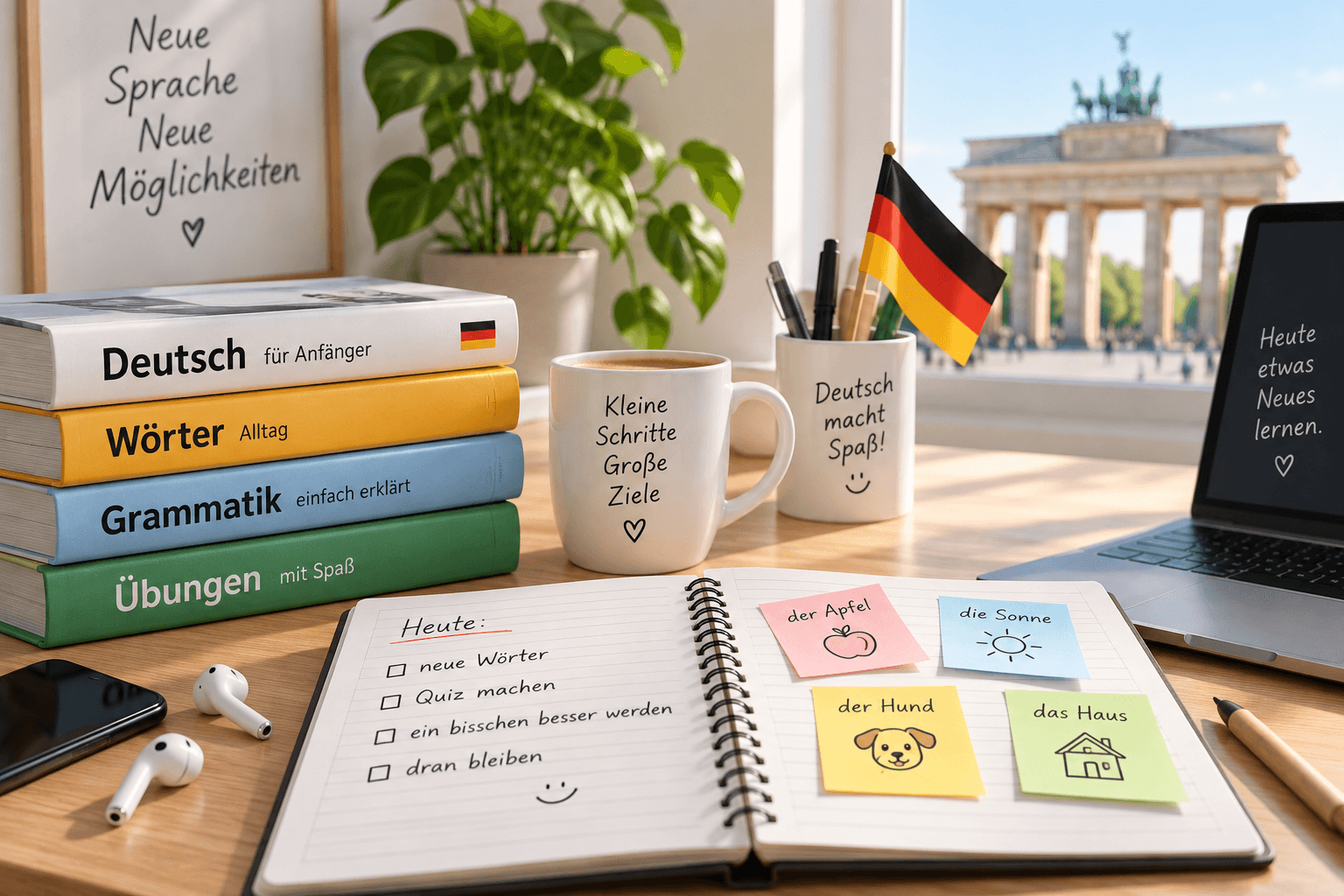
Don’t Know a Single Word of German Yet? Start with 5 Simple Questions
Want to learn German but have no prior knowledge at all? With DMS, you can start with a simple topic such as the alphabet, numbers, months, seasons, or weather, learn your first German words, and immediately try a 5-question quiz. You don’t have to write anything, know German grammar, or worry about making mistakes. Simply choose one of four answers and take your first step into the German language.
For many people, learning German can seem difficult at first. If you don’t know a single German word yet, it’s easy to think that you first need to learn hundreds of words, articles, verb endings, and grammar rules.
But your first step doesn’t have to be that big.
A few words. Five questions. A few minutes.
That’s enough to get started.
Can I take a DMS quiz without knowing any German?
Yes. The easiest DMS quizzes are suitable even for complete beginners who are just starting to learn German.
Before taking a quiz, you can look through the words for a particular topic, see their pronunciation, and explore examples. DMS then gives you 5 questions with four answer choices for each question.
You don’t have to type the correct German word yourself.
You don’t have to build a sentence.
You don’t need to know what Nominativ, Akkusativ, or Dativ means.
At first, it’s enough to try to recognize the correct answer.
And if you don’t know it, you can guess.
Even a wrong answer can become your first small German lesson.
Your first German lesson doesn’t have to feel like a lesson
Imagine you have never studied German before.
You open the Seasons topic in DMS and see just four words:
der Frühling — spring
der Sommer — summer
der Herbst — autumn
der Winter — winter
That’s all you need to begin.
Then you can start the short quiz straight away.
For example, DMS asks you to choose the German word for:
autumn
and gives you four possible answers.
Maybe you already remember that Herbst means autumn.
Maybe you simply guess.
Either way, you are learning.
If you choose the correct answer, you reinforce the word in your memory.
If you choose the wrong one, you discover the correct answer.
The next time you see Herbst, it will no longer be a completely unfamiliar German word.
Even the alphabet can become your first German quiz
In the DMS German alphabet section, you don’t just learn the letters. You can also see their pronunciation and simple example words:
A – Apfel
B – Buch
D – Deutsch
H – Haus
N – Nacht
S – Sonne
W – Wasser
You’ll also find the characters that are particularly important in German: Ä, Ö, Ü, and ß.
After looking through the alphabet, you can immediately try a 5-question quiz.
For example, you might see the German word:
Quelle
and be asked to choose its correct meaning in your language from four possible answers.
You don’t have to type anything in German.
Just choose an answer.
Don’t know it? Take a guess.
Got it wrong? Look at the correct answer.
If the word Quelle already looks familiar a few minutes later, you have learned another German word.
Learn German from scratch with simple topics
If you want to learn German from scratch, you don’t have to begin with difficult grammar.
In the DMS basics section, you can start with simple topics such as:
- the alphabet;
- numbers;
- months;
- seasons;
- weather;
- metric units;
- telling the time.
These topics have one major advantage: you already know many of the concepts from everyday life.
Now you only need to learn what they are called in German.
German numbers – a practical start for everyday life in Germany
Numbers are among the first things a German beginner can use in real life.
You need them to understand:
- prices;
- phone numbers;
- addresses;
- dates;
- time;
- quantities;
- ages.
With DMS, you can learn German numbers from the basics all the way up to 1,000,000.
Of course, you don’t need to learn everything at once.
Look at a few numbers, try the quiz, and continue when you’re ready.
Weather in German – your first everyday words
Weather is another great topic for complete beginners learning German.
For example:
sonnig — sunny
bewölkt — cloudy
warm — warm
kalt — cold
der Regen — rain
der Schnee — snow
der Wind — wind
das Gewitter — thunderstorm
These aren’t abstract grammar terms. They are German words you can encounter in weather forecasts, apps, conversations, and everyday life in Germany.
The DMS weather topic contains 40 entries covering weather, temperature, precipitation, wind, and other weather-related terms.
After that, you can move straight on to another short training session with just 5 questions.
Metric units in German – you already understand more than you think
Sometimes you can understand the meaning of a German word even if you have never studied it before.
For example:
mm – der Millimeter
cm – der Zentimeter
m – der Meter
km – der Kilometer
kg – das Kilogramm
°C – Grad Celsius
You already recognize the symbol. Now you only need to learn the German name.
With DMS, you can also explore words related to length, area, volume, mass, temperature, speed, and other measurements used in everyday life.
After exploring the topic, you can immediately test yourself with a 5-question quiz.
From your first German word to your first sentence
Once individual words and numbers start to feel familiar, you can take the next step and begin understanding simple German phrases and sentences.
Telling the time is a good example.
First, you learn the question:
Wie spät ist es? — What time is it?
Then you encounter simple expressions:
Es ist ein Uhr. — It’s one o’clock.
Es ist fünf nach eins. — It’s five past one.
Es ist halb zwei. — It’s half past one.
Es ist Viertel vor zwei. — It’s quarter to two.
At this point, you’re no longer learning only individual words. You’re starting to understand complete German expressions and sentences.
That’s a natural next step after the easiest beginner quizzes.
Why does a DMS quiz have only 5 questions?
The purpose of a short DMS quiz isn’t to test how much German you already know.
Its purpose is to make it easy to start.
Five questions are short enough to try right away.
You can:
- choose a topic;
- look at a few words;
- answer 5 questions;
- see what you already remember;
- try again or move on to another topic.
This breaks learning German into small, manageable steps.
You don’t have to promise yourself:
“Today I’m going to study German for two hours.”
Sometimes it’s enough to say:
“I’ll answer five questions.”
What happens if I get an answer wrong?
Nothing bad happens.
The short DMS quiz isn’t a German exam.
If you don’t know the answer, you can guess and then remember the correct one.
That means you can use the quiz not only to test yourself, but also to learn new German words.
The first time, you might not know the word at all.
The second time, it already looks familiar.
The third time, you may be able to choose the correct answer without guessing.
That is progress too.
Can I learn German with quizzes alone?
No. A five-question quiz can’t replace learning the whole German language.
It is a simple way to start learning German.
Once your first words begin to feel familiar, you can continue in DMS with more topics, German verbs, and grammar.
For example, your next step could be the German present tense — Präsens.
There you can learn common German verbs such as:
lernen — to learn
machen — to do / make
gehen — to go
sprechen — to speak
and then see how a verb changes:
ich lerne — I learn
du lernst — you learn
er lernt — he learns
wir lernen — we learn
Step by step, your learning path can develop like this:
first German word → vocabulary → simple phrases → verbs → German grammar
How can I start learning German from zero?
If you don’t know any German yet, there’s no reason to start with the hardest topics.
A simple learning path in DMS can look like this:
1. Alphabet
Learn the German letters, their pronunciation, and your first words.
↓
2. Numbers
Learn words you’ll need again and again in everyday life.
↓
3. Months and seasons
Start recognizing small, easy-to-understand groups of words.
↓
4. Weather
Build practical German vocabulary for everyday situations.
↓
5. Telling the time
Move from individual words to your first phrases and sentences.
↓
6. Präsens and German verbs
Start exploring German grammar step by step.
There is no rule for how quickly you need to follow this path.
What matters isn’t how much German you learn on your first day. What matters is that you start.
Frequently asked questions about learning German for beginners
Can I really learn German from scratch?
Yes. Start with very simple topics such as the alphabet, numbers, or seasons. With DMS, you can first look at a few words and then try a short 5-question quiz.
Do I need to know German grammar before taking the quiz?
No. You don’t need any grammar knowledge for the easiest beginner quizzes. At first, the main goal is simply to recognize German words and understand their meaning.
What if I don’t know any of the correct answers?
You can guess. Mistakes are part of learning. Once you see the correct answer, you may recognize the word the next time it appears.
How many questions are in a short DMS quiz?
Each quick topic training contains 5 questions with four answer choices for each question.
What is the best German topic for a complete beginner?
If you have never studied German before, you can start with the alphabet, numbers, or seasons. Then move step by step to months, weather, telling the time, and other topics.
Is DMS only for German beginners?
No. The simple basics are only the starting point. From there, you can continue with German verbs, the Präsens, and other German grammar topics.
Don’t know a single word of German yet? Just start
You don’t have to wait until you feel “ready” to learn German.
Choose one topic.
Look at a few words.
Answer five questions.
Don’t know the answer? Guess.
Got it wrong? Look at the correct answer.
Then try again.
That’s how your first German knowledge can begin.
Choose your first topic
- German alphabet + quiz
- German numbers + quiz
- Months in German
- Seasons in German + quiz
- Weather in German + quiz
- Metric units in German + quiz
- Telling the time in German + quiz
Or open the DMS German grammar section and choose where you want to begin.
Don’t know any German yet? That’s not a barrier. It’s exactly why starting with the first question makes sense.
Related practice
Continue with the learning pages and games connected to this article.