
Minimum Wage in Germany 2026 — Mindestlohn, Hourly Wage, Gross and Net Salary
If you work in Germany, one of the most important salary-related terms to understand is Mindestlohn — the statutory minimum wage required by German law.
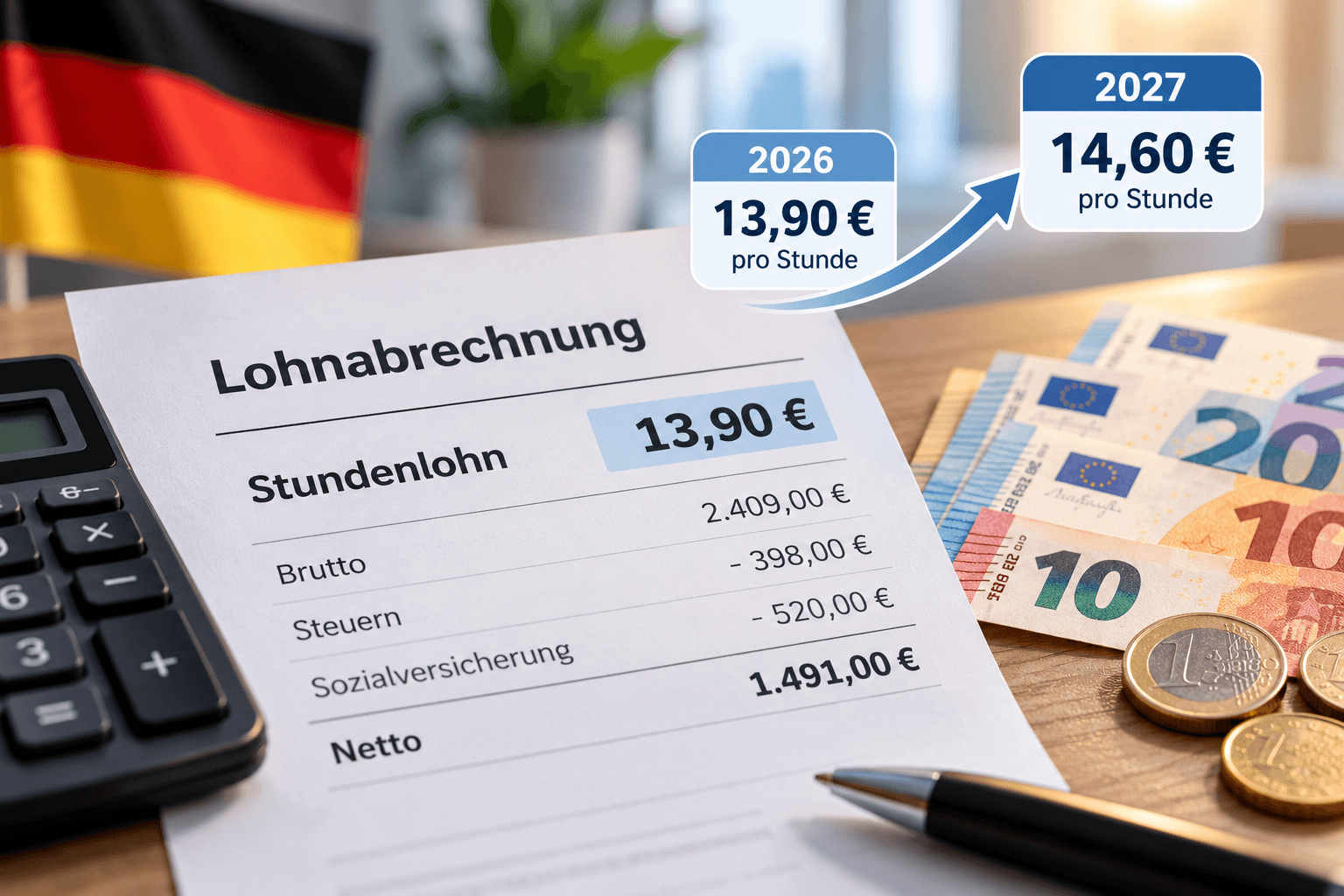
From 1 January 2026, the statutory minimum wage in Germany is €13.90 gross per hour. From 1 January 2027, it will increase to €14.60 gross per hour.
The minimum wage generally also applies to Minijobs — small-scale employment subject to special rules, part-time work and foreign employees working in Germany. However, German law provides for certain exceptions.
But the figure €13.90 alone does not tell you everything you need to know about your pay.
In a job advertisement, you may see Stundenlohn — hourly wage. Your employment contract may state your Bruttogehalt — gross salary, while your German payslip can contain many other terms and abbreviations.
In this guide, we explain:
- how high the minimum wage in Germany is in 2026;
- approximately how much that means per month;
- the difference between gross and net salary;
- who is entitled to the statutory minimum wage;
- how the minimum wage works for Minijobs and part-time employment;
- what happens with overtime and additional payments;
- how to check your actual hourly wage;
- what the most important terms on a German payslip mean;
- and what to do if you believe your employer is paying you too little.
1. What is the minimum wage in Germany in 2026?
Mindestlohn means the statutory minimum wage — the general minimum hourly rate that an employer must pay when German minimum wage regulations apply to the employment relationship.
In 2026, the statutory minimum wage is:
€13.90 gross per hour
From 1 January 2027, it will be:
€14.60 gross per hour.
The most important word here is gross.
€13.90 is not the amount you automatically receive in your bank account for every hour you work.
2. Gross and net salary — what is the difference?
These are two of the most important concepts to understand when working in Germany.
Bruttogehalt — gross salary is your pay before taxes and social security contributions are deducted.
Nettogehalt — net salary is the amount remaining after the applicable taxes and social security contributions have been deducted.
In simple terms:
Gross
↓
taxes + social security contributions
↓
Net
If a job advertisement says:
€15.00 brutto pro Stunde
this means €15.00 gross per hour, not €15.00 paid into your bank account.
There is no single universal figure for “minimum wage net” in Germany.
How much of your gross salary remains as net income depends on your individual tax and social security situation.
3. Stundenlohn and Monatsgehalt — two different ways of being paid
Stundenlohn means an hourly wage — the amount you are paid for one hour of work.
For example:
€15.50 brutto pro Stunde
Monatsgehalt, on the other hand, means a fixed monthly salary.
For example:
€2,700 brutto per month
Receiving a fixed monthly salary does not mean that the minimum wage is no longer relevant.
You also need to consider how many working hours you are expected to work for that salary.
For this reason, when comparing job offers in Germany, you should not look only at the monthly gross salary.
4. How much is the minimum wage per month in Germany?
Germany's statutory minimum wage is set per working hour, not as one universal monthly salary.
However, we can calculate an approximate monthly gross amount.
The calculation is:
weekly working hours × 52 weeks ÷ 12 months × €13.90
| Working time | Average hours per month | Approx. gross salary |
|---|---|---|
| 20 hours/week | 86.7 hours | approx. €1,205 |
| 30 hours/week | 130 hours | approx. €1,807 |
| 35 hours/week | 151.7 hours | approx. €2,108 |
| 40 hours/week | 173.3 hours | approx. €2,409 |
These are approximate mathematical examples, not guaranteed monthly salaries.
Your actual pay depends on your employment contract, paid working time, the hours you actually work and other employment conditions.
5. Who is entitled to the minimum wage in Germany?
Germany's general statutory minimum wage generally applies to employees working in Germany.
It is not limited to German citizens.
According to the Bundesministerium für Arbeit und Soziales (BMAS) — the German Federal Ministry of Labour and Social Affairs, the application of the minimum wage does not depend simply on an employee's nationality or the extent of their employment. It also applies to Minijob workers, seasonal workers and foreign employees working in Germany.
Therefore, the fact that you:
- have recently arrived in Germany;
- are a citizen of another country;
- do not yet speak German well;
is not, by itself, a reason for an employer to pay you less than the applicable minimum wage.
6. Does the minimum wage apply to part-time work (Teilzeit)?
Yes.
Teilzeit means part-time employment.
For example, someone may work:
- 20 hours per week;
- 25 hours per week;
- 30 hours per week.
The minimum wage is a minimum rate per working hour.
Working fewer hours per week does not, by itself, mean that a lower hourly wage is permitted.
7. Does the minimum wage apply to a Minijob?
Yes.
A Minijob is a form of small-scale employment in Germany that is subject to special tax and social security rules.
Minijob workers are generally also entitled to the statutory minimum wage.
In 2026, the Minijob earnings limit is:
€603 per month on an annual average basis.
This does not mean that a Minijob worker can legally be paid a lower hourly rate.
When the statutory minimum wage changes, the number of hours that can be worked at that rate while remaining within the Minijob earnings limit also changes.
8. Does the minimum wage apply to absolutely everyone?
No.
German minimum wage law includes certain exceptions.
It would therefore be too broad to say:
“Everyone in Germany must always be paid at least €13.90 per hour.”
A person's legal status and the specific type of employment are important.
Special rules may apply, for example, to certain internships, vocational training and other situations covered by specific legal provisions.
9. Do apprentices (Azubis) receive the statutory minimum wage?
Azubi is the common German abbreviation for Auszubildende/Auszubildender — a person completing vocational training.
Ausbildung is Germany's vocational training system, in which a profession is usually learned through a combination of practical training at a company and lessons at a vocational school.
Azubis do not receive the general statutory minimum wage in the same way as regular employees.
Instead, they receive an Ausbildungsvergütung — vocational training allowance, which is subject to separate rules.
For this reason, an Azubi's training allowance should not simply be compared with the Stundenlohn of a regular employee without considering the different employment status.
10. How can you calculate your hourly wage if your contract states a monthly salary?
Suppose your employment contract states:
€2,500 gross per month
and:
40 hours per week.
For an approximate comparison:
40 × 52 ÷ 12 ≈ 173.3 hours per month
€2,500 ÷ 173.3 ≈ €14.42 gross per hour.
This is a simplified calculation for guidance.
The actual situation may be more complicated if, for example, you work overtime, have an Arbeitszeitkonto, receive different salary components or are covered by a collective agreement.
11. Überstunden — what happens with overtime?
Überstunden means overtime — hours worked beyond the agreed or otherwise applicable working time.
It is therefore not enough to look only at the monthly salary stated in your employment contract.
You also need to ask:
How many hours are you actually working for that salary?
If an employee regularly works additional hours, these hours cannot simply be ignored when checking compliance with the minimum wage.
You may also find the following terms in your employment contract:
- Mehrarbeit — additional working time; the exact meaning may depend on the employment contract or collective agreement;
- Arbeitszeitkonto — a working time account used to record additional and reduced working hours;
- mit dem Gehalt abgegolten — wording indicating that a certain amount of additional work may already be included in the agreed salary.
This is why working hours and the terms of the employment contract need to be considered together.
12. Zuschläge — what are additional payments?
Zuschlag means an additional payment on top of your regular wage.
In Germany, you may encounter terms such as:
- Nachtzuschlag — additional payment for night work;
- Sonntagszuschlag — additional payment for Sunday work;
- Feiertagszuschlag — additional payment for working on a public holiday;
- Schichtzulage — additional payment for shift work.
An important point: not all additional payments are treated in the same way when determining whether the minimum wage requirement has been met.
According to the BMAS, certain additional payments that compensate employees for work performed may be counted towards the minimum wage. Other payments that an employer is required to make on a different legal basis may be treated differently. The BMAS cites legally required compensation for night work as one example.
Therefore, you should not automatically assume:
“Basic wage + any additional payment = minimum wage.”
The legal nature of the specific payment matters.
13. Mindestlohn is not the same as Tariflohn
It is important to distinguish between these terms.
Mindestlohn — the general statutory minimum wage.
Tarifvertrag — a collective agreement that may determine wages and other employment conditions for a particular sector or employment relationship.
Tariflohn — the wage determined according to the applicable collective agreement.
In an employment contract or job advertisement, you may also see:
Entgeltgruppe or Tarifgruppe — a pay group used to determine an employee's level of remuneration within a particular system.
A Tariflohn may be higher than the general statutory minimum wage.
So the relevant question is sometimes not only:
“Am I receiving at least €13.90?”
but also:
“What pay am I entitled to in my specific industry and job?”
14. Some industries may have special minimum pay rates
€13.90 is the general statutory minimum wage in Germany in 2026.
However, certain sectors may be subject to other binding minimum pay requirements or collective agreements.
This is particularly important for people working in areas such as:
- care and nursing;
- construction;
- warehouses and logistics;
- gastronomy and food service;
- cleaning;
- other practical occupations.
You should therefore check not only the general statutory minimum wage but also the rules that apply to your particular industry.
15. Why is working time documentation so important?
To check your actual hourly pay, you need to know how many hours you really worked.
Arbeitszeiterfassung means recording working time.
For certain types of employment and in certain industries, employers have specific obligations to document working hours.
According to the BMAS, this applies, for example, to Minijob employees with certain exceptions and to several sectors, including:
- construction;
- hotels and gastronomy;
- transport and logistics;
- building cleaning;
- the meat industry;
- hairdressing and cosmetics;
- and several other specified areas of employment.
In these cases, the documentation records the beginning, end and duration of the working day.
The BMAS also states that breaks are not counted as working time for this purpose and must be deducted from the recorded duration of work.
It is also useful for employees themselves to keep a record of:
date → start of work → end of work → breaks → hours actually worked
16. What can you find on a German payslip?
In Germany, a payslip may be called:
- Lohnabrechnung — payslip or payroll statement;
- Gehaltsabrechnung — salary statement or payslip.
A German payslip contains much more information than simply Gross and Net.
For example, you may see:
- Personalnummer — your internal employee number;
- Eintritt — the date your employment began;
- Steuer-ID — your personal tax identification number;
- Steuerklasse — the tax class used when calculating wage tax;
- Krankenkasse — your health insurance fund;
- wöchentliche Arbeitszeit — weekly working hours;
- Stundenlohn — hourly wage;
- Gehalt — salary;
- Gesamt-Brutto — total gross pay.
The payslip then shows taxes and social security contributions.
17. What do KV, RV, AV and PV mean on a German payslip?
German payslips frequently use abbreviations.
| Abbreviation | Meaning |
|---|---|
| KV — Krankenversicherung | Health insurance |
| RV — Rentenversicherung | Pension insurance |
| AV — Arbeitslosenversicherung | Unemployment insurance |
| PV — Pflegeversicherung | Long-term care insurance |
For example, you may see KV-Beitrag — health insurance contribution or RV-Beitrag — pension insurance contribution on your payslip.
These are typical terms used on German payroll documents.
18. Lohnsteuer, Kirchensteuer and Solidaritätszuschlag
Your German payslip may also contain a section showing taxes.
Lohnsteuer — wage tax deducted from your salary by your employer and transferred to the tax authorities.
Kirchensteuer — church tax, if it applies to the individual employee.
Solidaritätszuschlag — solidarity surcharge, if it is payable in the particular case.
This does not mean that every employee will necessarily see an amount deducted under all three categories.
19. Netto-Verdienst and Auszahlungsbetrag are not necessarily the same
Two other useful terms are:
Netto-Verdienst — net earnings after the relevant tax and social security deductions.
Auszahlungsbetrag — the final amount paid out according to the particular payroll calculation.
These amounts may be the same.
However, in certain situations, additional payments or deductions can result in a difference.
This is why you should not read your payslip by looking only at one large Netto figure.
Gross → taxes → social security contributions → Net → possible additional payroll items → Auszahlungsbetrag
20. How can you check whether your salary meets the minimum wage?
Start with four documents or sources of information:
-
Arbeitsvertrag — employment contract
Check your agreed salary and working hours.
-
Arbeitszeiterfassung — working time records
Check how many hours you actually worked.
-
Lohnabrechnung or Gehaltsabrechnung — payslip
Check your gross pay, working hours, additional payments and other salary components.
-
Bank account
Check the amount you actually received.
If you are paid by the hour, checking your wage is usually relatively straightforward.
If you receive a monthly salary and also work overtime, have an Arbeitszeitkonto or receive various additional payments, the calculation can be more complicated.
21. What should you do if your employer pays less than the minimum wage?
First, collect information and documents that can prove your working hours and pay.
Keep:
- your employment contract;
- payslips;
- working time records;
- shift schedules;
- information about overtime;
- records of salary payments.
Then check whether the general statutory minimum wage or another specific regulation applies to your employment relationship.
In Germany, compliance with minimum wage rules is monitored by, among others, the Finanzkontrolle Schwarzarbeit (FKS) — a unit of the German customs administration responsible for monitoring compliance with various employment regulations, including minimum wage requirements.
The statutory minimum wage is not a voluntary bonus from your employer.
If the statutory minimum wage applies to your employment relationship, you are legally entitled to the applicable minimum level of pay.
22. The most important German salary terms
| German term | Simple explanation in English |
|---|---|
| Mindestlohn | statutory minimum wage |
| Stundenlohn | hourly wage |
| Monatsgehalt | monthly salary |
| Bruttogehalt | salary before taxes and social security deductions |
| Nettogehalt | salary after the relevant deductions |
| Lohnabrechnung / Gehaltsabrechnung | payslip / payroll statement |
| Gesamt-Brutto | total gross pay |
| Lohnsteuer | wage tax |
| Krankenversicherung (KV) | health insurance |
| Rentenversicherung (RV) | pension insurance |
| Arbeitslosenversicherung (AV) | unemployment insurance |
| Pflegeversicherung (PV) | long-term care insurance |
| Netto-Verdienst | net earnings |
| Auszahlungsbetrag | final amount paid out |
| Überstunden | overtime |
| Arbeitszeitkonto | working time account |
| Zuschlag | additional payment / premium |
| Tarifvertrag | collective agreement |
| Tariflohn | wage set under a collective agreement |
| Teilzeit | part-time employment |
| Minijob | small-scale employment subject to special rules |
| Probezeit | probationary period |
| Ausbildung | vocational training |
23. Quick checklist — check your salary in Germany
When you receive a job offer or payslip in Germany, check:
- What is your Bruttogehalt?
- Are you paid a Stundenlohn or a Monatsgehalt?
- How many hours per week are stated in your employment contract?
- How many hours did you actually work?
- How are Überstunden handled?
- Do you have an Arbeitszeitkonto?
- Do you receive Zuschläge?
- Does a Tarifvertrag apply to your employment?
- Are there special pay rules for your industry?
- Does your payslip match your employment contract and the hours you actually worked?
Do not look only at the Netto amount that arrives in your bank account.
To understand your salary properly, you need to look at the full picture.
Frequently Asked Questions About the Minimum Wage in Germany
What is the minimum wage in Germany in 2026?
From 1 January 2026, the general statutory minimum wage in Germany is €13.90 gross per hour.
What will the minimum wage in Germany be in 2027?
From 1 January 2027, the statutory minimum wage will be €14.60 gross per hour.
How much is the minimum wage per month for a 40-hour working week?
Using the average calculation 40 × 52 ÷ 12, we get approximately 173.3 working hours per month.
At €13.90 per hour, this equals approximately:
€2,409 gross per month.
This is an approximate mathematical figure, not a universal guaranteed monthly salary.
How much is the minimum wage after tax in Germany?
There is no single universal net amount.
The statutory minimum wage is set as a gross hourly rate.
How much you receive after tax depends on your individual tax and social security situation.
Does the minimum wage in Germany apply to foreigners?
Yes. Nationality by itself does not remove an employee's right to the applicable minimum wage for work performed in Germany.
Does the minimum wage apply to part-time workers?
Yes. Teilzeit — part-time employment is not, by itself, an exception to the statutory minimum wage.
Does the minimum wage apply to Minijobs?
Yes. Minijob workers are generally also entitled to the statutory minimum wage.
What is the Minijob limit in Germany in 2026?
In 2026, the Minijob earnings limit is €603 per month on an annual average basis.
Does a break count as paid working time?
You should not automatically assume that it does. For example, under BMAS rules concerning the documentation of working time for minimum wage purposes, breaks are not counted as working time and are deducted from the documented working period.
Can an employer pay less than the minimum wage during Probezeit?
Probezeit — the probationary period does not, by itself, remove an employee's right to the applicable statutory minimum wage.
However, you should check whether a specific statutory exception applies to the particular situation.
Can an employer pay less because an employee does not speak German well?
No. A person's level of German language proficiency does not, by itself, remove their right to the applicable statutory minimum wage.
Are overtime hours important when calculating the minimum wage?
Yes. The hours actually worked must be taken into account. This is why accurate working time records are important.
Is €13.90 the minimum wage in every profession in Germany?
€13.90 is the general statutory minimum wage in Germany in 2026.
Certain industries or employment relationships may be subject to other binding minimum pay rules.
Conclusion — the minimum wage is about more than just €13.90
In 2026, the general statutory minimum wage in Germany is:
€13.90 gross per hour.
But if you work in Germany, it is important to understand the entire chain:
Mindestlohn → Stundenlohn → Arbeitszeit → Überstunden → Zuschläge → Gross → taxes and social security → Net → Auszahlungsbetrag
This allows you to understand not only the salary stated in your employment contract, but also how many working hours you are being paid for and how the final amount you receive is calculated.
If a job advertisement offers an attractive hourly wage, check the working conditions as well.
If your employment contract offers a good monthly salary, check the number of working hours and the rules for overtime.
When you receive your payslip, do not look only at the Net amount. Check the Gross amount, working hours, additional payments, taxes and social security contributions as well.
A good job offer is not just one large salary figure. What matters is what work you are being paid for, how many hours you are expected to work and under what conditions the salary is paid.
Related practice
Continue with the learning pages and games connected to this article.