

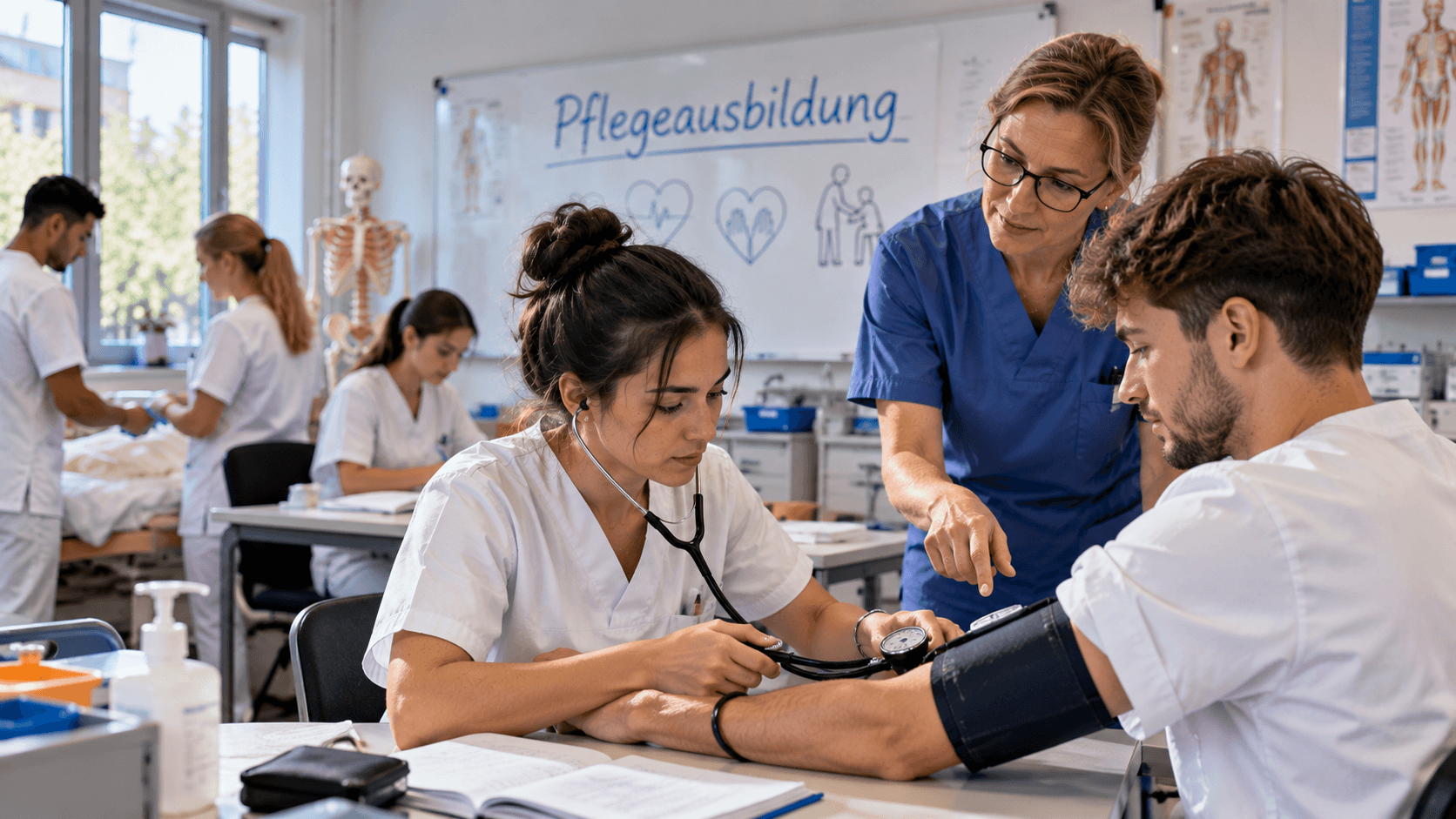
Nursing Ausbildung in Germany 2026 – Training, Salary, Requirements and German Language Skills
Would you like to become a qualified nursing professional in Germany? Find out how long a nursing Ausbildung takes, how much you can earn during training in 2026, whether B1 German is sufficient, which documents you need and where to find a training position.
In Germany, you can become a qualified nursing professional even without previous experience in healthcare or nursing. One of the main pathways is Pflege Ausbildung (nursing vocational training) – a state-regulated training programme that combines theoretical education, practical work and regular financial compensation.
The standard programme lasts three years. There are no tuition fees, and trainees receive a training allowance from their first year.
This opportunity is suitable both for young people who have finished school and for adults who want to change careers. People from Latvia, Poland, Romania and other countries can also apply, provided they meet the admission requirements.
This guide focuses specifically on obtaining the professional qualification of Pflegefachfrau, Pflegefachmann or Pflegefachperson in Germany.
If you already hold a nursing qualification or another relevant professional qualification obtained abroad, you should first explore the possibility of having it recognised in Germany – a process known as Anerkennung. This is a different pathway, covered in separate DMS guides.
1. Nursing Ausbildung in Germany 2026 – Key Facts at a Glance
| Question | Answer |
|---|---|
| Training duration | 3 years full-time |
| Part-time training | Up to 5 years |
| Tuition fees | €0 |
| Is training paid? | Yes, throughout the training period |
| Training salary in 2026 | €1,490.69–€1,653.38 gross per month under the TVAöD-Pflege example |
| German language requirements | Sufficient German skills; B1 or B2 is often required for admission |
| Previous nursing experience | Not a general mandatory requirement |
| State examination | Written, oral and practical |
| Qualification after training | Qualified nursing professional |
Important: The salary figures shown are examples from a specific collective agreement. They do not represent a uniform salary across all nursing and care facilities in Germany.
2. What Is Pflege Ausbildung in Germany?
In German, Pflege means nursing or care, while Ausbildung means vocational training.
Since 2020, Germany has operated a generalist nursing training system known as generalistische Pflegeausbildung.
This programme prepares trainees to care for people of different ages in a variety of healthcare and nursing settings.
During training, students learn not only practical nursing procedures but also how to observe patients' health conditions, plan care, maintain documentation, communicate professionally and understand their professional responsibilities.
After successfully completing the training, passing the state examination and meeting the remaining legal requirements, graduates may obtain permission to use one of the protected professional titles:
- Pflegefachfrau – the female professional title for a qualified nursing professional.
- Pflegefachmann – the male professional title for a qualified nursing professional.
- Pflegefachperson – the gender-neutral professional title.
Job advertisements also frequently use the term Pflegefachkraft, meaning a qualified nursing professional.
What Is the Difference Between Pflegefachkraft and Pflegehelfer?
| Profession | Main difference |
|---|---|
| Pflegehelfer – nursing care assistant | Performs support tasks according to their qualifications |
| Pflegefachassistenz – nursing care assistant with a defined professional qualification | Performs specific nursing tasks within the scope of assistant-level competencies |
| Pflegefachkraft – qualified nursing professional | Holds a full professional nursing qualification and the associated professional responsibilities |
Qualified nursing professionals have particular responsibility for assessing care needs, planning and organising nursing care, and ensuring the quality of the care process.
For this reason, a three-year nursing Ausbildung cannot be considered equivalent to a short nursing assistant course.
3. How Long Does Nursing Ausbildung Take in Germany?
The standard full-time nursing Ausbildung lasts three years.
Part-time training can take up to five years.
The programme includes:
| Training component | Hours |
|---|---|
| Theoretical and practical lessons at nursing school | 2,100 |
| Practical training in healthcare and nursing facilities | 2,500 |
| Total | 4,600 |
Practical training therefore accounts for more than half of the total training hours.
Can the Nursing Ausbildung Be Shortened?
In certain cases, yes.
If someone has already obtained a relevant professional qualification, such as through an eligible nursing assistant training programme, part of their previous education may be credited towards the new qualification.
However, shortening the training period is not automatic. It depends on the legal requirements and the decision of the competent authority.
4. What Are the Requirements for Nursing Ausbildung in Germany?
Section 11 of the German Nursing Professions Act (Pflegeberufegesetz) provides several pathways to admission.
One option is a mittlerer Schulabschluss, a German intermediate-level school-leaving qualification or an equivalent recognised qualification.
Alternative pathways are also available, such as certain lower-level school qualifications combined with appropriate completed vocational training.
It is therefore incorrect to claim that every applicant must have a Realschulabschluss obtained in Germany.
Additional requirements include:
- Sufficient German language skills.
- Medical fitness for the profession.
- Personal reliability.
- Required educational and identification documents.
Are School Certificates from Latvia, Poland or Romania Accepted?
School qualifications obtained abroad may meet the admission requirements for nursing Ausbildung in Germany.
However, the equivalence of each qualification must be assessed. Depending on the federal state and training provider, an official evaluation of educational documents may be necessary.
For example, someone with a secondary school certificate obtained in Latvia does not automatically need to obtain a new German school-leaving certificate.
Important: Assessing a foreign school certificate for admission to vocational training is not the same as recognising an existing foreign professional nursing qualification.
5. Nursing Ausbildung with B1 or B2 German – What Language Level Is Required?
German language skills are among the most important admission requirements.
Nursing professionals must be able to understand patients' complaints, professional instructions, educational materials and nursing documentation.
Individual training providers may require B1 or B2 German. However, there is no single admission rule requiring the same language level at every nursing school in Germany.
| German level | Practical meaning |
|---|---|
| A2 | Basic everyday communication; generally insufficient for professional nursing training |
| B1 | Communication in familiar situations and understanding essential information |
| B2 | Understanding more complex texts, professional instructions and detailed conversations |
Is B1 German Enough for Nursing Ausbildung?
If the chosen programme accepts applicants with B1 German, this may be sufficient for admission.
However, meeting the minimum language requirement does not always mean that your language skills will be sufficient to complete the training successfully.
During nursing Ausbildung, you need to read professional texts, understand descriptions of patients' conditions, write nursing documentation and take examinations in German.
For this reason, B2 is a valuable language goal, even if B1 is initially sufficient for admission.
Five Examples of Professional German for Nursing
1. „Haben Sie Schmerzen?“
Are you in pain?
2. „Wo genau haben Sie Schmerzen?“
Where exactly does it hurt?
3. „Ich messe jetzt Ihren Blutdruck.“
I am going to measure your blood pressure now.
4. „Die Patientin benötigt Unterstützung beim Aufstehen.“
The patient needs assistance getting up.
5. „Bitte dokumentieren Sie die Veränderungen im Pflegebericht.“
Please document the changes in the nursing care report.
These examples demonstrate why professional German used in nursing differs from ordinary everyday conversation.
6. Is Nursing Ausbildung Free in Germany?
Yes. Under the generalist nursing training system, training providers are not allowed to charge tuition fees, known in German as Schulgeld.
In addition, trainees receive a training allowance called Ausbildungsvergütung.
This means that you can obtain a recognised professional qualification while receiving a regular income.
However, you still need to consider personal expenses such as accommodation, transport and everyday living costs.
Before starting training, it is worth asking whether the employer offers assistance with housing, transportation or other practical arrangements.
7. Nursing Ausbildung Salary in Germany 2026 – How Much Do Trainees Earn?
The amount paid during vocational training depends on the employer and the applicable collective agreement.
One specific example is the public-sector collective agreement TVAöD-Pflege, which applies to the relevant nursing training programmes.
TVAöD-Pflege – Monthly Gross Training Salary
Valid from 1 May 2026 to 31 March 2027 for the category specified in § 1 Abs. 1 Buchst. b.
| Training year | Monthly gross salary |
|---|---|
| 1st year | €1,490.69 |
| 2nd year | €1,552.07 |
| 3rd year | €1,653.38 |
Source: TVAöD-Pflege collective agreement published by the Association of Municipal Employers' Associations (VKA).
These amounts are a specific, verifiable example rather than a standard salary paid by every nursing or care facility in Germany.
Private, church-affiliated and other care providers may apply different remuneration arrangements.
Nursing Ausbildung Net Salary – How Much Will You Take Home?
The amounts shown in the table are gross salaries.
Your net income depends on social insurance contributions, taxation and individual circumstances.
Therefore, an exact net salary cannot be calculated based solely on the year of training.
What Should You Check in Your Training Contract?
Before signing your contract, clarify the following:
- Gross training salary for each year.
- Applicable collective agreement.
- Dates of scheduled salary increases.
- Working and training hours.
- Holiday entitlement and conditions.
- Possible allowances and additional support.
Practical tip: When comparing nursing Ausbildung offers, consider more than just the salary. The organisation of practical placements, the location of the nursing school and transport connections are also important.
8. How Do Nursing Classes and Practical Training Work?
Nursing Ausbildung consists of closely connected theoretical education and practical training.
At nursing school, trainees study nursing knowledge, basic healthcare principles, communication, documentation, hygiene and professional responsibility.
Practical training takes place in different healthcare and nursing settings.
| Training location | What do trainees learn? |
|---|---|
| Krankenhaus – hospital | Acute care, patient observation and documentation |
| Pflegeheim – residential nursing home | Long-term care, everyday assistance and mobility support |
| Ambulanter Pflegedienst – home care service | Providing nursing care in people's homes |
| Pädiatrische Versorgung – paediatric care | Specific aspects of caring for children and adolescents |
| Psychiatrische Versorgung – psychiatric care | Nursing care for people with mental health conditions |
What Does Praxisanleitung Mean?
Praxisanleitung refers to structured practical instruction provided under the supervision of a suitably qualified professional.
Its purpose is to help trainees connect theoretical knowledge with professional practice.
Practical training is not simply ordinary work without guidance. It must be organised according to the objectives of the vocational training programme.
9. What Do You Learn During Nursing Ausbildung?
The training programme covers a broad range of subjects.
The main topics include human anatomy and physiology, assessment of nursing care needs, care planning, hygiene, observation of health conditions, mobility support, documentation and communication.
Trainees also learn principles of medication safety, professional ethics, legal regulations governing nursing care and cooperation with other healthcare professionals.
Ten Important German Nursing Terms
| German term | English meaning |
|---|---|
| Pflegeplanung | Nursing care planning |
| Pflegebericht | Nursing care report |
| Pflegedokumentation | Nursing documentation |
| Vitalzeichen | Vital signs |
| Blutdruck | Blood pressure |
| Körperpflege | Personal hygiene and body care |
| Mobilisation | Mobilisation and assistance with movement |
| Wundversorgung | Wound care |
| Übergabe | Shift handover |
| Praxisanleitung | Supervised practical instruction |
Learning these terms can be helpful even before your vocational training begins.
10. How to Apply for Nursing Ausbildung in Germany
The application process usually begins with finding a suitable training position.
In many cases, applications must be submitted directly to a hospital, nursing home or home care organisation that cooperates with a vocational nursing school.
Six Steps to Apply for Nursing Ausbildung
-
Find a training position.
Search the websites of hospitals, nursing organisations and vocational nursing schools.
-
Check the admission requirements.
Find out which school qualifications and German language level are required.
-
Prepare your application documents.
You will usually need a CV, an application letter and your school certificates.
-
Submit your application.
Follow the employer's application deadlines and submission procedures.
-
Attend an interview.
Be prepared to explain your motivation and interest in working in nursing care.
-
Review and sign your training contract.
Pay attention to the salary, working hours, training start date and organisation of practical placements.
Where Can You Find Nursing Ausbildung Positions?
Useful sources include:
- Bundesagentur für Arbeit – Germany's Federal Employment Agency.
- Make it in Germany – information about vocational training in Germany.
- Pflegeausbildung.net – information about nursing vocational education.
- Websites of hospitals, nursing organisations and vocational nursing schools.
Useful German Search Terms for Finding Training Positions
- „Pflegefachfrau Ausbildung 2026“ – nursing training for the female professional title in 2026.
- „Pflegefachmann Ausbildung 2026“ – nursing training for the male professional title in 2026.
- „Pflege Ausbildung mit B1“ – nursing training with B1 German.
- „Pflege Ausbildung Quereinsteiger“ – nursing training for career changers.
- „Pflege Ausbildung in der Nähe“ – nursing training near me.
11. What Documents Are Required for Nursing Ausbildung?
The exact list of required documents depends on the training provider.
| Document | German name |
|---|---|
| CV or résumé | Lebenslauf |
| Application or motivation letter | Bewerbungsschreiben |
| School certificates | Schulzeugnisse |
| Proof of German language skills, if required | Sprachzertifikat |
| Medical certificate, if required | Ärztliches Attest |
| Certificate of good conduct or criminal record check, if required | Führungszeugnis |
Documents issued abroad may require translations or an assessment of equivalence.
Before ordering translations, check the specific requirements of the institution to which you are applying.
12. Can You Start Nursing Ausbildung at 30, 40 or 50?
Yes.
Nursing vocational training is not intended exclusively for young people.
Adults who have previously worked in manufacturing, logistics, retail or another industry can also apply if they meet the admission requirements.
In German, changing to a new profession is often described as Quereinstieg.
There is no general statutory maximum age limit for starting the three-year nursing Ausbildung.
However, applicants should consider their readiness for studying, professional communication and practical nursing work.
Is Funded Retraining in Nursing Available?
In certain circumstances, financial support for vocational retraining may be available through the Agentur für Arbeit or Jobcenter.
This funding is not granted automatically.
If you intend to use such support, you should enquire about the funding conditions before starting your training.
13. What Are the Working Hours During Nursing Ausbildung?
Healthcare and nursing facilities often operate on a shift system.
As a result, practical training may include early morning, evening or weekend shifts.
However, working and training hours must be organised in accordance with legal requirements and vocational training regulations.
Additional working-time restrictions apply to trainees who are minors.
Before signing your contract, ask how shifts, school and practical training periods, holidays and the recording of additional working hours are organised.
14. What Exams Must You Pass at the End of Nursing Ausbildung?
Nursing vocational training concludes with a state examination known as staatliche Prüfung.
| Examination | Main content |
|---|---|
| Schriftliche Prüfung – written examination | Professional knowledge and assessment of nursing situations |
| Mündliche Prüfung – oral examination | Explanation of professional knowledge and communication skills |
| Praktische Prüfung – practical examination | Planning, carrying out and evaluating nursing care |
After passing the examination and meeting the remaining legal requirements, graduates may receive permission to use the protected professional title.
15. Where Can You Work After Nursing Ausbildung?
The generalist nursing qualification opens up employment opportunities in various areas of healthcare and nursing.
These include:
- Hospitals.
- Residential nursing homes.
- Home care services.
- Rehabilitation clinics.
- Psychiatric care facilities.
Later, nursing professionals can obtain additional qualifications, for example in intensive care, practical instruction or nursing management.
The available continuing education opportunities depend on the chosen professional field.
16. Nursing Assistant Training from 2027 – What Will Change?
From 1 January 2027, Germany will introduce a nationwide standardised vocational training programme for nursing care assistants, known as Pflegefachassistenz.
The standard full-time programme will last 18 months. A training allowance and opportunities for further professional education are also planned.
The new system will replace the different nursing helper and assistant training systems currently used across Germany's federal states, subject to transitional regulations.
Source: German Federal Ministry of Health (BMG).
Pflegefachassistenz vs Pflegefachperson – Comparison
| Feature | Pflegefachassistenz | Pflegefachperson |
|---|---|---|
| Profession | Nursing care assistant | Qualified nursing professional |
| Standard duration | 18 months from 2027 | 3 years |
| Qualification | Assistant-level qualification | Full professional nursing qualification |
| Further development | Possible transition to nursing professional training | Specialisation and continuing education |
Important: The 18-month Pflegefachassistenz programme does not replace the three-year Pflegefachperson Ausbildung.
17. Frequently Asked Questions About Nursing Ausbildung in Germany (FAQ)
How long does nursing Ausbildung take in Germany?
The standard full-time programme lasts three years. Part-time training may take up to five years.
How much do nursing Ausbildung trainees earn in 2026?
The training allowance depends on the employer and collective agreement. Under the TVAöD-Pflege example, from 1 May 2026 the monthly gross salary is €1,490.69 in the first year, €1,552.07 in the second year and €1,653.38 in the third year.
Is nursing Ausbildung free in Germany?
Yes. Tuition fees cannot be charged for the generalist nursing vocational training programme.
Can I start nursing Ausbildung with B1 German?
Some programmes may accept B1, while others require B2. You must check the specific admission requirements.
Can I start nursing Ausbildung without previous experience?
Yes. Previous professional experience in nursing is not a general mandatory admission requirement.
Can I start nursing Ausbildung after the age of 40?
Yes. There is no general statutory maximum age limit.
Can citizens of Latvia, Poland and Romania apply?
Yes. EU citizens can apply if they meet the relevant admission requirements.
Do nursing Ausbildung trainees have to work shifts?
Practical training may include different working hours, subject to applicable working-time laws and vocational training regulations.
Can I work in a hospital after nursing Ausbildung?
Yes. The generalist qualification prepares graduates to work in different nursing settings, including hospitals.
Are Pflegehelfer and Pflegefachkraft the same profession?
No. They have different qualification requirements and levels of professional responsibility.
Do I need to start nursing Ausbildung again if I have a nursing diploma from Poland or Romania?
Not necessarily. You should first check whether your existing qualification can be recognised in Germany.
18. Conclusion – How to Start Nursing Ausbildung in Germany
Nursing Ausbildung in Germany offers an opportunity to become a qualified nursing professional even without previous nursing experience.
The three-year programme combines theoretical education with practical work, does not charge tuition fees and provides regular financial compensation throughout training.
To get started successfully, you should check whether your school qualifications meet the admission requirements, prepare your application documents and develop your German language skills.
If your goal is to become a Pflegefachkraft, the first practical step is to find a suitable Ausbildung position and check its admission requirements.
DMS – Deutsch mit Spaß helps you learn German, develop your professional vocabulary and practise useful expressions that can support you during vocational training and everyday work in Germany.
Related practice
Continue with the learning pages and games connected to this article.