

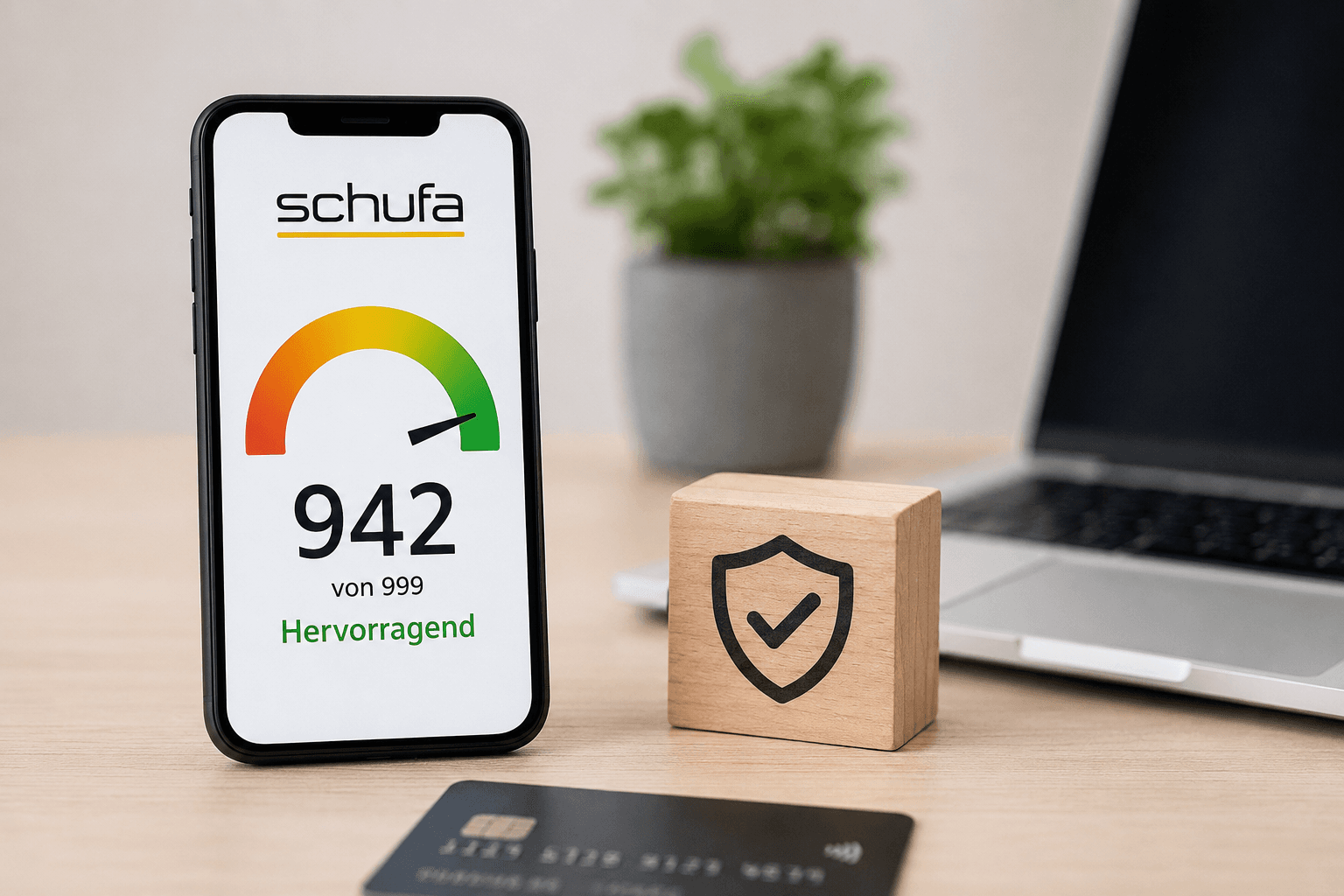
SCHUFA in Germany (2026): Score, Free Report, Negative Entries and How to Improve Your SCHUFA
If you live in Germany, sooner or later you will most likely come across SCHUFA.
It can become important when you are looking for an apartment, applying for a loan or credit card, buying something in instalments, or signing other contracts.
However, there are many misunderstandings surrounding SCHUFA.
Is SCHUFA a debtors’ blacklist? What is considered a good SCHUFA Score? Is 649 out of 999 a good result? Can a single Mahnung damage your SCHUFA? Do several bank enquiries lower your Score? And how can you check for free which data SCHUFA stores about you?
In this detailed guide, we explain the SCHUFA system step by step and use an anonymised real-life example to show how a SCHUFA report can look and how it should be interpreted.
SCHUFA explained briefly: the most important points in 30 seconds
SCHUFA is not a black list for people with debts.
SCHUFA processes certain information about contractual relationships and payment behaviour and uses this data to assess creditworthiness, or Bonität.
In 2026, the new SCHUFA Score uses a scale from:
100 to 999 points.
The higher the number of points, the better the statistical creditworthiness assessment.
The new Score is based on 12 criteria.
Important to know:
- a lower SCHUFA Score does not automatically mean that you have debts;
- a SCHUFA Score is not the same as a negative SCHUFA entry;
- one Mahnung does not automatically lead to a negative SCHUFA entry;
- SCHUFA itself does not decide whether a bank will grant you a loan;
- you can check which data SCHUFA stores about you;
- incorrect data can be disputed and reviewed;
- you do not need to give a landlord your complete detailed SCHUFA data copy.
What is SCHUFA?
SCHUFA is a German credit information agency.
It receives and processes certain data about consumers and calculates creditworthiness assessments based on the information available to it.
The SCHUFA Score is designed to statistically estimate
how likely it is that a person will meet future payment obligations in accordance with the contract.
It is not an indicator of how wealthy someone is.
It also does not show how much money is in a person’s bank account.
And SCHUFA itself does not make the final decision on whether someone receives a loan, credit card, smartphone on instalments, or another contract.
The final decision is made by the respective company.
For example, in addition to SCHUFA information, a bank may also assess income, expenses, existing liabilities and its own internal risk model.
Is it bad to be in the SCHUFA database?
No.
This is one of the most common misunderstandings.
People sometimes say:
“I have SCHUFA.”
They often mean that they have financial problems or negative entries.
However, the fact that SCHUFA stores data about a person does not itself mean that the person has a poor credit history.
For many people, SCHUFA only contains information about completely normal financial and contractual relationships.
The important question is therefore not:
“Does SCHUFA have any data about me?”
but:
“What data does SCHUFA store about me, and what does it mean?”
What data can SCHUFA store?
Depending on the individual situation, SCHUFA may store information about:
- Girokonto accounts;
- credit cards;
- Ratenkredite, or instalment loans;
- certain other types of credit;
- the beginning or end of contractual relationships;
- creditworthiness enquiries;
- payment disruptions;
- certain information from public registers;
- current and previous addresses;
- identity verification.
Not only the existence of a contract can be relevant. Its duration, status and other circumstances may also matter.
What does SCHUFA not know about you?
The SCHUFA Score is not a complete picture of a person’s financial situation.
When making a credit decision, a bank may separately assess:
- salary;
- other income;
- employment situation;
- household expenses;
- existing loans and liabilities;
- disposable income after expenses.
A good SCHUFA Score does not guarantee that you will receive a loan.
A lower SCHUFA Score does not automatically mean that your loan application will be rejected.
SCHUFA is only one part of the overall creditworthiness assessment.
The new SCHUFA Score in 2026
The SCHUFA scoring system has changed significantly in 2026.
The new SCHUFA Score is expressed on a scale from:
100 to 999 points.
The higher the score, the better the creditworthiness assessment.
The new system is based on 12 criteria.
A certain number of points is assigned to each criterion, and the total forms the final Score.
This is a major change compared with previous systems, where consumers could see different percentage-based industry scores and often did not clearly understand why the values differed.
The new Score is intended for use across several sectors, including:
- banks;
- Sparkassen;
- Volksbanken and other cooperative banks;
- telecommunications;
- retail;
- mail-order business and e-commerce.
An important point in 2026:
Companies have a transition period until the end of 2028 to move to the new system.
Therefore, during this transition period, consumers may still encounter results from older scoring models.
What is a good SCHUFA Score in 2026?
Under the new system, SCHUFA uses five assessment categories.
| SCHUFA Score | Category | Simplified meaning |
|---|---|---|
| 776–999 | Hervorragend | Very strong creditworthiness |
| 709–775 | Gut | Good creditworthiness |
| 642–708 | Akzeptabel | Acceptable creditworthiness |
| 100–641 | Ausreichend | Increased to significantly increased statistical risk |
| No Score | Ungenügend | Open serious payment disruptions or corresponding negative data |
It is important to understand that these categories do not determine a bank’s final decision.
For example, a person in the Akzeptabel category may still receive a loan. The bank will assess other factors as well.
Is 649 out of 999 SCHUFA points good?
This is a useful practical example.
If the figure really refers to the new SCHUFA Score on the 100–999 scale, then:
649 points fall into the “Akzeptabel” category.
This category covers 642 to 708 points.
That means the statistical payment default risk is assessed as higher than in the two better categories.
However, it does not automatically mean:
- that the person has debts;
- that there is an Inkasso case;
- that a bank will definitely reject a loan application;
- that the person has a “bad SCHUFA”.
This is why a Score should always be interpreted together with the rest of the SCHUFA data.
If 649/999 appears in an older document or in historical scoring information from a particular company, it should first be checked whether it really refers to the new standard SCHUFA Score.
Old and new scoring systems should not automatically be compared with each other.
Why can a SCHUFA report show several different Scores?
A detailed SCHUFA report may show:
- different companies;
- different dates;
- different percentages;
- different risk classes;
- different point values.
This does not automatically mean that SCHUFA has made an error.
In the past, different scoring models were used for different industries and types of transactions.
As a result, the same person could see values such as:
96.7% in one entry,
93.5% in another,
and 83.9% in a third.
These figures should not automatically be treated as if they measure exactly the same thing.
They may have been:
- calculated at different times;
- intended for different companies;
- linked to different transactions;
- calculated using different scoring models.
The new more standardised SCHUFA Score is intended to reduce this complexity.
Practical example: what can a real SCHUFA report look like?
DMS analysed an anonymised real SCHUFA report.
The documents of one person showed several different risk assessments at different points in time.
Among them were values:
- above 96%;
- around 95%;
- around 93–94%;
- around 90%;
- in some models around 83–87%.
At the same time, the analysed documents did not show obvious negative entries such as:
- Inkasso claims;
- outstanding unpaid claims;
- insolvency;
- entries in the Schuldnerverzeichnis.
A lower percentage-based Score by itself is not proof of a negative SCHUFA entry.
To interpret a detailed SCHUFA report correctly, you should check:
- Which scoring model was used?
- When was the Score calculated?
- For which company was the Score calculated or transmitted?
- Which data did SCHUFA have at that time?
- Are there actually any negative payment-related entries?
Therefore, you should not draw a quick conclusion from one number such as:
“I have a bad SCHUFA.”
What affects the SCHUFA Score?
The new SCHUFA system is significantly more transparent.
The Score is calculated from a combination of 12 criteria.
This means that the final result usually cannot be explained by only one factor.
Several factors may have an impact at the same time.
SCHUFA Score criteria: what do they mean in practice?
| Criterion | What SCHUFA assesses | Practical meaning |
|---|---|---|
| Zahlungsstörungen | Whether qualified payment disruptions have occurred | One of the most important factors |
| Ratenkredite in the last 12 months | Number of recently taken instalment loans | Several new loans within a short period may mean fewer points |
| Kreditstatus | Whether an instalment loan is active, absent or successfully repaid | A successfully repaid loan may result in more points |
| Remaining term of a Ratenkredit | How much longer an active loan will run | A very long remaining term may mean fewer points |
| Age of the newest Rahmenkredit | How long a flexible credit line has existed | A newly opened credit line may initially result in fewer points |
| Girokonto and credit card activity | New enquiries and contracts in the past 12 months | Many new products within a short time may reduce points under this criterion |
| Enquiries outside the banking sector | Certain enquiries from e-commerce, telecommunications and financial services | Many enquiries may lead to fewer points |
| Age of the current address | How long a person has lived at the current address | Longer residential stability may mean more points |
| Identity verification | Whether SCHUFA has information about verified identity | Verified identity may provide additional points |
| Other stability criteria in the new model | Structure and duration of certain stored contractual relationships | Considered together with the other factors |
Important: This table is intended to provide a practical overview.
The current details and exact point allocations should always be checked in the latest explanation of the new SCHUFA Score, because scoring systems can be updated.
Examples of points for individual SCHUFA criteria
One advantage of the new system is that point ranges for individual criteria are more transparent.
Payment disruptions – up to 264 points
If there is no relevant payment disruption, the maximum number of points can be achieved under this criterion.
This shows how important payment history can be for the overall Score.
Girokonto and credit card enquiries/contracts – up to 117 points
If there have been no relevant new enquiries or contracts in the last 12 months, the maximum score under this criterion may be possible.
Important:
Several relevant activities within a 28-day period are counted only once.
Enquiries outside the banking sector – up to 99 points
These may include certain enquiries from:
- online retailers;
- telecommunications companies;
- financial service providers.
Again, several relevant enquiries within 28 days may be grouped together as one.
Duration at the current address – up to 94 points
The longer a person has lived at the current address, the more points may be possible under this criterion.
With a residence period of up to seven months, this criterion may result in 0 points.
After living at the same address for 20 years or more, up to 94 points may be possible.
Ratenkredite in the last 12 months – up to 66 points
If no relevant Ratenkredit has been taken out in the previous 12 months, up to 66 points may be possible.
One new loan gives fewer points, two loans fewer still, while three or more may result in 0 points under this specific criterion.
This does not mean that the loan itself is a negative SCHUFA entry.
It is a statistical risk factor within the scoring system.
Remaining term of a Ratenkredit – up to 61 points
If there is no relevant loan or if its remaining term is comparatively short, the maximum number of points may be possible.
A very long remaining repayment period may result in fewer points under this criterion.
Identity verification – up to 38 points
If SCHUFA has information that an identity verification has been carried out, up to 38 points may be possible under this criterion.
Age of a Rahmenkredit – up to 36 points
If there is no Rahmenkredit, or if it has existed for a longer period, this criterion may result in more points than a newly opened credit line.
Kreditstatus – up to 19 points
An interesting feature of the new system:
A successfully repaid Ratenkredit may provide more points under this criterion than a situation in which a person has never had a Ratenkredit at all.
This shows why the statement
“I have never had a loan, so my SCHUFA Score must automatically be perfect”
is not correct.
Do several bank accounts or credit cards worsen SCHUFA?
It is too simplistic to say:
“A second credit card damages your SCHUFA.”
The new Score looks at specific activity over defined periods.
One criterion assesses the number of new Girokonto and credit card enquiries and contracts during the previous 12 months.
Several relevant activities within 28 days are grouped together.
An important detail:
Not every bank card is treated as a credit card.
Debit cards and prepaid cards are not treated under this specific criterion in the same way as classic credit cards with a credit limit.
Likewise, Tagesgeldkonto, certain Verrechnungskonto accounts, Basiskonto and Pfändungsschutzkonto accounts are not assessed under this specific scoring criterion in the same way as an ordinary Girokonto.
Does taking out a loan always worsen SCHUFA?
No.
This is where the new system becomes particularly interesting.
If someone takes out several Ratenkredite within a short period, this may reduce points under one criterion.
However, another criterion looks at Kreditstatus.
A successfully and fully repaid Ratenkredit may provide more points under that criterion than having no instalment loan history at all.
A loan itself is therefore not automatically a “bad entry”.
The overall situation and payment behaviour are what matter.
Does a SCHUFA enquiry by a bank lower the Score?
Not necessarily.
SCHUFA documents may show different types of company enquiries and checks.
For example, the anonymised SCHUFA report analysed by DMS showed bank checks related to Betrugsprävention, meaning fraud prevention.
The documents themselves stated that the specific procedure did not affect SCHUFA credit scoring.
This is a good example of why seeing the name of a bank or company in a SCHUFA report does not automatically mean:
“This bank lowered my SCHUFA Score.”
You always need to look at the specific type of enquiry or check.
Does your address affect the SCHUFA Score?
Yes.
One criterion in the new SCHUFA Score is:
Alter der aktuellen Adresse
— the length of time a person has lived at the current address.
Up to 94 points may be possible under this criterion.
Someone who has only lived at the current address for a few months may receive fewer points than someone who has lived at the same address for many years.
This may be particularly relevant for people who have recently moved to Germany.
But it is very important to understand:
A recent move is not a negative SCHUFA entry.
It is a statistical scoring criterion.
SCHUFA and Anmeldung in Germany
For people who have recently moved to Germany, the SCHUFA topic is closely connected with the first administrative steps.
A typical path may look like this:
Apartment
↓
Anmeldung
↓
Bank account
↓
First contracts
↓
Financial history in Germany
After Anmeldung, many other administrative and financial matters become easier to organise.
SCHUFA is therefore not an isolated topic.
It is part of the broader financial and administrative system in Germany.
Does a short credit history in Germany mean a bad SCHUFA?
Not necessarily.
If someone has only lived in Germany for a short time, SCHUFA may simply have a shorter or different financial history for that person than for someone who has lived in Germany for many years.
The new scoring model also takes the duration of certain factors into account.
For example:
- time at the current address;
- duration or status of certain loans;
- activity involving new financial products.
Someone who has just moved to Germany should therefore not try to artificially “build SCHUFA” by taking unnecessary loans or opening many credit cards.
Stable and normal financial behaviour is much more important.
What is a negative SCHUFA entry?
A negative SCHUFA entry and a lower SCHUFA Score are not the same thing.
Negative data can, for example, be linked to qualified payment disruptions or certain information from the Schuldnerregister or Insolvenzregister.
The Score, on the other hand, is a statistical risk assessment.
Therefore, the following situation is entirely possible:
A person may have no negative SCHUFA entry but still not have the maximum possible Score.
Does one Mahnung immediately damage SCHUFA?
No.
One Mahnung does not automatically mean that a negative payment entry will immediately appear in SCHUFA.
Certain conditions must be met before information about an unpaid claim may be transmitted.
One possible scenario may include:
- the claim is due;
- it has not been disputed;
- the person has received at least two written reminders;
- the person has been informed about a possible SCHUFA notification;
- at least four weeks have passed between the first reminder and the possible data transfer.
Mahnung ≠ automatic negative SCHUFA entry.
However, a Mahnung should not be ignored.
If the claim is incorrect, it should be disputed.
If it is justified, the issue should be resolved as early as possible.
Does SCHUFA know my salary?
The SCHUFA Score is not the same as a bank’s income assessment.
When considering a loan, a bank may separately ask for:
- Gehaltsabrechnungen;
- employment contract;
- bank statements;
- information about expenses.
Very good SCHUFA Score + insufficient income = possible loan rejection.
Or:
Less-than-perfect SCHUFA Score + stable income + good internal bank assessment = loan may still be possible.
The final decision is not made by SCHUFA.
Why can different banks make different decisions?
Because SCHUFA is only one source of information.
A bank may assess:
SCHUFA + income + expenses + employment + existing liabilities + its own internal risk model.
Therefore, one bank may reject a loan while another offers one to the same person.
The anonymised DMS example also showed that different financial companies could assess the same person’s risk quite differently.
This illustrates an important principle:
SCHUFA Score ≠ final credit assessment by the bank.
How can I check my SCHUFA data for free?
Everyone has the right to know which personal data is stored about them.
One important option is:
Datenkopie nach Art. 15 DSGVO.
It is intended primarily for the person concerned and allows them to review stored information.
In 2026, SCHUFA also offers digital access to certain stored data and explanations of the new Score through the SCHUFA Account.
When checking your data, pay particular attention to:
- name and date of birth;
- current and previous addresses;
- bank and credit information;
- enquiries made by companies;
- contract status;
- possible Zahlungsstörungen;
- Score information.
Datenkopie or SCHUFA BonitätsCheck – what is the difference?
This distinction is important.
Datenkopie nach Art. 15 DSGVO
It is primarily intended for you personally.
It may contain detailed personal and financial information.
It is used to check which data SCHUFA stores about you.
SCHUFA BonitätsCheck
This is intended for situations where you need to prove your creditworthiness to a third party, for example:
to a landlord.
The BonitätsCheck is designed so that you do not have to disclose your complete detailed SCHUFA information.
Therefore, when applying for an apartment, you should not automatically send a stranger your full DSGVO data copy.
SCHUFA when looking for an apartment in Germany
For many people, Wohnungssuche is the first time they deal seriously with SCHUFA.
A landlord wants to assess whether a potential tenant is likely to pay rent reliably.
That is why an apartment application may require a Bonitätsauskunft or BonitätsCheck.
However, SCHUFA is usually only one part of the application documents.
You may also need:
- payslips;
- employment contract;
- Mieterselbstauskunft;
- identity documents;
- other proof of ability to pay.
SCHUFA is therefore only one part of the documentation needed when searching for housing.
What should I do if SCHUFA contains incorrect data?
SCHUFA data is not beyond challenge.
If you discover:
- an incorrect address;
- a contract that does not belong to you;
- a terminated contract that is still shown as active;
- an incorrect claim;
- other incorrect information,
you should not ignore it.
You can request that the data be reviewed and corrected where necessary.
In practice, it is useful to keep documents that can prove the error, such as:
- confirmation of contract termination;
- payment confirmation;
- correspondence from the company;
- other documents showing the actual situation.
How can I improve my SCHUFA Score?
There is no secret method that guarantees a perfect SCHUFA Score overnight.
However, the new more transparent scoring system makes it easier to understand which factors may matter.
1. Pay bills and financial obligations on time
This is the most important principle.
2. Check your SCHUFA data regularly
If information is incorrect, request a review and correction.
3. Do not take unnecessary loans just to “build SCHUFA”
The new model considers the number of recently taken Ratenkredite.
4. Do not open many Girokonto accounts and credit cards within a short period without a real need
Activity involving new financial products during the previous 12 months is one of the scoring criteria.
5. When comparing offers, pay attention to the type of enquiry
Not every SCHUFA enquiry is the same.
6. Do not ignore Mahnungen
Legitimate payment problems should be resolved as early as possible.
7. Do not try to manipulate the Score artificially
The internet contains many outdated or exaggerated “SCHUFA hacks”.
Some of these tips relate to earlier scoring systems.
In 2026, it is far more useful to understand the actual criteria used by the new Score.
How quickly can a SCHUFA Score improve?
There is no single timeline that applies to everyone.
It depends on why the Score is lower in the individual situation.
Some criteria relate to activity during the previous 12 months.
Others change over time.
For example:
- the duration at the current address increases over time;
- the impact of a new Rahmenkredit changes as it becomes older;
- activity involving new banking products is assessed over a defined period;
- a successfully completed loan can change the Kreditstatus.
Therefore, there is no universal rule such as:
“Wait three months and your SCHUFA will automatically become good.”
The specific criteria need to be considered.
Common SCHUFA myths
“If SCHUFA stores data about me, I have a problem.”
False.
The fact that SCHUFA stores data about you is not in itself negative.
“One Mahnung ruins my SCHUFA.”
False.
Specific conditions must be met before negative payment information can be reported.
“Every SCHUFA enquiry lowers my Score.”
False.
There are different types of enquiries, and they cannot all be treated the same way.
“If I have no debts, I must have 999 points.”
False.
The Score is based on several criteria.
“A loan is always bad for SCHUFA.”
False.
Under the new scoring system, a successfully repaid Ratenkredit may even result in more points under the Kreditstatus criterion than having no previous Ratenkredit history.
“SCHUFA decides whether I get a loan.”
False.
The final decision is made by the bank.
SCHUFA for people who are new to Germany
If you have recently moved to Germany, you do not need to be afraid of SCHUFA.
At the beginning, your German financial and contractual history is simply still developing.
A typical process may look like this:
Anmeldung
↓
Girokonto
↓
Employment and everyday contracts
↓
Regular payments
↓
Longer financial history in Germany
The goal should not be to artificially create a “perfect SCHUFA”.
You do not need to take out a loan you do not need simply to create a credit history.
Much more important are:
stable contractual relationships + correct data + reliable payments.
How to check SCHUFA: step-by-step checklist
If you want to understand your SCHUFA situation:
- Get access to your SCHUFA data.
- Check your personal details.
- Check your current and previous addresses.
- Review Girokonto and credit card entries.
- Review stored loans.
- Check enquiries made by companies.
- Check whether Zahlungsstörungen or other negative data are stored.
- Find out which scoring system was used.
- Do not directly compare old percentage-based Scores with the new 100–999 scale.
- If you find an error, request a review and correction.
- If you need SCHUFA for an apartment, do not provide more personal information than necessary.
Frequently asked questions about SCHUFA
What is a good SCHUFA Score in 2026?
Under the new system, 776–999 points belong to the highest category, Hervorragend, while 709–775 points are classified as Gut.
Is 649 SCHUFA points good?
If 649 points refer to the new SCHUFA Score, they fall into the Akzeptabel category, which covers 642–708 points.
How can I get SCHUFA for free?
You can review your stored personal data using the available SCHUFA access options, including the Datenkopie nach Art. 15 DSGVO and digital services.
What lowers the SCHUFA Score?
The new SCHUFA Score is based on 12 criteria. These include payment disruptions, certain credit and financial product activity, enquiries and other factors.
How quickly can the SCHUFA Score improve?
There is no universal timeframe. Some criteria relate to the previous 12 months, while others depend on the duration of contracts, loans or the current address.
Does one Mahnung lower SCHUFA?
A single Mahnung does not automatically lead to a negative SCHUFA entry. Certain conditions must be met before a payment disruption can be reported.
Does SCHUFA know my salary?
The SCHUFA Score is not a complete income assessment. A bank may request separate proof of income during a credit application.
Does opening a new bank account affect SCHUFA?
The new Score takes into account certain Girokonto and credit card enquiries and contracts during the previous 12 months. However, not all account types are treated in the same way.
Is a debit card treated as a credit card by SCHUFA?
Under this specific criterion of the new Score, debit cards and prepaid cards are not treated in the same way as traditional credit cards with a credit limit.
Does moving house affect the SCHUFA Score?
Yes. The length of time at the current address is one of the criteria in the new SCHUFA Score. However, moving itself is not a negative SCHUFA entry.
Does a loan always make SCHUFA worse?
No. Recently taken loans may affect one criterion, while a successfully repaid Ratenkredit may be considered positively under the Kreditstatus criterion.
Can SCHUFA itself reject a loan?
No. SCHUFA calculates and provides creditworthiness information. The final decision is made by the bank or other company.
Do I have to give my landlord the complete SCHUFA Datenkopie?
No. The detailed Datenkopie is intended for you personally. Separate creditworthiness documents such as the SCHUFA BonitätsCheck are designed for third parties.
Conclusion: understand SCHUFA instead of being afraid of the Score
SCHUFA is not a “blacklist” containing only people with debts.
It is a credit information and scoring system used by banks, retailers, telecommunications companies and other businesses to assess statistical payment risk.
In 2026, the SCHUFA system has become significantly more transparent.
The new SCHUFA Score uses a scale from:
100 to 999 points
and is based on:
12 criteria.
The most important points to remember are:
- A SCHUFA Score is not the same as a negative SCHUFA entry.
- A lower Score does not automatically mean that you have debts.
- One Mahnung does not automatically lead to a negative SCHUFA entry.
- Not every SCHUFA enquiry affects the Score in the same way.
- SCHUFA does not make the final decision on whether you receive a loan.
- It is worth checking your stored data and requesting corrections if anything is wrong.
For someone starting life in Germany, SCHUFA is only one part of a much bigger picture:
Anmeldung → bank account → Steuer-ID → SCHUFA → housing → work and a stable financial life in Germany.
In the long term, stable contractual relationships, correct data and reliable payment behaviour are far more important than trying to find some supposed “SCHUFA trick”.
Related practice
Continue with the learning pages and games connected to this article.