

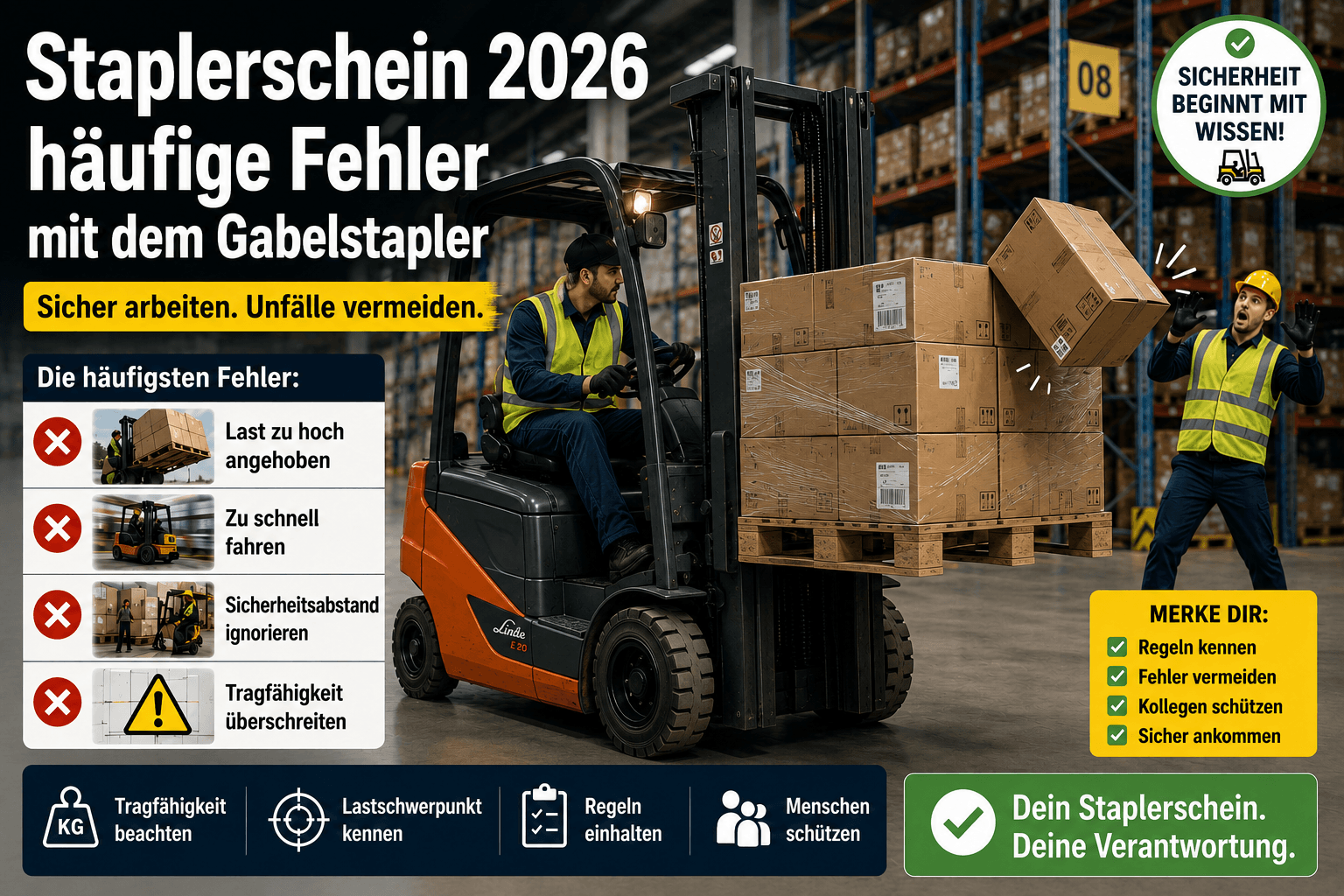
Staplerschein (2026) — The Most Common Forklift Mistakes and How to Avoid Them
Are you planning to obtain a Staplerschein or already working with a forklift (Gabelstapler) in Germany?
Most forklift accidents are not caused by technical failures. They happen because of human mistakes. Many of these errors are made by both beginners and experienced forklift operators.
In this article, we will look at the most common forklift mistakes, their potential consequences, and how to avoid them. This knowledge will not only help you pass the Staplerschein exam more successfully but also enable you to work more safely in warehouses, logistics centers, and production facilities.
Important: Even with a valid Staplerschein, operators must always follow company-specific safety regulations, use personal protective equipment, and operate only the equipment for which they are trained and authorized.
Why Is Forklift Safety So Important?
Every year, warehouses, logistics centers, and manufacturing facilities experience accidents involving:
- overturned forklifts;
- falling loads;
- collisions with pedestrians;
- poor visibility;
- failure to follow safety procedures.
Most of these accidents can be prevented if operators follow safety rules, understand load capacity limits, and regularly refresh their knowledge.
That is why workplace safety is such an important part of every Staplerschein training course.
Top 10 Mistakes Most Beginners Make
- Incorrect load placement.
- Ignoring the load center of gravity.
- Underestimating pallet weight.
- Ignoring rack load capacity.
- Driving too fast.
- Insufficient safety distance.
- Poor awareness of the surrounding environment.
- Working without safety shoes.
- Lifting loads higher than allowed by the load chart.
- Becoming overconfident after obtaining a Staplerschein.
The good news is that all of these mistakes can be avoided through regular practice, adherence to safety principles, and a good understanding of the work environment.
Why Are These Mistakes Important?
Many Staplerschein theory questions focus on:
- workplace safety;
- load capacity;
- stability;
- load handling;
- protecting people in the work area.
This is why these mistakes regularly appear both during training and in real-life work situations.
1. Driving with a Load Raised Too High
A raised load:
- reduces stability;
- limits visibility;
- increases the risk of tipping over.
It is much safer to travel with the load positioned as low as possible.
2. Underestimating the Weight of the Load
Many operators assume that if the forklift can lift the load, everything is fine.
However, every forklift has a specified maximum load capacity.
Overloading the forklift significantly increases the risk of accidents.
3. Ignoring the Load Center of Gravity
This is one of the most important topics in Staplerschein training.
Even if the load weight is within the permitted limit, an incorrectly positioned center of gravity can create a dangerous situation.
That is why stability principles receive so much attention during forklift training.
4. Driving Too Fast in the Warehouse
A warehouse is not a racetrack.
Excessive speed reduces reaction time and increases the risk of collisions.
This is especially dangerous:
- around corners;
- at intersections;
- in narrow aisles;
- near pedestrian areas.
5. Ignoring Limited Visibility
Many accidents occur because operators cannot properly see their surroundings.
If the load blocks visibility:
- reduce speed;
- choose a safe route;
- drive in reverse when necessary.
6. Incorrect Load Placement on Storage Racks
Improperly placed loads can:
- fall;
- damage goods;
- endanger employees.
Always ensure that the load is positioned securely and stably.
7. Skipping Daily Inspections
Before starting work, operators should inspect:
- tires;
- forks;
- brakes;
- hydraulic systems;
- warning and safety devices.
A small defect can quickly become a serious safety issue.
8. Ignoring People in the Work Area
The most important rule is simple:
People always have priority over machines.
Even low-speed collisions can cause serious injuries.
9. Using a Mobile Phone While Working
Just a few seconds of distraction can lead to an accident.
During operation, full attention must be focused on the surrounding environment.
10. Incorrect Driving on Ramps and Slopes
Ramps and inclines are among the most dangerous areas in a workplace.
Improper load positioning or sudden maneuvers can cause the forklift to tip over.
11. Transporting an Unstable Load
The load should be:
- balanced;
- correctly positioned;
- properly secured.
Unstable loads are one of the leading causes of forklift accidents.
12. Failing to Maintain Safe Distances
Safe distances are necessary:
- between forklifts;
- between people;
- between storage racks;
- between vehicles.
Maintaining distance provides valuable reaction time in unexpected situations.
13. Working Without Site-Specific Training
Even with a Staplerschein, employers must provide workplace-specific instruction.
This includes:
- warehouse layout;
- safety requirements;
- traffic routes;
- company procedures.
Every workplace is different.
14. Ignoring First Aid Knowledge
Although first aid is not the main focus of the Staplerschein exam, basic first aid knowledge is extremely valuable.
Every forklift operator should know:
- how to call emergency services;
- how to respond to bleeding;
- how to assist an unconscious person;
- how to secure an accident scene.
15. Ignoring Rack Load Capacity
Many operators focus only on the forklift’s load capacity.
However, the load capacity of storage racks is equally important.
Every warehouse rack has a maximum load rating.
This is especially important:
- on upper rack levels;
- when storing heavy pallets;
- in high-bay warehouses;
- in industrial storage facilities.
Overloading a rack can result in:
- structural deformation;
- rack collapse;
- falling loads;
- serious workplace accidents.
16. Lifting Loads Higher Than Allowed by the Load Chart
Many beginners assume that if a forklift can lift a load to the second rack level, it can safely place the same load on the sixth or seventh level.
This is incorrect.
As lifting height increases:
- stability decreases;
- mast stress increases;
- hydraulic load increases;
- the risk of load drops becomes higher.
This is why operators must always follow the forklift’s load chart, also known as the load capacity diagram.
17. Working Without Safety Shoes
In warehouses, logistics centers, and many manufacturing facilities, safety shoes are mandatory.
Safety footwear helps protect against:
- falling loads;
- pallet-related injuries;
- forklift accidents;
- sharp objects on the floor;
- slipping hazards.
Even a small pallet or heavy box can cause serious injuries.
18. Believing That a Staplerschein Means “I Know Everything”
This is one of the most dangerous mistakes.
A Staplerschein is not the finish line.
It is the beginning.
Experienced forklift operators regularly:
- review safety principles;
- improve their skills;
- follow instructions;
- learn from mistakes.
What Is More Important: Forklift Load Capacity or Rack Load Capacity?
The correct answer is:
Both are equally important.
For safe operation, an operator must know:
- the forklift’s maximum load capacity;
- the load chart;
- the weight of the load;
- the condition of the pallet;
- the rack load capacity;
- the permitted load for the specific rack level.
Ignoring even one of these factors significantly increases the risk of accidents.
Which Mistakes Do Beginners Make Most Often?
If someone has just received a Staplerschein, the most common mistakes include:
- Incorrect load placement.
- Driving too fast.
- Insufficient safety distance.
- Ignoring the center of gravity.
- Poor observation of the surrounding environment.
- Underestimating pallet and load weight.
- Ignoring rack load capacity, especially at higher storage levels.
- Not using personal protective equipment.
Many beginners focus only on whether the forklift can lift the load.
However, it is equally important to understand:
- how much the load weighs;
- at what height it will be stored;
- the rack’s load capacity;
- whether the specific rack level is designed for that load.
Why Do Experienced Operators Still Make Mistakes?
Many accidents are caused not by beginners but by experienced operators.
Common reasons include:
- routine;
- overconfidence;
- rushing;
- loss of concentration.
That is why regular safety briefings and refresher training remain extremely important.
Which Mistakes Most Commonly Cause Forklift Accidents?
The most common causes are:
- Driving with a raised load.
- Overloading the forklift.
- Excessive speed.
- Limited visibility.
- Ignoring people in the work area.
Why Do Employers Pay Attention to These Mistakes?
Many employers want to ensure that a candidate:
- understands safety principles;
- knows the importance of load capacity;
- can assess risks;
- works responsibly.
For this reason, understanding common forklift mistakes helps not only during the exam but also when applying for jobs.
Quick Answers
What is the most common forklift mistake?
Driving with a load raised too high.
What most commonly causes forklift tip-overs?
Overloading, an incorrect load center of gravity, and sudden maneuvers.
Is forklift load capacity the only important factor?
No. Rack load capacity, load weight, and the load chart are equally important.
Are these mistakes covered in Staplerschein training?
Yes.
Can these mistakes lead to failing the exam?
Yes.
Can these mistakes cause workplace accidents?
Yes.
Are safety shoes mandatory in warehouses?
In many companies, yes.
Practice on the Deutsch mit Spaß Platform
In addition to articles, you can use our interactive learning tools:
- ✅ Forklift vocabulary and themes;
- ✅ German for warehouse workers;
- ✅ Word Search games;
- ✅ German for professions;
- ✅ First aid learning materials;
- ✅ Exam and certification preparation.
Learning through themed exercises, games, and professional vocabulary helps reinforce the knowledge needed for working in German warehouses and logistics companies much faster.
Useful Articles and Resources on Our Blog
- Staplerschein FAQ (2026) – Frequently Asked Questions;
- Staplerschein Exam – Complete Guide;
- German for Warehouse Workers;
- First Aid in Germany;
- First Aid Core Catalog;
- Forklift Learning Topics;
- Warehouse Learning Topics;
- Logistics and Warehouse Word Search Games.
Conclusion
Most forklift accidents can be prevented. In many cases, they are caused not by equipment failures but by human error.
If you understand load capacity, center of gravity, rack load limits, and workplace safety principles, you can not only pass the Staplerschein course successfully but also work much more safely and professionally.
Continuous learning, practical experience, and a strong safety culture are the key foundations of a successful career in warehousing, logistics, and manufacturing in Germany.
Related practice
Continue with the learning pages and games connected to this article.