

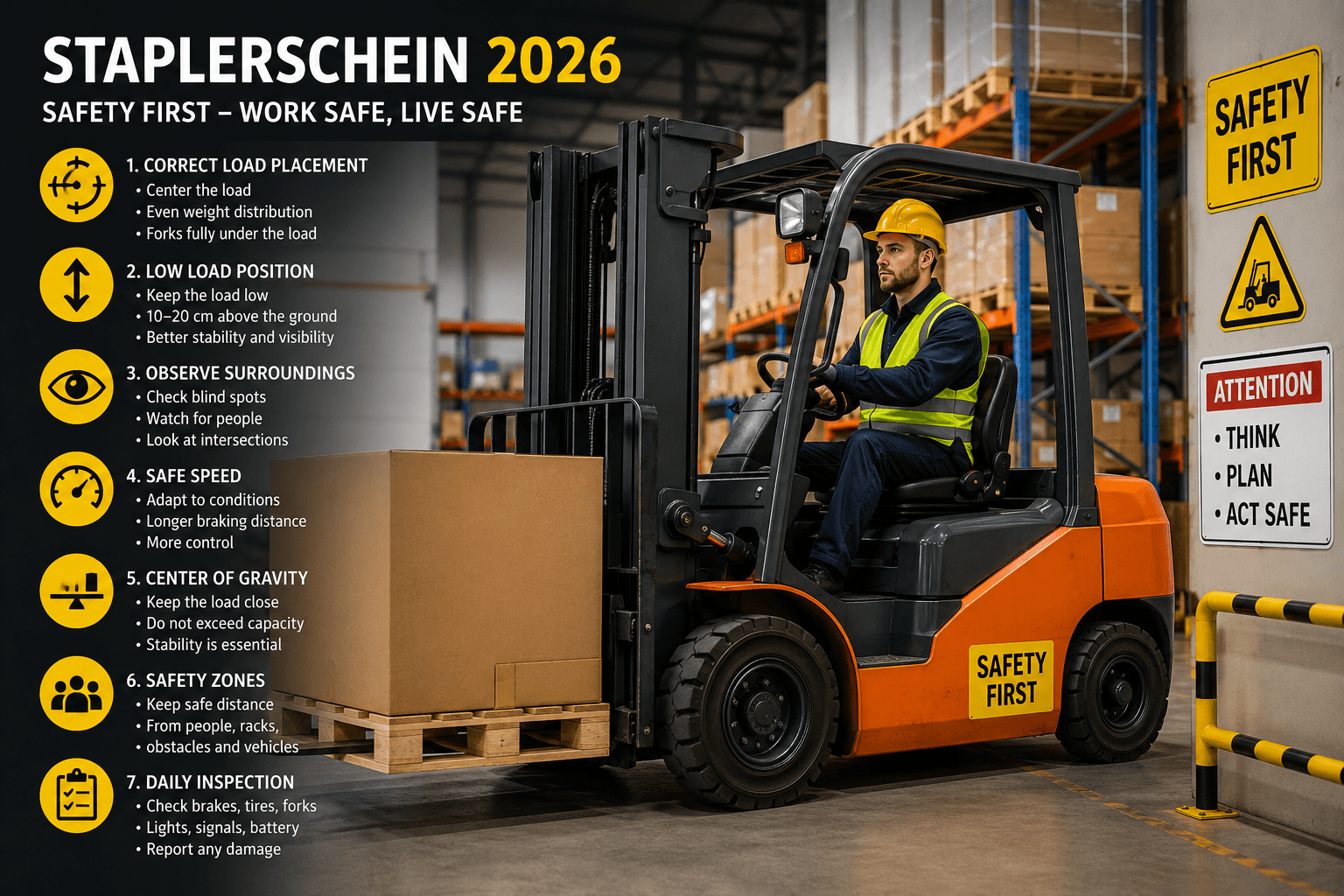
Staplerschein 2026 — Most Important Safety Principles and Common Mistakes When Working with a Gabelstapler (Forklift)
Working with a forklift (Gabelstapler) in Germany is much more than simply driving and moving loads. A forklift operator must understand safety regulations, be able to assess risks, and make correct decisions in different workplace situations.
Many people preparing for the Staplerschein exam try to memorize only the correct answers. However, in practice it is far more important to understand why certain rules exist and which mistakes most often lead to dangerous situations.
Safety principles not only help you pass the Staplerschein exam but also allow you to work more safely in everyday warehouse, logistics, and transport environments.
In this article, we will look at the most important safety principles and the most common mistakes made while working with a forklift.
Why Is Safety So Important When Working with a Forklift?
Forklifts move heavy loads every day, operate in narrow spaces, and often work close to people.
Even a small mistake can lead to:
- damage to loads
- equipment damage
- collisions
- operator injuries
- injuries to other people
- work interruptions
This is exactly why Staplerschein training focuses not only on driving skills but also on workplace safety, risk assessment, and correct actions in different situations.
1. Incorrect Load Placement
One of the most common mistakes is incorrect load positioning on the forks.
Common problems:
- the load is placed too far forward
- the load is not centered
- unstable load
- uneven weight distribution
Incorrect load placement reduces stability and increases the risk of accidents.
Safe practice:
- the load should be centered
- the weight should be evenly distributed
- the forks should be fully positioned underneath the load
2. Carrying the Load Too High During Movement
When moving with an elevated load:
- stability decreases
- visibility becomes worse
- the risk of tipping increases
Safe practice:
- during movement, the load should be kept in a low position
Typically, the load is transported approximately 10–20 cm above the ground to maintain stability and visibility.
3. Insufficient Observation of the Surroundings
Many collisions do not happen because of equipment failures.
They happen because the operator:
- does not notice people
- ignores intersections
- does not check blind spots
- drives too fast
- does not pay enough attention to the surrounding environment
Before moving, the operator should always ensure the surrounding area is safe.
4. Excessive Speed
Speed often seems insignificant, especially to experienced operators.
However, higher speed means:
- a longer braking distance
- less control over the equipment
- greater risk in narrow spaces
- increased risk in slippery areas
A safe speed always depends on:
- floor conditions
- visibility
- the load
- the work area
- movement of people nearby
5. Ignoring the Load Center of Gravity
One of the most important Staplerschein principles is understanding the load center of gravity.
If the load:
- is positioned too far forward
- is too high
- is unevenly distributed
- exceeds the safe load capacity
the stability of the forklift is significantly reduced.
The further the load center of gravity is from the forks, the more forklift stability decreases.
Ignoring the load center of gravity is one of the most common causes of dangerous situations.
6. Ignoring Safety Zones
The operator should always maintain a safe distance from:
- people
- other forklifts
- shelves and racks
- obstacles
- intersections
- work areas
Rushing often creates situations where safety zones are ignored.
7. Skipping Daily Inspections
Before starting work, the forklift should be inspected.
Check:
- tires
- brakes
- forks
- warning systems
- lights
- battery or fuel system
- visible damage
Small issues can later develop into serious problems.
How Can You Prepare for Staplerschein Questions Faster?
1. Start with Basic Safety Principles
First, understand safety logic and common workplace situations.
2. Practice Questions Regularly
Short and regular training sessions are usually more effective than one very long study session.
3. Repeat Mistakes
Pay attention to questions where you made errors.
4. Train Different Workplace Situations
Different situations help you understand the logic more quickly.
5. Understand Principles Instead of Memorizing Answers
In real situations, understanding the situation is much more important than remembering a single correct answer.
Frequently Asked Questions (FAQ)
Is the Staplerschein Exam Difficult?
Usually, the exam is not difficult if safety principles are understood and questions are practiced regularly.
Is It Enough to Memorize Only the Correct Answers?
No. In practical situations, understanding safe actions is much more important.
Is It Possible to Prepare Online?
Yes. Questions can be practiced digitally multiple times.
Can I Study on My Phone?
Yes. Short, regular practice sessions are often more effective than one long study session.
How Long Is a Staplerschein Valid in Germany?
A Staplerschein usually does not have a fixed expiration date, but companies may require regular safety training and knowledge refreshers.
Related Staplerschein Topics
- load center of gravity
- stability
- safety principles
- maneuvering
- warehouse traffic rules
- emergency situations
- forklift technology
- load transportation
- warehouse safety
- operator responsibilities
Learn step by step and practice Staplerschein questions, workplace situations, and professional German terminology so you can feel confident both during the exam and in a real working environment in Germany.
Related practice
Continue with the learning pages and games connected to this article.