

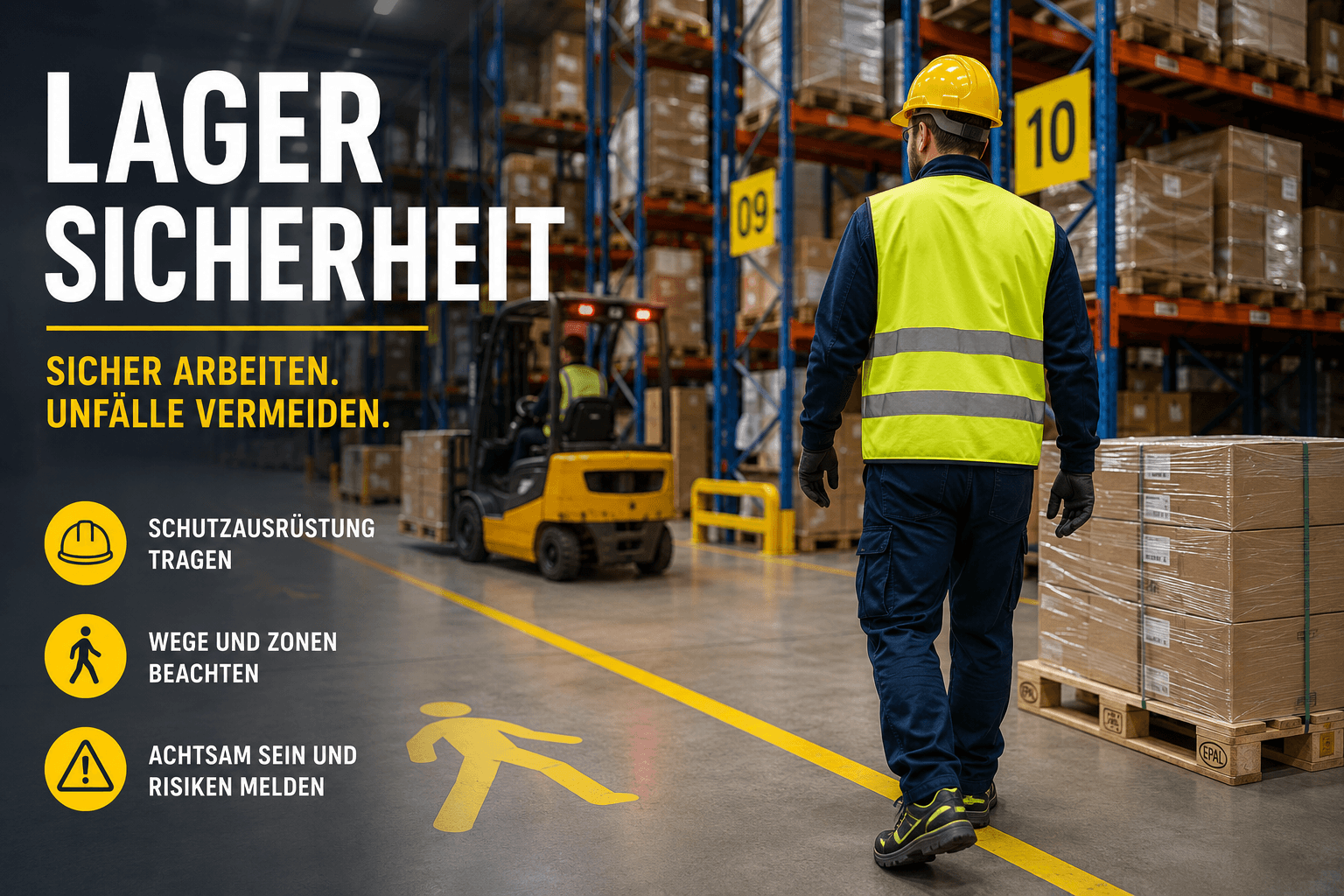
Warehouse Safety in Germany (2026) – Regulations, Hazards, Accidents and Occupational Health & Safety
Modern warehouses are complex working environments. Receiving goods, order picking, inventory counting, transportation, storage and shipping often take place simultaneously. To ensure that all these processes run safely, companies implement occupational health and safety systems that must be followed by every employee, regardless of position or experience.
Warehouse safety is much more than a set of rules. It helps prevent accidents, protects employee health, and ensures smooth business operations.
In this article, you will learn:
- what warehouse safety (Lager Sicherheit) means;
- the most common risks in warehouses;
- which personal protective equipment (PPE) is used;
- how to safely handle loads and pallets;
- how to prevent workplace accidents;
- the mistakes most often made by beginners;
- the occupational safety requirements that apply in Germany.
What Is Warehouse Safety?
Warehouse safety refers to the rules, procedures, and protective measures designed to prevent accidents and protect employees from injuries.
Safety applies to all warehouse processes, including:
- Goods Receiving (Wareneingang)
- Order Picking (Kommissionierung)
- Inventory Counting (Inventur)
- Storage Operations
- Goods Dispatch (Warenausgang)
- Loading and Unloading
- Working with Material Handling Equipment
- Moving Around Warehouse Facilities
Workplace safety is not only the employer’s responsibility. Employees also play a crucial role in maintaining a safe working environment.
Why Is Warehouse Safety So Important?
Warehouses are busy environments where the following often operate simultaneously:
- Employees
- Forklifts
- Electric Pallet Trucks
- Heavy Loads
- Trucks
- Various Warehouse Machines and Equipment
Even a small mistake can result in:
- Employee injuries
- Damaged goods
- Equipment damage
- Work interruptions
- Financial losses
This is why German companies place great importance on occupational safety, safety training, and risk assessments.
Mandatory Personal Protective Equipment (PPE)
Safety Shoes
Safety shoes are required in most warehouses.
They protect against:
- Falling objects
- Heavy loads
- Foot injuries
High-Visibility Vest
A reflective safety vest helps equipment operators notice employees in time.
It is especially important:
- At loading docks
- In outdoor areas
- In locations with heavy vehicle traffic
Protective Gloves
Protective gloves help prevent:
- Cuts
- Scratches
- Injuries from sharp edges
Safety Glasses
Some warehouse tasks also require the use of protective eyewear.
Safety Markings in Warehouses
Warehouses commonly include:
- Pedestrian walkways
- Safety lines
- Warning signs
- Emergency escape routes
- Restricted areas
Safety markings and instructions should never be ignored.
Safe Movement Inside the Warehouse
Many accidents happen simply while moving around the warehouse.
Important safety rules:
- Do not run.
- Do not use your phone while walking.
- Follow all safety markings.
- Be cautious at intersections and blind corners.
- Stay out of hazardous areas unless necessary.
Safety at Loading Docks
Loading docks are among the most dangerous areas in a warehouse.
Main risks include:
- Falls
- Vehicle movement
- Improperly secured loads
- Communication errors
Safe operations require following company procedures and safety instructions at all times.
Ergonomics and Lifting Heavy Loads
Many workplace injuries are caused not by accidents but by long-term physical strain.
Common issues include:
- Back pain
- Joint stress
- Repetitive strain injuries
How to Lift Heavy Loads Correctly
- Bend your knees, not your back.
- Keep the load close to your body.
- Avoid sudden movements.
- Use lifting aids when the load is too heavy.
Safety When Working with Pallets
Many employees focus only on the weight of the load, but the condition of the pallet is equally important.
Even a correctly stacked load can become dangerous if the pallet is damaged.
Inspect the Pallet Before Moving It
Check for:
- Broken boards
- Cracks
- Damaged blocks
- Deformations
- Previous signs of damage
A damaged pallet carrying a heavy load can fail at any time.
Special Attention to High-Bay Racking
If a heavy load is placed high on a rack using a damaged pallet:
- The load may shift.
- Products may fall.
- Serious injuries can occur.
- Significant material damage is possible.
EUR Pallets and One-Way Pallets
Not all pallets are created equal.
| Pallet Type | Characteristics |
|---|---|
| EUR Pallets | Standardized dimensions, high durability and excellent stability. |
| One-Way Pallets | Lighter, less durable and not designed for repeated long-term use. |
Heavy loads should be placed on these pallets with extra caution.
Safety When Working with Warehouse Equipment
Always Lower Forks When Not in Use
Whenever a forklift is parked:
- ✅ The forks must be lowered to ground level.
- ✅ The vehicle should be parked in its designated area.
Raised forks create a serious hazard because colleagues may:
- Trip over them
- Hit their legs against them
- Suffer injuries
Working Safely with Electric Pallet Trucks
In many situations, it is safer to operate a small electric pallet truck while walking backward.
Advantages include:
- Better visibility
- Improved control
- Easier maneuvering in narrow spaces
- Reduced risk of hitting pallets or racking
Always follow your company's operating procedures and safety instructions.
Never Stand Under a Raised Load
Even a load that appears stable can:
- Shift
- Tip over
- Fall
For this reason, employees should never stand beneath a raised load.
Never Transport People on Forks
Forklift forks are designed for transporting goods—not people.
Fire Safety in Warehouses
Warehouses often contain:
- Cardboard
- Plastic
- Packaging materials
- Various chemicals
Every employee should know:
- Where fire extinguishers are located
- Where emergency exits are located
- How to react in case of fire
First Aid in the Warehouse
Every employee should know:
- Where the first-aid kit is located
- Where the first-aid room is located
- Who should be informed after an accident
- How to call for assistance
Employee Rights and Responsibilities
Employer Responsibilities
Employers must provide:
- A safe working environment
- Personal protective equipment
- Safety training
- Regular inspections
- First-aid equipment
Employee Responsibilities
Employees must:
- Follow safety regulations
- Attend and follow safety training
- Use PPE correctly
- Report hazards and damages
Near Miss Incidents
Not every dangerous situation results in an injury.
Examples include:
- A pallet almost falls.
- A forklift narrowly avoids hitting a pedestrian.
- An employee almost slips.
These incidents should also be reported. They provide valuable opportunities to prevent future accidents.
What Happens After a Workplace Accident?
- First aid is provided.
- Emergency services are called if necessary.
- A supervisor is informed.
- The accident is documented.
- The causes are investigated.
The goal is to prevent similar incidents in the future.
How to Build a Safety Culture in a Warehouse
The best companies do not rely solely on rules.
They create a culture where:
- Hazards are reported.
- Problems are not hidden.
- Safety is more important than speed.
- Employees look out for one another.
Why Safety Knowledge Improves Your Employment Opportunities
Employers value workers who:
- Understand safety requirements
- Follow procedures
- Work responsibly
- Reduce accident risks
Questions about workplace safety are common during job interviews, especially in logistics and warehouse operations.
The 10 Most Common Warehouse Safety Mistakes
- Not wearing safety shoes.
- Using a mobile phone during work.
- Running inside the warehouse.
- Blocking emergency exits and evacuation routes.
- Lifting heavy loads incorrectly.
- Using damaged pallets.
- Leaving forklift forks raised.
- Failing to report hazards or damage.
- Ignoring safety instructions.
- Working too fast and rushing.
Warehouse Safety Vocabulary
| German | English |
|---|---|
| Arbeitssicherheit | Occupational Safety |
| Arbeitsschutz | Occupational Health and Safety |
| Unfall | Accident |
| Gefahr | Hazard |
| Sicherheitsvorschriften | Safety Regulations |
| Sicherheitsschuhe | Safety Shoes |
| Warnweste | High-Visibility Vest |
| Schutzhandschuhe | Protective Gloves |
| Schutzbrille | Safety Glasses |
| Erste Hilfe | First Aid |
| Evakuierungsweg | Evacuation Route |
| Notausgang | Emergency Exit |
| Brandschutz | Fire Safety |
| Gabelstapler | Forklift |
| Europalette | EUR Pallet |
| Einwegpalette | One-Way Pallet |
DMS Learning Path
Continue learning with these related topics:
- Working in a Warehouse in Germany
- Order Picking (Kommissionierung)
- Goods Receiving (Wareneingang)
- Goods Dispatch (Warenausgang)
- Forklift License (Staplerschein)
- First Aid (Erste Hilfe)
- Inventory Counting (Inventur)
- German for Warehouse Workers
Conclusion
Warehouse safety is an essential part of everyday warehouse operations. Understanding hazards, using personal protective equipment correctly, operating equipment safely, and knowing how to respond in dangerous situations help prevent accidents and create a safer, more efficient workplace. Strong safety knowledge not only protects employees but also improves professionalism and long-term career opportunities in the logistics industry.
Related practice
Continue with the learning pages and games connected to this article.