
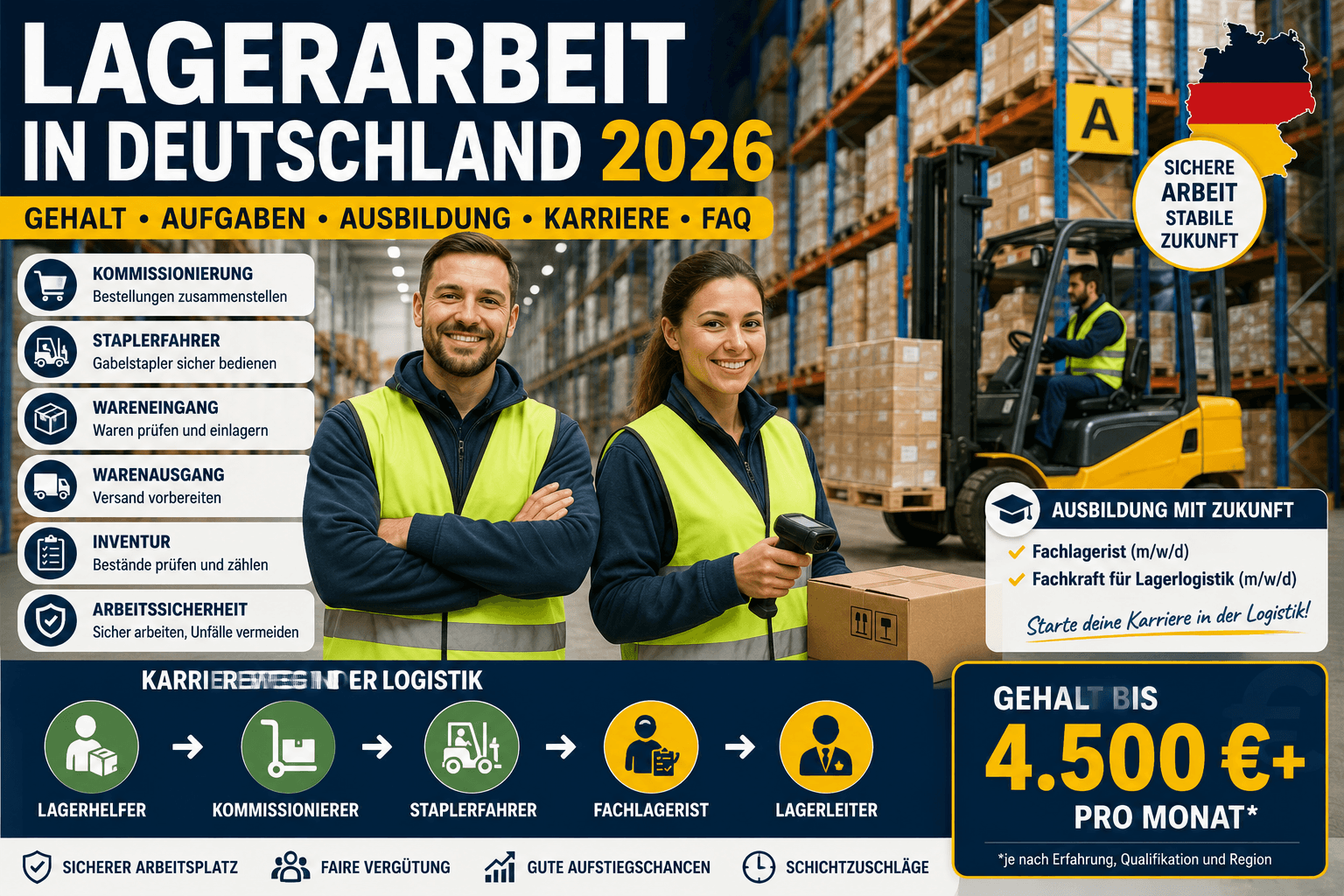
Warehouse Work in Germany (2026) — Complete Guide, FAQ, Salary, Duties and Career Opportunities
Warehouse work (Lagerarbeit) is one of the most in-demand types of employment in Germany. Logistics, e-commerce, manufacturing and retail companies regularly hire new employees for a variety of positions, ranging from order pickers to forklift operators and warehouse managers.
Many people start their first job in Germany in a warehouse because numerous companies hire workers even without previous experience. At the same time, the logistics industry offers excellent career growth opportunities and stable demand throughout the country.
In this guide, you will find answers to the most common questions about warehouse jobs in Germany, including information about salaries, responsibilities, workplace safety, German language requirements, career opportunities, and key logistics processes.
What Is Warehouse Work?
Warehouse work involves receiving, storing, picking, packing and shipping goods.
Typical responsibilities include:
- receiving goods;
- storing products;
- order picking;
- packing;
- shipping;
- inventory counting.
What Is a Warehouse Worker?
A warehouse worker (Lagerarbeiter) is an employee who performs various warehouse-related tasks.
Depending on the company, they may:
- receive goods;
- pick customer orders;
- operate a forklift;
- prepare shipments;
- perform inventory counts;
- work with warehouse management systems.
Do You Need German Language Skills for Warehouse Work?
Yes.
Many companies accept applicants with A1–A2 German skills. However, better job opportunities are usually available to people with B1-level German or higher.
It is especially important to understand:
- safety instructions;
- work assignments;
- product labels;
- warehouse documentation.
Can You Work in a Warehouse Without Speaking German?
Some companies hire employees with very limited German skills, especially large logistics centers.
However, learning German significantly improves employment opportunities, helps workers understand safety regulations, and often leads to better-paid positions.
Do You Need a Forklift License (Staplerschein)?
Not always.
Many warehouse positions do not require a forklift license.
However, a Staplerschein often helps you:
- find a job faster;
- earn a higher salary;
- take on additional responsibilities;
- advance your logistics career.
What Is Order Picking (Kommissionierung)?
Kommissionierung means order picking.
Employees receive an order list and collect the required products from different warehouse locations.
It is one of the most common jobs in German logistics centers.
What Is Wareneingang?
Wareneingang means goods receiving.
Employees:
- inspect deliveries;
- compare shipping documents;
- register goods in warehouse systems;
- place products into storage.
What Is Warenausgang?
Warenausgang means goods dispatch or shipping.
It includes:
- checking orders;
- packing products;
- labeling shipments;
- preparing freight for transportation.
What Is Inventory (Inventur)?
Inventur means inventory counting.
During an inventory process, employees check:
- stock quantities;
- storage locations;
- accuracy of warehouse records.
Is Previous Experience Required?
Not necessarily.
Many companies hire people without experience and provide on-the-job training.
Is Shift Work Common in Warehouses?
Yes.
Many warehouses operate with:
- morning shifts;
- evening shifts;
- night shifts.
Shift bonuses may apply depending on the employer.
Are Safety Shoes Required?
Yes.
Safety shoes (Sicherheitsschuhe) are mandatory in almost all warehouses.
They protect workers from:
- falling objects;
- pallets;
- forklift traffic;
- other workplace hazards.
Is Additional Protective Equipment Required?
Depending on the workplace, employees may need:
- gloves;
- high-visibility vests;
- safety glasses;
- hearing protection.
What Are the Most Common Warehouse Accidents?
The most common risks include:
- collisions with forklifts;
- falling loads;
- slips and falls;
- improper lifting techniques;
- overloaded shelving systems.
Is First Aid Training Required?
Some companies require First Aid (Erste Hilfe) training for specific positions.
Even when it is not mandatory, first aid knowledge is always valuable for workplace safety.
Are All Warehouses the Same?
No.
There are many different types of warehouses, including:
- e-commerce warehouses;
- food warehouses;
- pharmaceutical warehouses;
- industrial warehouses;
- automotive warehouses.
Is Warehouse Work Physically Demanding?
It depends on the position.
Some warehouses are highly automated, while others still require regular manual handling of goods.
What Warehouse Positions Exist?
Common warehouse jobs include:
- Lagerhelfer (Warehouse Assistant);
- Lagerarbeiter (Warehouse Worker);
- Kommissionierer (Order Picker);
- Versandmitarbeiter (Shipping Associate);
- Wareneingang Mitarbeiter (Goods Receiving Employee);
- Staplerfahrer (Forklift Operator);
- Fachlagerist;
- Fachkraft für Lagerlogistik;
- Teamleiter Lager (Warehouse Team Leader);
- Schichtleiter (Shift Supervisor);
- Lagerleiter (Warehouse Manager).
Responsibilities vary depending on the company and position.
Warehouse Positions and Responsibilities
| Position | Main Responsibilities |
|---|---|
| Warehouse Assistant | Moving goods, packing, support tasks |
| Warehouse Worker | General warehouse duties |
| Order Picker | Collecting customer orders |
| Goods Receiving Employee | Receiving and inspecting goods |
| Shipping Associate | Preparing goods for shipment |
| Forklift Operator | Operating forklifts |
| Fachlagerist | Organizing warehouse processes and inventory |
| Logistics Warehouse Specialist | Managing logistics and warehouse operations |
| Team Leader | Organizing employee activities |
| Warehouse Manager | Overall warehouse management |
Can You Build a Career in Logistics?
Yes.
Many people start as warehouse workers and later become:
- team leaders;
- shift supervisors;
- logistics specialists;
- warehouse managers.
Which Skills Do Employers Value Most?
- accuracy;
- responsibility;
- punctuality;
- compliance with safety regulations;
- teamwork.
Is Warehouse Work Suitable for People Without Formal Qualifications?
Yes.
Many companies hire workers without vocational qualifications if they are motivated and willing to learn.
Is Vocational Education Required?
No.
Many warehouse positions are available without formal vocational training.
However, qualifications such as Fachlagerist or Fachkraft für Lagerlogistik can improve career opportunities and salary potential.
What Is a Fachlagerist?
A Fachlagerist is a professionally trained warehouse specialist.
This qualification is usually obtained through a vocational training program (Ausbildung) in Germany.
Typical responsibilities include:
- receiving goods;
- storage management;
- order picking;
- shipping;
- warehouse documentation.
What Is a Fachkraft für Lagerlogistik?
A Fachkraft für Lagerlogistik (Logistics Warehouse Specialist) is one of the most popular logistics professions in Germany.
In addition to daily warehouse work, these professionals often handle:
- logistics planning;
- warehouse process optimization;
- transportation coordination;
- document and system management.
Can You Complete a Logistics Apprenticeship (Ausbildung)?
Yes.
The most popular logistics training programs in Germany are:
- Fachlagerist;
- Fachkraft für Lagerlogistik.
During training, apprentices learn:
- warehouse operations;
- logistics processes;
- inventory management;
- safety requirements;
- warehouse management systems.
Can Employees Decide Where to Store Goods?
No.
Employees must follow company storage systems and shelf load limits.
Why Is Shelf Load Capacity Important?
Every storage rack has a maximum load limit.
Overloaded shelves can:
- deform;
- collapse;
- cause serious accidents.
Special attention must be paid to upper rack levels.
Can Heavy Loads Be Lifted to Any Height?
No.
A forklift's lifting capacity decreases as the lifting height increases.
Operators must always follow the manufacturer's load chart.
What Can Happen If the Load Chart Is Ignored?
Possible consequences include:
- load tipping;
- forklift instability;
- equipment damage;
- serious workplace accidents.
Can Any Employee Operate a Forklift?
No.
The following are required:
- a valid Staplerschein;
- employer authorization;
- company-specific practical training.
What Is Employer Authorization?
Even with a valid forklift license, the employer must officially authorize an employee to operate a forklift within the company.
This is an important workplace safety requirement in Germany.
Do Warehouses Use Computers and Scanners?
Yes.
Modern warehouses widely use:
- barcode scanners;
- tablets;
- warehouse management systems;
- digital picking solutions.
Can You Work in a Warehouse Without a Driver's License?
Yes.
Most warehouse jobs do not require a car driver's license.
How Can You Prepare for a Warehouse Job Interview?
It is helpful to understand:
- basic German workplace vocabulary;
- safety regulations;
- job responsibilities;
- the company's business sector.
Is Warehouse Work a Good Start to a Career in Germany?
Yes.
For many people, it is the first step toward stable employment, improved German language skills, and long-term career growth in logistics.
How Can You Find Warehouse Jobs in Germany?
Warehouse jobs can be found through:
- company career pages;
- recruitment agencies;
- job portals;
- logistics company websites.
Demand for warehouse workers remains high in many regions of Germany.
Which Companies Frequently Hire Warehouse Workers?
Major employers in logistics and warehousing include:
- Amazon;
- DHL;
- Hermes;
- DPD;
- GLS;
- DB Schenker;
- Kühne + Nagel.
In addition, many local logistics, manufacturing and retail companies regularly hire warehouse staff.
How Much Do Warehouse Workers Earn in Germany?
| Position | Approximate Gross Monthly Salary |
|---|---|
| Warehouse Assistant | €2,400–€2,600 |
| Order Picker | €2,600–€3,000 |
| Shipping Associate | €2,600–€3,000 |
| Goods Receiving Employee | €2,700–€3,100 |
| Forklift Operator | €2,800–€3,300 |
| Warehouse Team Leader | €3,500–€4,500+ |
Actual earnings depend on the federal state, employer, shift schedule, experience and qualifications.
Does a Forklift License Help You Earn More?
Often, yes.
Many employers value workers who can operate forklifts and perform additional logistics tasks.
This can positively impact both job opportunities and salary levels.
Career Opportunities in Logistics
A typical career path is:
Warehouse Worker → Order Picker → Forklift Operator → Team Leader → Shift Supervisor → Warehouse Manager
Logistics is one of the industries where practical experience often leads to advancement into higher positions.
Do Women Work in German Warehouses?
Yes.
Both men and women work in warehouses throughout Germany.
Women are often employed in:
- order picking;
- packing;
- quality control;
- goods receiving;
- warehouse system and scanner operations.
In many companies, women represent an important part of the logistics workforce.
Do You Need Significant Physical Strength for Warehouse Work?
Not necessarily.
Many modern warehouses use:
- electric pallet trucks;
- forklifts;
- lifting equipment;
- automated systems.
As a result, many warehouse positions are suitable for people with different levels of physical fitness.
Essential German Vocabulary for Warehouse Work
| English | German |
|---|---|
| Warehouse | Lager |
| Pallet | Palette |
| Shelf/Rack | Regal |
| Load | Ladung |
| Goods Receiving | Wareneingang |
| Goods Dispatch | Warenausgang |
| Inventory | Inventur |
| Order | Bestellung |
| Order Picking | Kommissionierung |
| Forklift | Gabelstapler |
Which Topics Should You Learn for Warehouse Work?
On the Deutsch mit Spaß platform, the following topics are especially useful:
- Warehouse (Lager);
- Logistics (Logistik);
- Forklifts (Gabelstapler);
- Workplace Safety (Arbeitssicherheit);
- Transport;
- First Aid (Erste Hilfe);
- Professional German (Berufsdeutsch).
These topics help learners build professional German language skills and prepare for jobs in the logistics industry.
Who Is This Job Suitable For?
Warehouse work can be a good fit for:
- people without previous work experience in Germany;
- individuals who want to improve their German language skills in a workplace environment;
- people planning to obtain a Staplerschein;
- those interested in building a logistics career;
- men and women seeking stable employment with growth opportunities.
Conclusion
Warehouse work in Germany offers excellent opportunities for both newcomers and experienced logistics professionals. Knowledge of workplace safety, German language skills, warehouse operations and logistics processes can help you find a job faster and build a successful career.
Whether you plan to work as a Warehouse Worker, Order Picker, Shipping Associate or Forklift Operator, proper preparation and professional German language skills will make it much easier to start working in Germany.
Related practice
Continue with the learning pages and games connected to this article.