
What to Do on Weekends in Germany: Day Trips, Free Time and Public Holidays
Your first Sunday in Germany can be surprising.
Most shops are closed. A shopping centre is not automatically the place where people spend their Sunday afternoon. Sunday is also not necessarily the best time for noisy renovation work at home or mowing the lawn.
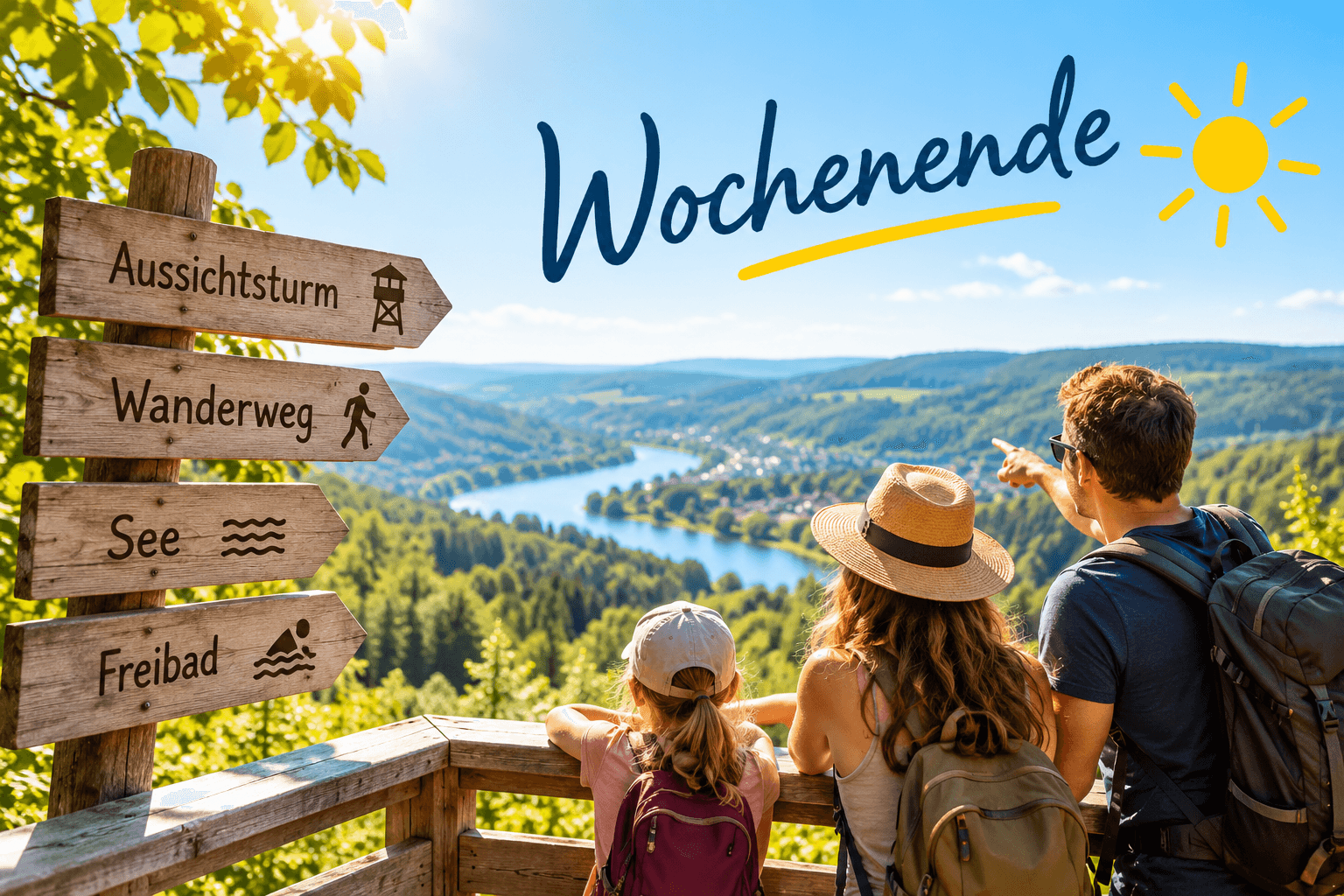
But when the weather is good, you may see plenty of families, couples and groups of friends in forests, on walking and hiking trails, by lakes and around observation towers.
People go for walks, cycle, hike or take an Ausflug — usually a day trip that ends with returning home in the evening.
In summer, many people head to a Freibad — an outdoor swimming pool. When the weather is bad, a museum, a Hallenbad — an indoor swimming pool — or a traditional German Kegelbahn can be good alternatives.
This is part of everyday life in Germany that many newcomers only discover after moving here.
At the same time, free time is a great opportunity to learn German not only at a desk, but in real-life situations.
Was machen wir am Wochenende?
What are we doing this weekend?
Lass uns einen Ausflug machen.
Let’s go on a day trip.
Wollen wir wandern gehen?
Shall we go hiking?
Why are Sundays different in Germany?
In Germany, Sunday is not simply another day off.
Sundays and officially recognised public holidays receive special protection as days of rest from work. This principle is even anchored in Germany’s constitutional framework.
You can notice this in everyday life.
On Saturdays, many people go shopping, take care of household tasks and get things done that they did not have time for during the working week.
On Sunday, the rhythm changes.
If you come from a country where supermarkets and shopping centres are open on Sundays almost as they are on any other day, you may initially have a very practical question:
So what can you actually do on a Sunday in Germany?
One of the simplest answers is: go outside.
Most shops are closed on Sundays
In Germany, most regular shops are closed on Sundays and public holidays.
The exact rules are not identical across all 16 federal states, and there are various exceptions. In Baden-Württemberg, for example, the protection of Sundays and public holidays is one of the basic principles behind shop-opening regulations. Under certain conditions, however, specially authorised verkaufsoffene Sonntage — Sundays when shops are allowed to open — and other statutory exceptions are possible.
But that does not mean that all of Germany shuts down on Sunday.
Restaurants, cafés, hotels, museums, sports facilities and many leisure venues can also operate on Sundays. Germany’s Working Hours Act specifically provides exceptions for Sunday work in areas including hospitality, accommodation, sport, leisure, tourism and museums.
A Bäckerei — bakery — may also be open on Sunday in many places. Opening hours and operating conditions can vary, so it is always worth checking the Öffnungszeiten — opening hours — of the particular bakery before you go.
Hat die Bäckerei sonntags geöffnet?
Is the bakery open on Sundays?
Wie sind die Öffnungszeiten am Sonntag?
What are the opening hours on Sunday?
Sunday is also a day of rest
German Sunday culture is about more than closed shops.
Ruhe — peace and quiet — also plays an important role.
Of course, this does not mean that you have to tiptoe around your home on Sundays. However, noisy work that disturbs other people may be restricted or prohibited.
Under federal noise-protection rules, certain outdoor machines and equipment may not be operated throughout Sundays and public holidays in residential and certain other protected areas. These include lawnmowers, leaf blowers, hedge trimmers, chainsaws and various other types of equipment. Additional rules may also apply at federal-state or local level.
That is why Sunday is generally not the best day for mowing the lawn or doing noisy work around the house and garden.
Useful German words:
- die Ruhe — peace, quiet
- der Ruhetag — day of rest
- die Ruhezeit — quiet period
- die Hausordnung — house rules
- Rasen mähen — to mow the lawn
- bohren — to drill
Sonntags ist Ruhetag.
Sunday is a day of rest.
This also helps explain why so many people are outdoors on a beautiful Sunday.
Ausflug — a day trip without an overnight stay
One word you will hear frequently in Germany when people talk about their free time is:
der Ausflug — usually a short or one-day trip after which you return home.
For example, a family gets into the car in the morning, drives to the mountains, a lake or another interesting place, follows a hiking trail, stops at a café and returns home in the evening.
That is an Ausflug.
Wir machen am Sonntag einen Ausflug.
We’re going on a day trip on Sunday.
If a trip lasts several days and includes an overnight stay, other words are normally more appropriate:
- die Reise — trip, journey
- der Kurzurlaub — short break
- der Wochenendtrip — weekend trip
It is a small but useful distinction in everyday German.
Spazieren gehen or wandern?
You do not have to travel hundreds of kilometres to enjoy a Sunday.
In German, it is useful to distinguish between two very common expressions:
- spazieren gehen — to go for a walk
- wandern — to go hiking
Wir gehen im Wald spazieren.
We’re going for a walk in the forest.
Wir gehen heute wandern.
We’re going hiking today.
Other useful words include:
- der Wanderweg — hiking trail
- der Wald — forest
- der Berg — mountain
- der See — lake
- die Natur — nature
- die Aussicht — view, scenery
- die Strecke — route, distance
Germany’s network of paths can be surprising
If you have only recently moved to Germany, you may be surprised not only by how many people go walking and hiking on Sundays, but also by the infrastructure.
Outside towns and cities, you will often find well-developed Feldwege and Wirtschaftswege — field and agricultural access roads. Many have a firm or paved surface and are convenient for both walking and cycling.
Narrower paths with natural surfaces are more commonly found in forests and on designated hiking routes.
The network of signs and trail markings is particularly useful. At junctions and intersections, you can often find information about the next village or town, a local attraction, an observation point or the remaining distance to your destination.
Useful words include:
- der Feldweg — field path or road
- der Wirtschaftsweg — agricultural or service road
- der Wegweiser — signpost
- die Markierung — trail marking
- die Abzweigung — junction, turn-off
- die Entfernung — distance
Wo beginnt der Wanderweg?
Where does the hiking trail begin?
Welcher Weg führt zum Aussichtspunkt?
Which path leads to the viewpoint?
Wie weit ist es bis zum nächsten Ort?
How far is it to the next town or village?
Folgen Sie der Markierung.
Follow the trail markings.
Aussichtstürme — observation towers as a destination
You can find many different kinds of Aussichtstürme — observation towers — along walking and hiking routes in Germany.
They may be small wooden towers in a forest or much taller structures offering wide views over forests, mountains, towns and valleys.
An observation tower can even become the main destination of a day trip.
You leave the car in a parking area, continue on foot, follow the signs along the way and eventually reach the tower. For families with children, having a clear destination can make a walk more interesting.
- der Aussichtsturm — observation tower
- der Aussichtspunkt — viewpoint
- die Aussichtsplattform — observation platform
- der Aufstieg — ascent, climb
- die Treppe — stairs
Wie weit ist es bis zum Aussichtsturm?
How far is it to the observation tower?
Ist der Aussichtsturm kostenlos?
Is the observation tower free?
Kann man auf den Turm steigen?
Can you climb the tower?
A perfectly ordinary Sunday might look like this:
Parkplatz → Wanderweg → Wegweiser → Aussichtsturm → Café → home.
That is a classic Ausflug.
In summer, head to the Freibad
Of course, not everyone wants to spend every weekend walking through a forest.
On a hot summer day, a popular alternative is the Freibad — an outdoor swimming pool.
Freibäder are not limited to large cities. Many smaller towns and communities in Germany have their own outdoor swimming pool, so you often do not need to travel far for a summer day by the water.
A Freibad is usually more than just one pool. Depending on the facility, there may be a children’s pool, sunbathing lawns, water slides, playgrounds, sports areas and a kiosk or another place to buy food and drinks.
Useful words:
- das Freibad — outdoor swimming pool
- das Schwimmbad — swimming pool
- das Hallenbad — indoor swimming pool
- die Liegewiese — lawn for relaxing and sunbathing
- das Kinderbecken — children’s pool
- das Nichtschwimmerbecken — pool for non-swimmers or less confident swimmers
- die Wasserrutsche — water slide
Wann öffnet das Freibad?
When does the outdoor pool open?
Wie viel kostet der Eintritt?
How much is admission?
Gibt es hier ein Kinderbecken?
Is there a children’s pool here?
Freibad or Badesee?
These two terms are worth distinguishing.
A Freibad is generally an organised outdoor swimming facility with pools and leisure infrastructure.
A Badesee is a lake used for swimming.
Either can be a good destination on a hot summer Sunday.
Flohmarkt, Stadtfest and other weekend events
Not every day off has to involve hiking or going swimming.
Many towns and communities hold local events:
- der Flohmarkt — flea market
- das Stadtfest — town or city festival
- das Straßenfest — street festival
- das Volksfest — traditional public festival
- der Jahrmarkt — fair
- der Weihnachtsmarkt — Christmas market
- die Veranstaltung — event
For newcomers, these events are especially useful because they provide an opportunity to hear the German people actually use in everyday life — and to speak it yourself.
Wann beginnt das Fest?
When does the festival start?
Wie viel kostet das?
How much does it cost?
Kann ich mit Karte bezahlen?
Can I pay by card?
What can you do in Germany when the weather is bad?
Not every Sunday in Germany will be sunny.
When the weather is bad, you might visit a museum, cinema, Hallenbad, climbing gym or choose another indoor activity.
You may also come across another very German word:
die Kegelbahn — a skittles lane or venue.
Kegeln is not the same as Bowling
At first glance, the two games look similar, but Kegeln and Bowling are not the same thing.
Traditional Kegeln uses nine skittles, while bowling uses ten pins. The balls and lanes are also different.
In Germany, a Kegelbahn is not found only in large entertainment centres. You may also find one in a restaurant, hotel, sports club or local clubhouse.
- kegeln — to play skittles
- der Kegel — skittle
- die Kugel — ball
- der Kegelclub — skittles club
Habt ihr eine Kegelbahn?
Do you have a Kegelbahn?
Kann man die Kegelbahn reservieren?
Can we reserve the Kegelbahn?
Was können wir bei schlechtem Wetter machen?
What can we do when the weather is bad?
Feiertage — public holidays in Germany
On many public holidays, everyday life follows a rhythm similar to Sunday.
der Feiertag — public holiday.
Germany has one important peculiarity: not every public holiday applies throughout the entire country.
Some public holidays are nationwide, while others apply only in particular Bundesländer — federal states.
If you live in Germany, it is therefore useful to know which public holidays apply in your federal state.
Ist morgen Feiertag?
Is tomorrow a public holiday?
Haben wir am Montag frei?
Do we have Monday off?
Wie sind die Öffnungszeiten am Feiertag?
What are the opening hours on the public holiday?
What is a Brückentag?
Another very useful German word is:
der Brückentag — a working day between a public holiday and a weekend that people often take off to create a longer continuous break.
For example, if a public holiday falls on a Thursday, Friday can become a Brückentag.
By using just one day of annual leave, you can get four consecutive days off.
In everyday German, you might say:
Ich nehme mir am Freitag frei und mache ein langes Wochenende daraus.
I’m taking Friday off and turning it into a long weekend.
How to find Ausflugsziele and Freizeitaktivitäten near you
You do not need to know every attraction in Germany.
It is much more useful to know how to find interesting places and activities in your own area.
In Google or another search engine, combine the name of your town or region with German searches such as:
- Ausflugsziele in der Nähe — day-trip destinations near me
- Wanderwege in der Nähe — hiking trails near me
- Aussichtstürme in der Nähe — observation towers near me
- Freibad in der Nähe — outdoor swimming pool near me
- Veranstaltungen am Wochenende — events this weekend
- Flohmarkt am Sonntag — flea market on Sunday
- Ausflüge mit Kindern — day trips with children
- kostenlose Ausflugsziele — free day-trip destinations
Another very useful search phrase is:
Was ist am Wochenende los?
What’s happening this weekend?
German immediately becomes useful in practice: it helps you discover much more about what is happening where you live.
You don’t have to travel far for a good Ausflug
A good Ausflug does not mean driving to Berlin, Munich or the Alps every Sunday.
Start by looking at what is 20, 30 or 50 kilometres from home.
There may be a hiking trail, lake, castle, observation tower, small historic town, Freibad or local festival that you simply have not discovered yet.
Was gibt es in der Nähe?
What is there nearby?
Sometimes the most interesting destination is much closer than you expect.
Free time can become a German lesson
You do not have to learn German only from a textbook or at a computer.
A weekend offers dozens of situations in which you can connect new words with real experiences.
You do not simply read:
der Wanderweg — hiking trail,
you actually walk along one.
You do not simply learn:
der Wegweiser — signpost,
you use one to find the next point on your route.
You climb an Aussichtsturm, go to a Freibad in summer, check the Öffnungszeiten, buy an Eintrittskarte and order something in a café in German.
After that, these words are no longer just entries in a vocabulary list.
They are connected to a real place and a real experience.
That is how German gradually becomes part of everyday life in Germany.
Frequently asked questions
Are shops open on Sundays in Germany?
Most regular shops are closed on Sundays. There are exceptions, and the exact rules vary between the federal states. In Baden-Württemberg, for example, specially authorised shopping Sundays and other statutory exceptions are possible under certain conditions.
Are restaurants and cafés open on Sundays in Germany?
Yes. Hospitality is one of the sectors in which Germany’s Working Hours Act permits work on Sundays and public holidays. However, it is still worth checking the opening hours of the individual restaurant or café before visiting.
Can you mow the lawn on Sunday in Germany?
Under federal rules, lawnmowers and various other listed outdoor machines may not be operated on Sundays and public holidays in residential and certain other protected areas. Additional local rules may also apply.
What does Ausflug mean in German?
An Ausflug is usually a short, often one-day outing without an overnight stay. You go somewhere and return home later the same day.
What is a Freibad in Germany?
A Freibad is an outdoor swimming facility with pools and usually additional leisure infrastructure.
What is the difference between Kegeln and Bowling?
They are similar but distinct games. Traditional Kegeln uses nine skittles, while bowling uses ten pins. The lanes and balls also differ.
What is a Brückentag in Germany?
A Brückentag is a working day between a public holiday and the weekend. Many people take annual leave on that day to create a long weekend.
Next Sunday, discover something new
If you do not yet know what to do on your next day off, you do not need to plan a major trip.
Open the map and see what is nearby.
Maybe it is a Wanderweg.
Maybe an Aussichtsturm.
In summer, a Freibad.
When the weather is bad, a Kegelbahn or Hallenbad.
Or simply a new Feldweg you have never walked along before.
And the next time someone asks:
Was machen wir am Sonntag?
the answer can be very simple:
Wir machen einen Ausflug.
Related practice
Continue with the learning pages and games connected to this article.