

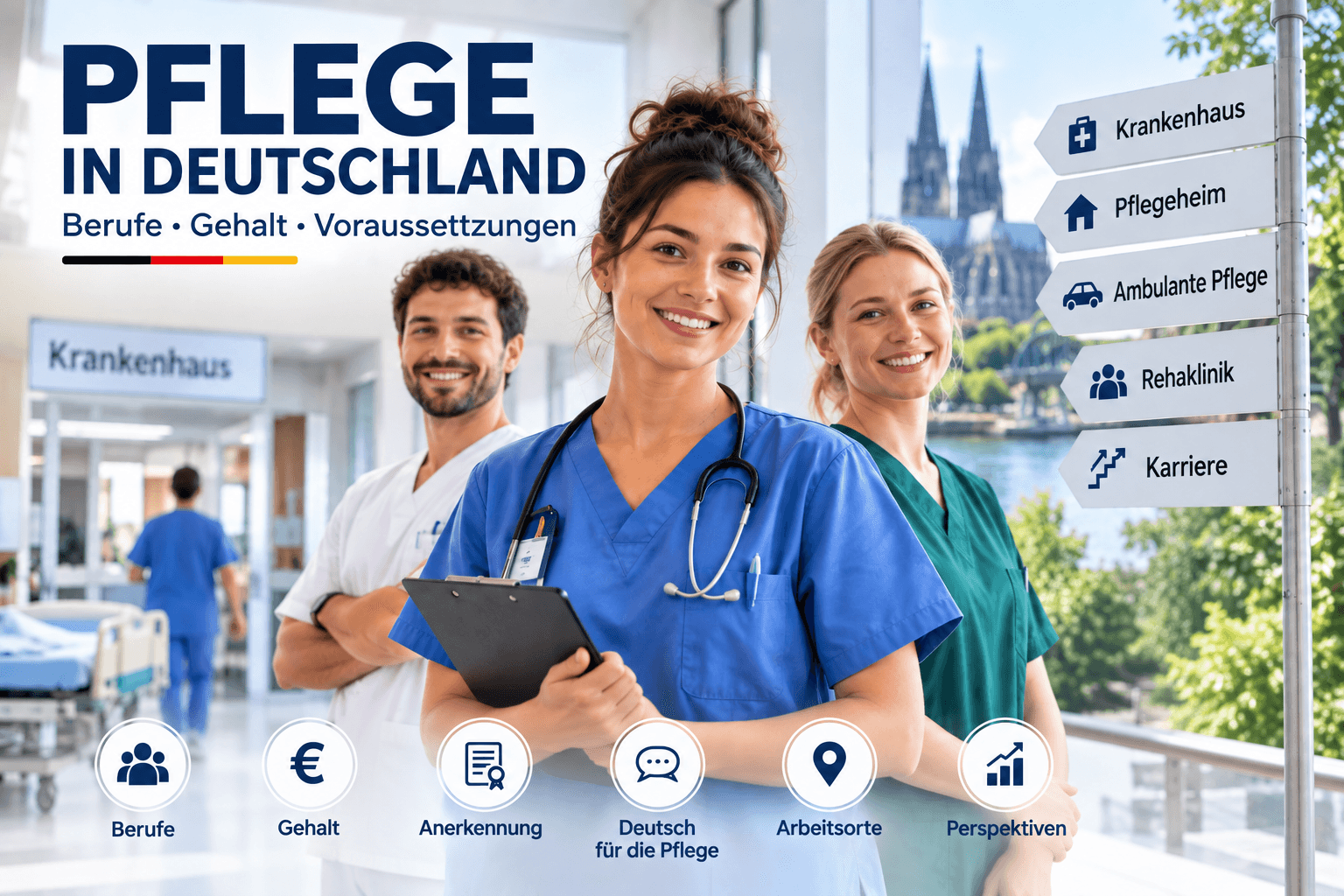
Working in Care in Germany in 2026 – Salary, Requirements, Jobs and German Language Skills
Working in care in Germany continues to offer good career opportunities in 2026. You can work in the care sector, for example, as a Pflegehilfskraft or Pflegeassistenz, or as a qualified Pflegefachkraft. However, the requirements, responsibilities, required German language skills and salary differ significantly. Pflegefachperson is a regulated profession in Germany, which means that people who obtained their professional qualification abroad need official recognition, known as Anerkennung. For certain care assistant positions, however, it is possible to start working without a Pflegefachkraft qualification.
In this guide, you will learn:
- which care professions exist in Germany;
- the difference between a Pflegehilfskraft and a Pflegefachkraft;
- how much you can earn working in care in Germany in 2026;
- whether professional training is required;
- how recognition of a foreign professional qualification works;
- what level of German you need;
- where care workers can work;
- how to start working in care in Germany step by step.
Are care workers in demand in Germany?
Yes. Care remains one of the sectors in Germany where qualified workers are particularly needed in 2026.
Data from the Bundesagentur für Arbeit show that around 1.8 million people were employed in the care sector in jobs subject to social security contributions in 2025. Compared with the previous year, the number of employees increased by around 2%.
At the same time, the shortage of qualified professionals continues. The unemployment rate among qualified Pflegefachkräfte was only 1.1% in 2025. Care and healthcare professions remain among the occupational groups in Germany where qualified workers are in short supply.
Foreign workers also play an important role. In 2025, around 20% of employees working in care had foreign citizenship.
For people with suitable qualifications and sufficient German language skills, the care sector can therefore offer good employment opportunities in Germany.
What care professions are there in Germany?
The German term Pflege does not refer to just one profession. The care sector includes different levels of qualification and professional responsibility.
Job advertisements often use terms such as:
- Pflegefachfrau / Pflegefachmann / Pflegefachperson – qualified care professional;
- Pflegehilfskraft – care assistant;
- qualifizierte Pflegehilfskraft – qualified care assistant;
- Pflegeassistenz / Pflegeassistent – care assistant or care support worker;
- Altenpflege – care for older people;
- ambulante Pflege – care provided in a person's home;
- stationäre Pflege – care provided in a residential facility;
- Krankenpflege – patient care in hospitals and other healthcare facilities.
Job titles can vary depending on the employer. For this reason, you should not look only at the job title but also at the required qualification, actual duties and level of responsibility.
Pflegehilfskraft or Pflegefachkraft – what is the difference?
This is one of the most important distinctions to understand if you want to work in care in Germany.
| Pflegehilfskraft | Pflegefachkraft | |
|---|---|---|
| Type of work | Support work in care | Qualified professional care |
| Professional responsibility | Lower | Significantly higher |
| Professional training | Depends on the position and federal state | Appropriate professional qualification required |
| Recognition of a foreign qualification | Depends on the specific position | Required to work in the regulated profession with a foreign qualification |
| German language | Requirements vary by employer and position | Specific language requirements must be met during the recognition process |
| Salary | Usually lower | Usually significantly higher |
| Duties | Support with everyday care | Professional care, care planning, documentation and greater responsibility |
What does a Pflegehilfskraft do?
A Pflegehilfskraft supports people who need care as well as qualified care professionals in their everyday work.
Depending on the workplace, duties may include:
- helping with personal hygiene;
- helping people get dressed and undressed;
- assistance with eating and drinking;
- helping people stand up and move around;
- accompanying people who need care;
- preparing beds and the immediate environment;
- various everyday care tasks.
The exact duties a Pflegehilfskraft may and should perform depend on their qualifications, the employer and the specific workplace.
What does a Pflegefachkraft do?
A Pflegefachkraft is a professionally qualified care worker with significantly greater professional responsibility.
Duties may include:
- assessing an individual's care needs;
- planning care;
- organising the care process;
- monitoring a person's health;
- preparing professional care documentation;
- working with doctors and other healthcare professionals;
- carrying out certain medical and nursing procedures;
- evaluating the care process and its results.
Because of this higher level of responsibility, the requirements relating to qualifications, language skills and recognition of foreign professional qualifications are higher for Pflegefachkräfte.
How much can you earn working in care in Germany in 2026?
Salary in the German care sector depends on factors such as qualifications, professional experience, employer, federal state, Tarifvertrag and the specific workplace.
It is important to distinguish between two things.
The Pflegemindestlohn is the minimum hourly wage that applies to certain employment relationships in the care sector.
The actual salary is often higher, particularly for qualified Pflegefachkräfte.
Minimum wage in the care sector in 2026
According to Section 2 of the 7. Pflegearbeitsbedingungenverordnung, the following minimum gross hourly rates apply from 1 July 2026:
| Qualification | Minimum gross pay |
|---|---|
| Pflegekraft / Pflegehilfskraft | €16.52 per hour |
| Pflegekraft with at least one year of relevant professional training | €17.80 per hour |
| Pflegefachkraft | €21.03 per hour |
From 1 July 2027, these minimum rates are scheduled to increase to €16.95, €18.26 and €21.58 per hour, respectively.
Important: these minimum wage rules do not automatically apply to every situation in which one private individual helps or cares for another person. It is necessary to check whether the specific employment relationship falls within the scope of the Pflegearbeitsbedingungenverordnung.
How much does a Pflegefachkraft earn in Germany?
Data from the Entgeltatlas of the Bundesagentur für Arbeit show that qualified Pflegefachkräfte often earn considerably more than the statutory minimum wage for the care sector.
For full-time work, a typical gross salary is around €4,587 per month. Around 25% of employees earn less than €4,111, while 25% earn more than €5,116 gross per month.
Actual salary can vary considerably depending on the region, professional experience, employer, workplace and additional payments.
For example:
- Baden-Württemberg – around €4,784 gross per month;
- Bavaria – around €4,632;
- North Rhine-Westphalia – around €4,600;
- Berlin – around €4,655.
In some cities, salary levels are even higher. In Stuttgart, for example, the figure is around €4,922 gross per month.
What affects salary in the care sector?
Even people with similar job titles may receive different salaries.
Factors that can affect pay include:
- professional qualifications;
- professional experience;
- federal state;
- workplace;
- employer;
- Tarifvertrag;
- night shifts;
- Sunday work;
- work on public holidays;
- additional qualifications;
- the level of professional responsibility.
When comparing job offers, you should therefore look at more than just the monthly gross salary.
Also check:
- Zuschläge – additional payments, for example for nights, Sundays or public holidays;
- Arbeitszeit – working hours;
- Schichtdienst – shift work;
- Urlaubstage – number of annual leave days;
- Tarifvertrag – whether pay is governed by a collective agreement;
- other benefits offered by the employer.
Can you work in care without professional training?
Yes, this is possible in certain care assistant positions.
However, this does not mean that you can work as a Pflegefachkraft without the appropriate professional qualification.
There are Pflegehilfskraft positions where the requirements for professional training may be lower, or where employers provide opportunities to acquire the necessary knowledge and qualifications.
Requirements can vary depending on:
- the federal state;
- the employer;
- the workplace;
- the position;
- the specific duties.
You should therefore check carefully whether a job advertisement is looking for a:
Pflegehilfskraft, Pflegeassistenz or Pflegefachkraft.
These are not the same positions.
Does a foreign care qualification need to be recognised in Germany?
If you want to work as a Pflegefachperson with a professional qualification obtained abroad, you need official recognition in Germany.
Pflegefachperson is a regulated profession in Germany.
This means that the right to work in the profession and use the corresponding professional title is not granted automatically simply because you obtained a nursing, care or similar qualification in another country.
During the Anerkennung process, the responsible German authority compares your foreign professional qualification with the corresponding German qualification.
The assessment may include:
- equivalence of professional education and training;
- professional experience;
- additional qualifications;
- medical fitness;
- personal suitability;
- German language skills.
Professional experience can also be important. If the content of the foreign training differs from German requirements in certain areas, professional experience and additional knowledge may also be taken into account.
If significant differences remain, this does not necessarily mean that recognition will be permanently refused. Depending on the individual case, it may be possible to compensate for missing requirements through measures such as an Anpassungslehrgang or an examination.
How does recognition of a foreign care qualification work?
In simplified form, the process looks like this:
foreign professional qualification → identify the corresponding German profession → find the responsible recognition authority → submit the application and documents → qualification and professional experience are assessed → decision on equivalence → complete any additional requirements if necessary → permission to work in the regulated profession
The exact procedure depends on:
- the qualification you obtained;
- the country where you obtained it;
- the federal state where you want to work;
- the specific profession.
For this reason, people with foreign qualifications should not rely only on someone else's experience. Your own qualification and the requirements in the federal state where you intend to work are what matter.
Official information and the responsible authority can be found on the German government's Anerkennung in Deutschland portal.
What level of German do you need to work in care?
This depends on the position.
Pflegehilfskraft
German language requirements for care assistant positions can vary depending on the employer and the specific duties.
However, a Pflegehilfskraft still needs to be able to understand people who require care, colleagues, work instructions and safety-related information.
Pflegefachkraft
Stricter language requirements apply to the regulated profession of Pflegefachperson.
In Baden-Württemberg, for example, recognition of a foreign Pflegefachperson qualification requires German language skills at B2 level.
In addition, a Fachsprachenprüfung, or professional language examination, may be required to demonstrate job-specific German language skills. Exceptions may apply in certain cases, for example if the professional training was completed in German.
For this reason, the statement “You always need B2 to work in care” is not completely accurate.
B2 is an important requirement in the recognition process for Pflegefachpersonen. Language requirements for care assistant positions can vary.
Why is a B2 certificate alone not enough?
A language certificate confirms a particular level of general German. However, everyday care work also requires professional language skills.
Care workers need to be able to:
- understand people who need care;
- ask precise questions;
- understand instructions from colleagues;
- pass information on during a shift handover;
- understand professional terminology;
- work with care documentation;
- respond correctly in unexpected situations.
Anyone planning to work in care should therefore learn not only general German but also Deutsch für Pflege – German for care work.
Important German for working in care
Language is part of everyday work in the care sector.
Talking about how someone feels
Wie fühlen Sie sich heute?
How are you feeling today?
Haben Sie Schmerzen?
Are you in pain?
Wo haben Sie Schmerzen?
Where does it hurt?
Ist Ihnen schwindelig?
Do you feel dizzy?
Helping someone move
Können Sie aufstehen?
Can you stand up?
Ich helfe Ihnen.
I'll help you.
Bitte setzen Sie sich hin.
Please sit down.
Gehen Sie bitte langsam.
Please walk slowly.
Eating and drinking
Möchten Sie etwas trinken?
Would you like something to drink?
Haben Sie heute schon gegessen?
Have you eaten today?
Professional care vocabulary
In everyday work, you will regularly encounter words and topics such as:
- Körperpflege – personal care;
- Mobilität – mobility;
- Ernährung – nutrition;
- Ausscheidung – elimination and bodily functions;
- Medikamente – medication;
- Schmerzen – pain;
- Blutdruck – blood pressure;
- Temperatur – temperature;
- Dokumentation – documentation;
- Übergabe – shift handover;
- Notfall – emergency.
With DMS learning materials for German for working in care, you can learn vocabulary and phrases that are useful in real working situations.
Where can you work in the care sector?
Working in care does not only mean working in a retirement home.
Possible workplaces include:
- Krankenhaus – hospital;
- Pflegeheim – residential care home;
- Seniorenheim – home for older people;
- ambulanter Pflegedienst – home care service;
- Rehaklinik – rehabilitation clinic;
- Tagespflege – day care facility;
- palliative care facilities;
- other healthcare and social care institutions.
Duties and language requirements may differ depending on the working environment.
Working in a Pflegeheim or Seniorenheim
In care for older people, employees often work with the same residents over a longer period.
Everyday duties may include:
- helping with personal hygiene;
- helping with mobility;
- assistance with eating and drinking;
- monitoring a person's health;
- documentation;
- communication with colleagues and relatives of the person receiving care.
Good communication skills and the ability to understand older people are particularly important in this type of work.
Working in a Krankenhaus
The pace of work in a hospital is often faster, and professional German language skills are particularly important.
You may need:
- an understanding of medical terminology;
- professional documentation skills;
- cooperation with doctors and other specialists;
- communication between different hospital departments;
- preparation of patients for examinations and procedures;
- the ability to react quickly and correctly when a patient's condition changes.
Working in ambulante Pflege
In ambulatory or home care, employees travel to people in their homes.
This involves:
- more independent work;
- working according to a set schedule;
- travelling between different addresses;
- regular communication with people receiving care and their relatives.
Many job advertisements for ambulante Pflege also require a Category B driving licence – Führerschein Klasse B, because workers often need to travel between clients by car.
Is working in care physically and emotionally demanding?
Yes. Care work can be demanding.
The job may involve:
- shift work;
- night work;
- weekend work;
- work on public holidays;
- physical strain;
- contact with seriously ill people;
- emotionally difficult situations;
- a demanding work pace;
- a high level of professional responsibility.
For this reason, you should not choose a career in care only because there are many vacancies.
At the same time, for people who enjoy working with others and want to develop professionally in healthcare and care services, it can offer a stable long-term career with various opportunities for further training and professional development.
How to start working in care in Germany – step by step
-
1. Decide what type of job you want
First, determine whether your goal is to work as a:
- Pflegehilfskraft;
- Pflegeassistenz;
- Pflegefachkraft;
- or complete an Ausbildung in the care sector.
Your next steps will depend on this choice.
-
2. Check your professional qualification
If you already have medical or care-related training from another country, find out how your qualification can be recognised in Germany.
-
3. Check the requirements in your federal state
The recognition process and responsible authority depend on the specific profession and the federal state where you want to work.
-
4. Assess your German language skills realistically
If your German is not yet sufficient, start with general German and learn job-specific care vocabulary at the same time.
-
5. Prepare for real working situations
Learn German for:
- conversations with people who need care;
- personal care;
- mobility;
- discussing symptoms and how someone feels;
- medication;
- documentation;
- shift handovers;
- emergencies.
-
6. Look for a suitable job
Compare job offers based on:
- qualification requirements;
- salary;
- Tarifvertrag;
- additional payments;
- working hours;
- shift system;
- location;
- language requirements.
Frequently asked questions about working in care in Germany
How much does a Pflegefachkraft earn in Germany?
According to the Entgeltatlas of the Bundesagentur für Arbeit, a typical gross salary for a full-time Pflegefachkraft is around €4,587 per month. Actual salary depends on factors such as region, professional experience, employer, Tarifvertrag and additional payments.
What is the minimum wage in the German care sector in 2026?
From 1 July 2026, the minimum gross hourly pay in the relevant care-sector employment relationships is €16.52 for Pflegekräfte, €17.80 for workers with at least one year of appropriate professional training, and €21.03 for Pflegefachkräfte.
Can you work in care without an Ausbildung?
Yes, in certain Pflegehilfskraft positions. However, without the appropriate professional qualification, you cannot work in the regulated profession of Pflegefachperson.
Do you need B2 German to work in care?
B2 is not automatically required for every care position. Requirements for care assistants can vary. In Baden-Württemberg, for example, recognition of a foreign qualification as a Pflegefachperson requires German at B2 level as well as proof of professional language skills.
Can you work in Germany with a foreign nursing qualification?
Yes. However, if you want to work in the regulated profession of Pflegefachperson with a foreign professional qualification, you need to complete an official recognition procedure.
How is a foreign care qualification recognised in Germany?
The responsible German authority compares the foreign professional qualification with the corresponding German qualification. The assessment considers the professional training and may also take professional experience and additional qualifications into account. If significant differences are identified, additional training measures or an examination may be required depending on the individual case.
Can you work in care with limited German?
Language requirements may be lower for some care assistant positions. However, working in care is very difficult if you cannot adequately understand people who need care, colleagues and work instructions. Good communication in care is also a matter of safety.
Where can care workers work?
Care workers can work in hospitals, Pflegeheime, Seniorenheime, ambulante Pflegedienste, rehabilitation clinics, Tagespflege facilities and other healthcare and social care institutions.
Are care workers in demand in Germany?
Yes. Germany continues to have a shortage of qualified care professionals. Data from the Bundesagentur für Arbeit show a very low unemployment rate among Pflegefachkräfte and a significant proportion of foreign workers in the sector.
Would you like to work in care in Germany?
Good preparation for work begins not only with professional qualifications, but also with the ability to understand and use German confidently in real working situations.
With DMS, you can learn:
- important German words for care work;
- conversations with people who need care;
- vocabulary about the body and health;
- typical situations from everyday care work;
- job-specific German;
- German for work and everyday life in Germany.
Prepare for working in care in Germany step by step.
→ Start your DMS path for working in care
Related practice
Continue with the learning pages and games connected to this article.